
Barber Shop Software Migori County is designed for owners searching for a practical way to manage queue, services, products, payroll across Migori Town, Rongo, Awendo, Isebania and Kehancha. PRIM gives barber shop businesses a mobile-first operating system for the daily work that protects revenue and client trust.
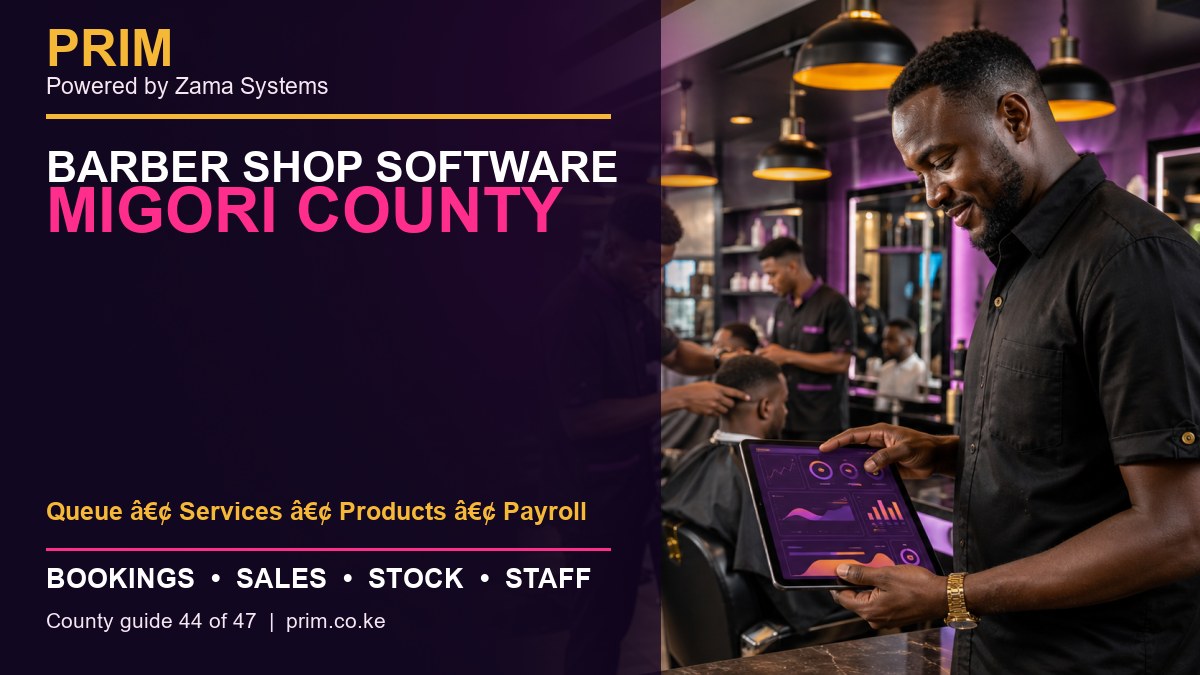
Powered by Zama Systems. PRIM combines beauty and wellness workflows with Kenyan implementation experience, role-based access, local payment realities and scalable business automation.
Request a PRIM demo for Migori County
Bring your service list, staff structure, payment methods, stock challenges and current booking process. See PRIM using your own workflow.
Why businesses in Migori County need management software
high walk-in demand needs fair queues, quick service checkout, product tracking and employee accountability. The problem is rarely a lack of effort. It is that appointments, payments, products and employee work are recorded in different places.
Businesses serving Migori Town, Rongo, Awendo, Isebania and Kehancha need fast answers: who is booked, which professional is available, what the client bought, how they paid, what stock moved and whether the day closed correctly. PRIM brings those answers into one system.
Control walk-in queues and barber performance
Barber shops combine walk-in demand, appointments, multiple chairs and quick checkout. A digital queue shows arrival order, requested service and available barber. This reduces confusion and makes waiting expectations clearer.
Every completed service should connect to the barber, payment method and any retail product sold. The same record supports commission review and daily closing.
What buyers should expect from Barber Shop Software Migori County
- Shared booking calendar: appointments, reschedules, confirmations and walk-ins should be visible to authorized team members.
- Client profiles: visit history and preferences help teams provide consistent service and relevant follow-up.
- POS and M-Pesa records: services and products should connect to the payment method and employee responsible.
- Stock control: purchases, retail sales, service consumption and adjustments should create a reviewable trail.
- Staff accountability: schedules, service totals and commissions should come from completed transactions.
- Owner reports: managers should see sales, payments, stock and performance without rebuilding spreadsheets.
Local rollout plan for a Migori business
1. Map the current day
Follow one client from enquiry to booking, arrival, service, checkout and next visit. Mark every delay, duplicate entry and decision that depends on one person’s memory.
2. Clean the service menu
Confirm service names, prices, duration, required skills and whether a deposit is needed. Consistent setup prevents calendar conflicts and misleading reports.
3. Verify products and opening stock
Separate products sold to clients from products consumed during services. Count the opening balance and assign responsibility for receiving and adjustments.
4. Define roles
Decide who can discount, refund, edit stock, view commissions, export reports and change prices. Do not give every user full administrator access.
5. Train with real scenarios
Practice a walk-in, reschedule, split payment, package redemption, staff substitution, product sale and closing mismatch before going live.
How PRIM reduces common revenue leaks
Missed bookings reduce chair or room utilization. Unrecorded services weaken sales reports. Product usage without stock entries hides loss. Informal commission calculations create disputes. PRIM provides a transaction trail so management can identify the process causing the problem.
Software does not replace leadership. Owners should review the first weeks closely, compare reports with M-Pesa, cash and physical stock, then correct setup or training gaps quickly.
Questions to ask during the demonstration
- Can PRIM handle both appointments and walk-ins?
- Can services have different durations, prices and skill requirements?
- How are cash, M-Pesa and other payment methods separated?
- Can stock used during services be distinguished from retail sales?
- Can commission reports be traced to individual transactions?
- Can the platform support a future branch elsewhere in Migori County?
- What onboarding, training and support are included?
Frequently asked questions
Is PRIM suitable for a small business?
Yes. A small team can begin with essential booking, POS, client and stock workflows, then add more controls as the business grows.
Does PRIM support M-Pesa?
PRIM can organize payment records by method. The exact integration or reconciliation scope should be confirmed during the demo.
Can PRIM manage commissions?
PRIM can support documented commission rules and transaction-level review. Complex rules should be tested before launch.
Can an owner check reports remotely?
PRIM is built to improve management visibility. Access and permissions should be configured around the owner’s security requirements.
How long does setup take?
Timing depends on data quality, number of users, stock items, integrations, branches and training needs. A focused discovery produces the most reliable estimate.
Explore PRIM in other counties
- Barber Shop Software Isiolo County
- Barber Shop Software Turkana County
- Barber Shop Software Bungoma County
View the national PRIM salon, spa, barber, beauty, wellness and gym management platform. PRIM is Powered by Zama Systems.
Grow with better records
Request a focused demonstration of Barber Shop Software Migori County. Start with PRIM.