Tag: PRIM

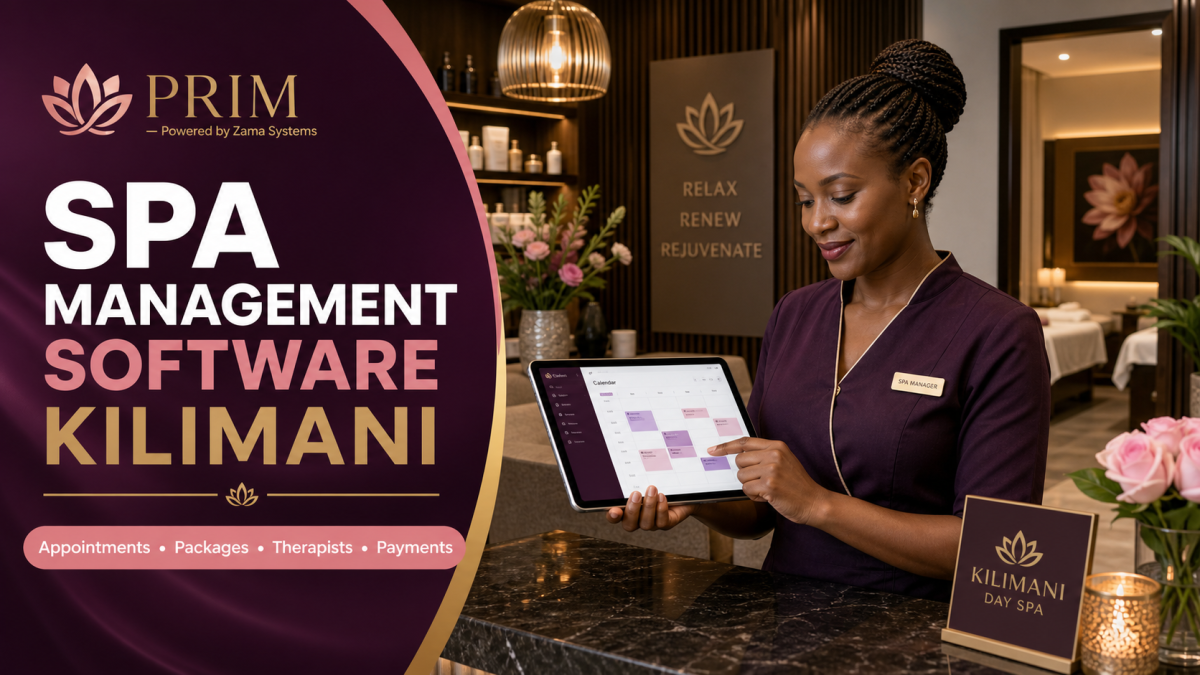
  • Spa Management Software Kilimani: Appointments, Packages and Therapist Scheduling

    Spa Management Software Kilimani: Appointments, Packages and Therapist Scheduling

    Spa Management Software Kilimani is a commercial search made by an owner who wants fewer operational leaks, faster service and a clearer view of the business. PRIM is built for day spas, massage studios, wellness centres, skin-care clinics and beauty spas operating across Kilimani, Hurlingham, Yaya, Kileleshwa, Lavington and nearby Nairobi neighbourhoods.

    Spa Management Software Kilimani
    Spa Management Software Kilimani operations guide by PRIM, Powered by Zama Systems.

    Powered by Zama Systems. PRIM combines beauty-business workflows with practical Kenyan software implementation, mobile-first access and local payment realities.

    See PRIM with your own workflow

    Bring your service list, staff roles, current booking method, payment methods and stock challenges. We will show how PRIM can organize the exact work your team performs every day.

    Request a PRIM demo

    Why Kilimani spa owners search for management software

    A growing beauty business can look busy and still lose money. The owner sees full chairs, frequent M-Pesa messages and shelves moving, yet the end-of-day figures remain uncertain. In Kilimani, common problems include appointment gaps, room conflicts, forgotten packages, therapist scheduling problems and weak follow-up after a client visit. These are not only accounting problems. They affect client experience, staff trust and the owner’s ability to grow.

    PRIM brings appointments, sales, payments, products, employees and customers into one operating record. Instead of checking a diary, a WhatsApp phone, a till book, M-Pesa messages and several spreadsheets, the manager can review the business from one controlled platform.

    What clients expect from Spa Management Software Kilimani

    Buyers are rarely searching for software simply because they want technology. They want a practical result: fewer missed appointments, faster checkout, accurate stock, fair commissions, better follow-up and reports they can trust. The core capabilities for this workflow are appointment calendar, therapist and room scheduling, packages, memberships, deposits, treatment notes, stock, payments, reminders and management reports.

    One appointment calendar for the team

    Bookings should show the client, service, expected duration, assigned professional and status. A shared calendar reduces double booking and helps the receptionist know what can still be sold today. Walk-ins can also be recorded so that the business does not measure only clients who booked in advance.

    A customer record that supports repeat visits

    A useful client profile can hold contact details, visit history, preferred services, package balance and follow-up notes. Staff should only access the information required for their work. The objective is better service and retention, not uncontrolled marketing.

    POS and payment visibility

    Every service and retail product should be recorded before payment is closed. Cash, M-Pesa and other accepted methods should be separated in reports. Managers can then investigate a mismatch using the transaction trail instead of relying on memory or screenshots.

    Stock connected to real sales

    Professional products are used during services while retail products are sold to clients. PRIM helps distinguish these movements, record purchases, flag low stock and show which items move fastest. A stock count still matters, but software makes variances visible earlier.

    Transparent staff performance and commissions

    Commission rules may differ by employee, service, product or branch. The system should attribute work consistently and allow a manager to review the underlying transactions before payroll. Clear records reduce end-of-month disagreements and make coaching more objective.

    How PRIM fits a business in Kilimani

    Businesses in Kilimani, Hurlingham, Yaya, Kileleshwa, Lavington and nearby Nairobi neighbourhoods range from independent owner-operated studios to busy multi-chair locations. PRIM should be configured around the real operating model. A small salon may need a quick appointment and POS workflow. A larger spa may require rooms, therapist availability, packages and deposits. A growing group may need branch comparison, user permissions and centralized stock oversight.

    The best implementation begins with discovery. List every service, duration, price, employee role, stock item, payment method, commission rule and report currently used. Remove duplicate or outdated records before migration. Then test the most important journeys: a new booking, a walk-in, a reschedule, a partial payment, a retail sale, a product return, a staff absence and end-of-day closing.

    Problems PRIM can help spa owners solve

    Missed appointments and no-shows

    When bookings live in different phones and notebooks, the team cannot follow a consistent confirmation process. Central booking records make reminders, deposits and rescheduling easier to manage. No software can eliminate every no-show, but a clear process can reduce avoidable gaps.

    Stock loss hidden inside a busy day

    Stock loss may come from unrecorded sales, excessive service usage, incorrect receiving, damaged items or weak access control. PRIM supplies the transaction evidence needed to identify patterns. Owners should combine this with physical counts and clear responsibility for receiving and issuing products.

    Unclear M-Pesa and cash reconciliation

    An M-Pesa confirmation proves a payment occurred, but the business still needs to know which client, service, employee and branch produced it. Linking operational records to payment records makes daily reconciliation faster and supports management review.

    No reliable way to measure client retention

    Revenue from repeat clients is usually more predictable than depending entirely on new walk-ins. Visit history can show who has not returned, which services bring clients back and which packages remain unused. Follow-up should be relevant, consent-aware and easy to opt out of.

    Buyer checklist: choosing salon or spa software in Nairobi

    • Workflow fit: can it handle appointments, walk-ins, packages, retail sales and the business’s actual commission model?
    • Ease of use: can receptionists, stylists, therapists, barbers and managers complete their daily tasks without confusion?
    • Permissions: can owners limit discounts, refunds, reports, stock changes and sensitive client data by role?
    • Payment records: can the business separate and reconcile cash, M-Pesa and other payment methods?
    • Stock controls: can the system record purchases, sales, service consumption, adjustments and low-stock warnings?
    • Reporting: can the owner see sales by day, service, employee, payment method, product and branch?
    • Support: is there a clear onboarding, training and issue-resolution process?
    • Growth: can the system support more staff, services, locations and reports without starting again?

    A practical PRIM rollout plan

    Step 1: Map the current day

    Follow a client from enquiry to booking, arrival, service, checkout and follow-up. Note where staff repeat work, wait for information or create an unofficial workaround.

    Step 2: Clean services, prices and products

    Agree on names, durations, prices, categories, units and starting quantities. Good reports depend on clean source records.

    Step 3: Define roles and approvals

    Decide who can create discounts, cancel sales, change prices, adjust stock, view payroll information and export data. Do not give every account full administrator access.

    Step 4: Train with realistic transactions

    Practice with the situations that create pressure: a late client, a changed service, split payment, package redemption, staff substitution and an end-of-day mismatch.

    Step 5: Review the first weeks

    Compare software reports with physical stock, M-Pesa and cash. Fix setup errors quickly, coach users and agree on a repeatable closing routine.

    Frequently asked questions

    Is PRIM suitable for a small salon in Kilimani?

    Yes. The implementation can begin with essential booking, POS, client, staff and stock workflows, then add more controls as the business grows.

    Can PRIM support both appointments and walk-ins?

    Yes. A beauty business needs both. Recording walk-ins ensures staff performance, sales and client history are not limited to pre-booked customers.

    Can PRIM record M-Pesa and cash separately?

    PRIM can organize transactions by payment method so the manager can review closing totals. The exact integration or reconciliation setup should be confirmed during the demo.

    Does PRIM calculate staff commissions?

    PRIM can support commission tracking based on configured business rules. Complex rules should be documented and tested before going live.

    Can one owner manage multiple branches?

    PRIM is intended to support growing beauty and wellness operations. Ask for a demonstration of branch access, consolidated reporting and stock oversight for the required setup.

    How quickly can a business start?

    Timing depends on data quality, number of users, service and stock lists, integrations and training needs. A clean small-business setup is faster than a multi-branch migration with custom rules.

    Related PRIM Nairobi guides

    For a county-wide overview, see PRIM salon, spa, barber, beauty, wellness and gym management software. For enterprise automation and integration expertise, visit Zama Systems.

    Ready to control bookings, sales, stock and staff?

    Request a focused PRIM demonstration using your actual spa workflow in Kilimani. Start with PRIM.

  • Salon Management Software Westlands: Bookings, POS, Stock and Staff Control

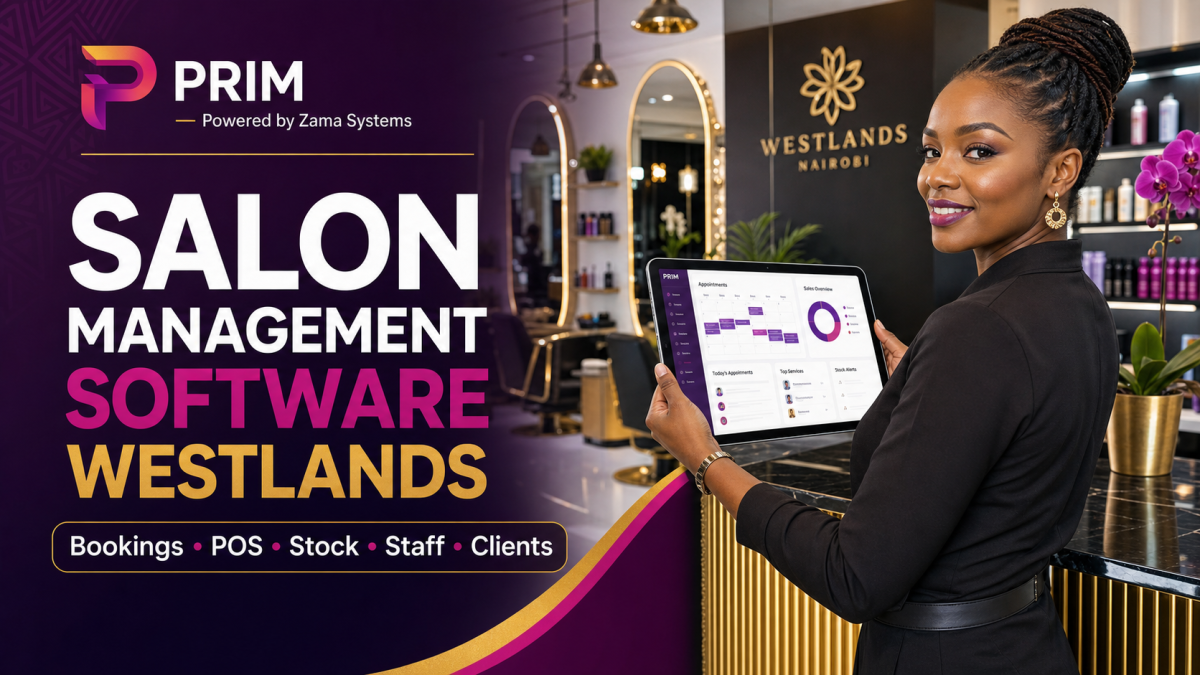
    Salon Management Software Westlands: Bookings, POS, Stock and Staff Control

    Salon Management Software Westlands is a commercial search made by an owner who wants fewer operational leaks, faster service and a clearer view of the business. PRIM is built for premium salons, nail bars, hair studios, multi-service beauty businesses and growing salon chains operating across Westlands, Parklands, Highridge, Kitisuru, Spring Valley, Kangemi and nearby Nairobi neighbourhoods.

    Salon Management Software Westlands
    Salon Management Software Westlands operations guide by PRIM, Powered by Zama Systems.

    Powered by Zama Systems. PRIM combines beauty-business workflows with practical Kenyan software implementation, mobile-first access and local payment realities.

    See PRIM with your own workflow

    Bring your service list, staff roles, current booking method, payment methods and stock challenges. We will show how PRIM can organize the exact work your team performs every day.

    Request a PRIM demo

    Why Westlands salon owners search for management software

    A growing beauty business can look busy and still lose money. The owner sees full chairs, frequent M-Pesa messages and shelves moving, yet the end-of-day figures remain uncertain. In Westlands, common problems include double bookings, missed WhatsApp requests, stock leakage, unclear stylist commissions and no reliable daily sales view. These are not only accounting problems. They affect client experience, staff trust and the owner’s ability to grow.

    PRIM brings appointments, sales, payments, products, employees and customers into one operating record. Instead of checking a diary, a WhatsApp phone, a till book, M-Pesa messages and several spreadsheets, the manager can review the business from one controlled platform.

    What clients expect from Salon Management Software Westlands

    Buyers are rarely searching for software simply because they want technology. They want a practical result: fewer missed appointments, faster checkout, accurate stock, fair commissions, better follow-up and reports they can trust. The core capabilities for this workflow are online and walk-in booking, client profiles, service timing, POS, M-Pesa recording, inventory, staff rosters, commissions, packages and branch reporting.

    One appointment calendar for the team

    Bookings should show the client, service, expected duration, assigned professional and status. A shared calendar reduces double booking and helps the receptionist know what can still be sold today. Walk-ins can also be recorded so that the business does not measure only clients who booked in advance.

    A customer record that supports repeat visits

    A useful client profile can hold contact details, visit history, preferred services, package balance and follow-up notes. Staff should only access the information required for their work. The objective is better service and retention, not uncontrolled marketing.

    POS and payment visibility

    Every service and retail product should be recorded before payment is closed. Cash, M-Pesa and other accepted methods should be separated in reports. Managers can then investigate a mismatch using the transaction trail instead of relying on memory or screenshots.

    Stock connected to real sales

    Professional products are used during services while retail products are sold to clients. PRIM helps distinguish these movements, record purchases, flag low stock and show which items move fastest. A stock count still matters, but software makes variances visible earlier.

    Transparent staff performance and commissions

    Commission rules may differ by employee, service, product or branch. The system should attribute work consistently and allow a manager to review the underlying transactions before payroll. Clear records reduce end-of-month disagreements and make coaching more objective.

    How PRIM fits a business in Westlands

    Businesses in Westlands, Parklands, Highridge, Kitisuru, Spring Valley, Kangemi and nearby Nairobi neighbourhoods range from independent owner-operated studios to busy multi-chair locations. PRIM should be configured around the real operating model. A small salon may need a quick appointment and POS workflow. A larger spa may require rooms, therapist availability, packages and deposits. A growing group may need branch comparison, user permissions and centralized stock oversight.

    The best implementation begins with discovery. List every service, duration, price, employee role, stock item, payment method, commission rule and report currently used. Remove duplicate or outdated records before migration. Then test the most important journeys: a new booking, a walk-in, a reschedule, a partial payment, a retail sale, a product return, a staff absence and end-of-day closing.

    Problems PRIM can help salon owners solve

    Missed appointments and no-shows

    When bookings live in different phones and notebooks, the team cannot follow a consistent confirmation process. Central booking records make reminders, deposits and rescheduling easier to manage. No software can eliminate every no-show, but a clear process can reduce avoidable gaps.

    Stock loss hidden inside a busy day

    Stock loss may come from unrecorded sales, excessive service usage, incorrect receiving, damaged items or weak access control. PRIM supplies the transaction evidence needed to identify patterns. Owners should combine this with physical counts and clear responsibility for receiving and issuing products.

    Unclear M-Pesa and cash reconciliation

    An M-Pesa confirmation proves a payment occurred, but the business still needs to know which client, service, employee and branch produced it. Linking operational records to payment records makes daily reconciliation faster and supports management review.

    No reliable way to measure client retention

    Revenue from repeat clients is usually more predictable than depending entirely on new walk-ins. Visit history can show who has not returned, which services bring clients back and which packages remain unused. Follow-up should be relevant, consent-aware and easy to opt out of.

    Buyer checklist: choosing salon or spa software in Nairobi

    • Workflow fit: can it handle appointments, walk-ins, packages, retail sales and the business’s actual commission model?
    • Ease of use: can receptionists, stylists, therapists, barbers and managers complete their daily tasks without confusion?
    • Permissions: can owners limit discounts, refunds, reports, stock changes and sensitive client data by role?
    • Payment records: can the business separate and reconcile cash, M-Pesa and other payment methods?
    • Stock controls: can the system record purchases, sales, service consumption, adjustments and low-stock warnings?
    • Reporting: can the owner see sales by day, service, employee, payment method, product and branch?
    • Support: is there a clear onboarding, training and issue-resolution process?
    • Growth: can the system support more staff, services, locations and reports without starting again?

    A practical PRIM rollout plan

    Step 1: Map the current day

    Follow a client from enquiry to booking, arrival, service, checkout and follow-up. Note where staff repeat work, wait for information or create an unofficial workaround.

    Step 2: Clean services, prices and products

    Agree on names, durations, prices, categories, units and starting quantities. Good reports depend on clean source records.

    Step 3: Define roles and approvals

    Decide who can create discounts, cancel sales, change prices, adjust stock, view payroll information and export data. Do not give every account full administrator access.

    Step 4: Train with realistic transactions

    Practice with the situations that create pressure: a late client, a changed service, split payment, package redemption, staff substitution and an end-of-day mismatch.

    Step 5: Review the first weeks

    Compare software reports with physical stock, M-Pesa and cash. Fix setup errors quickly, coach users and agree on a repeatable closing routine.

    Frequently asked questions

    Is PRIM suitable for a small salon in Westlands?

    Yes. The implementation can begin with essential booking, POS, client, staff and stock workflows, then add more controls as the business grows.

    Can PRIM support both appointments and walk-ins?

    Yes. A beauty business needs both. Recording walk-ins ensures staff performance, sales and client history are not limited to pre-booked customers.

    Can PRIM record M-Pesa and cash separately?

    PRIM can organize transactions by payment method so the manager can review closing totals. The exact integration or reconciliation setup should be confirmed during the demo.

    Does PRIM calculate staff commissions?

    PRIM can support commission tracking based on configured business rules. Complex rules should be documented and tested before going live.

    Can one owner manage multiple branches?

    PRIM is intended to support growing beauty and wellness operations. Ask for a demonstration of branch access, consolidated reporting and stock oversight for the required setup.

    How quickly can a business start?

    Timing depends on data quality, number of users, service and stock lists, integrations and training needs. A clean small-business setup is faster than a multi-branch migration with custom rules.

    Related PRIM Nairobi guides

    For a county-wide overview, see PRIM salon, spa, barber, beauty, wellness and gym management software. For enterprise automation and integration expertise, visit Zama Systems.

    Ready to control bookings, sales, stock and staff?

    Request a focused PRIM demonstration using your actual salon workflow in Westlands. Start with PRIM.

  • Salon Loyalty Program Software Kenya: 10 Powerful Retention Ideas

    Salon Loyalty Program Software Kenya: 10 Powerful Retention Ideas

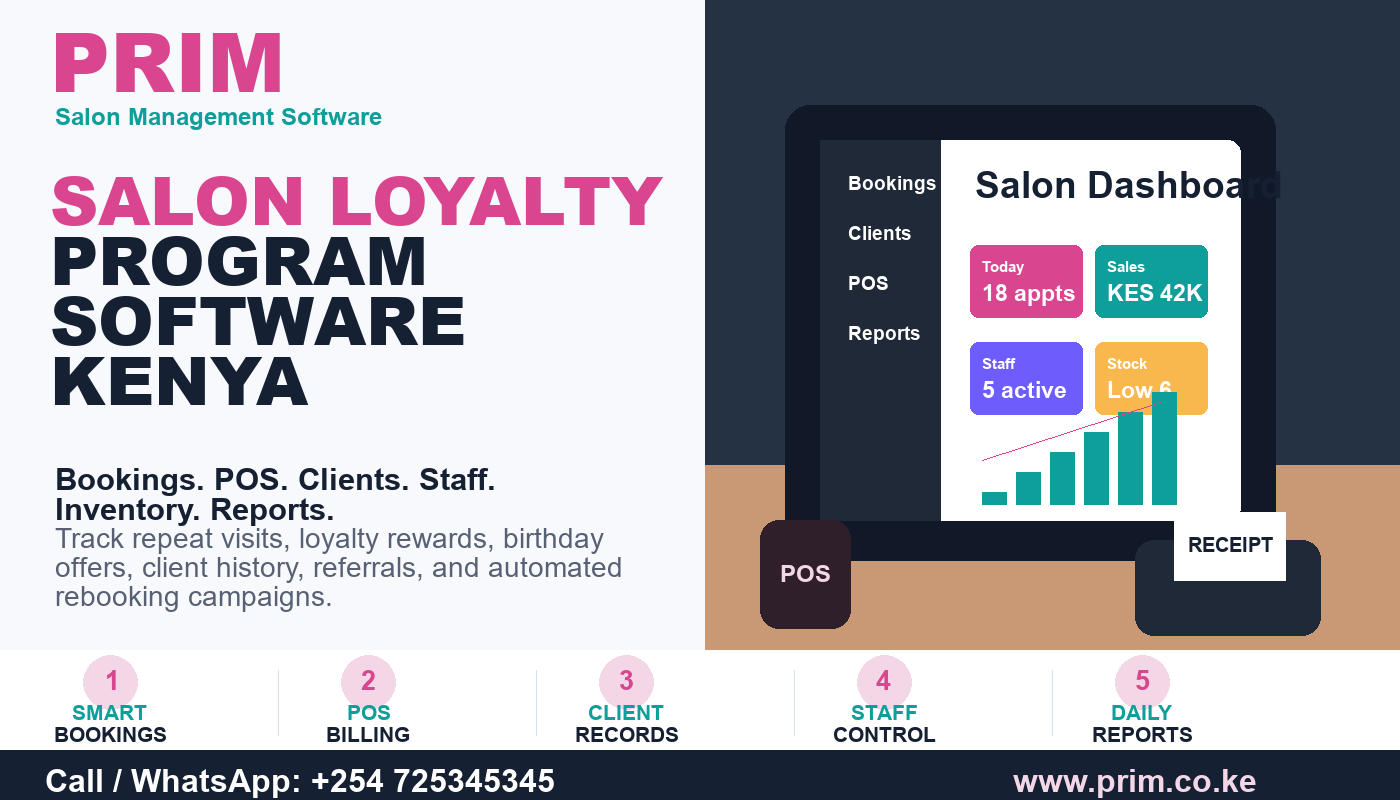
    Salon Loyalty Program Software Kenya helps Kenyan organizations replace scattered records with a controlled digital workflow. This guide explains the most important features, implementation checks and reporting decisions buyers should compare.

    Salon Loyalty Program Software Kenya: 10 powerful checks before implementation

    1. Salon Loyalty Program Software Kenya check 1: define the business goal and responsible owner.
    2. Salon Loyalty Program Software Kenya check 2: prepare clean opening records before setup.
    3. Salon Loyalty Program Software Kenya check 3: confirm user roles and approval limits.
    4. Salon Loyalty Program Software Kenya check 4: test the complete daily workflow.
    5. Salon Loyalty Program Software Kenya check 5: test failed and exceptional transactions.
    6. Salon Loyalty Program Software Kenya check 6: review payment and integration references.
    7. Salon Loyalty Program Software Kenya check 7: protect customer and financial information.
    8. Salon Loyalty Program Software Kenya check 8: confirm backups and recovery procedures.
    9. Salon Loyalty Program Software Kenya check 9: train every user by responsibility.
    10. Salon Loyalty Program Software Kenya check 10: review dashboards and action reports.
    11. Salon Loyalty Program Software Kenya check 11: measure time saved and errors reduced.
    12. Salon Loyalty Program Software Kenya check 12: document support and escalation contacts.
    13. Salon Loyalty Program Software Kenya check 13: review access whenever staff roles change.
    14. Salon Loyalty Program Software Kenya check 14: reconcile source records frequently.
    15. Salon Loyalty Program Software Kenya check 15: improve the workflow using real feedback.
    16. Salon Loyalty Program Software Kenya check 16: define the business goal and responsible owner.

    Why Salon Loyalty Program Software Kenya supports better decisions

    Start with the official product or service website, continue with this related internal guide, and compare the recommendations with this authoritative external resource.

    Salon Loyalty Program Software Kenya: 10 Powerful Ways to Keep Clients Coming Back

    Salon Loyalty Program Software Kenya is an important search topic for Kenyan salon owners who want a practical way to manage bookings, payments, customers, staff, stock, and daily reports. Many salons still depend on notebooks, WhatsApp chats, screenshots, and manual follow-ups. That can work for a small business for a short time, but it becomes risky when the salon starts getting more clients, more staff, more product sales, and more daily payments.

    PRIM is built to help Kenyan salons and barbershops run the full day from one place. The system supports appointments, walk-ins, checkout, M-Pesa tracking, customer records, staff commissions, inventory, expenses, loyalty, reminders, and reports. This guide explains how salons can use client history, reminders, packages, rewards, and follow-up to increase repeat visits and shows why better client retention and repeat bookings matters for serious beauty businesses.

    For a complete view of the product, start with PRIM salon management software. That internal backlink connects this guide to the main PRIM website where salon owners can review the full system, pricing, support details, and trial information.

    Why this keyword matters in Kenya

    Kenyan salon owners do not only need general software. They need software that fits local work habits, local payment methods, local client communication, and local staff management. A salon may receive bookings on WhatsApp, handle walk-ins during busy hours, collect M-Pesa payments, sell hair products, pay staff commissions, and still need a clear report at the end of the day. When these activities are separated, the owner loses visibility.

    Salon Loyalty Program Software Kenya helps target salon owners who are already searching for a better way to manage these problems. The keyword is strong because it connects to real business pressure. Owners want fewer missed bookings, fewer payment errors, better staff accountability, better customer follow-up, and clearer daily reporting.

    Problem 1: scattered salon records

    The first problem is scattered record keeping. A client may book through WhatsApp, pay through M-Pesa, buy a product at checkout, and request another appointment later. If these activities are stored in different places, the salon team wastes time trying to understand what happened. A receptionist may know the appointment, the owner may know the payment, and the stylist may know the service, but no one has the full record in one place.

    PRIM helps reduce that gap by making salon activity easier to connect. Booking records, customer details, payments, stock, staff activity, and reports can be reviewed from one system. This gives the owner a more reliable picture of daily performance.

    Problem 2: weak payment and checkout tracking

    Payment control is one of the biggest reasons salons need better systems. When money comes through M-Pesa, cash, deposits, balances, or product sales, the owner needs to know exactly what the payment covered. A simple message is not enough because it does not explain the service, staff member, discount, product, or pending balance. That is why checkout should be connected to reporting.

    For official mobile money context, salon owners can review Safaricom M-Pesa information. This external backlink is useful because M-Pesa is a major payment channel for Kenyan customers and salon owners need to understand how payment tracking fits their daily operations.

    Problem 3: poor follow-up with clients

    Client follow-up is another area where many salons lose money. A client may forget an appointment, miss a repeat treatment, or fail to return after one visit. If the salon has no clear reminder system, the business depends on memory and manual messages. This can reduce repeat bookings and make the salon look disorganized.

    Modern salon software should help the team remember clients, services, history, preferences, and follow-up needs. It should support reminders and communication so the salon can stay close to the customer without adding too much manual work.

    Problem 4: staff performance is hard to measure

    Salon teams often include stylists, barbers, nail technicians, receptionists, therapists, and managers. Each person may have different services, schedules, commissions, and responsibilities. Without a proper system, performance can be judged by feeling instead of records. That can create confusion when paying commissions or reviewing productivity.

    With a better system, the owner can see which staff members completed services, generated revenue, served repeat clients, or sold products. This helps with fair commissions and better planning. It also helps identify training needs and strong performers.

    Problem 5: inventory and product movement are unclear

    Many beauty businesses sell products and use stock during services. Hair treatments, oils, shampoos, creams, nail products, skincare items, and accessories can disappear slowly when inventory is not tracked. If the salon does not connect product sales and product use to stock movement, the owner may only notice the problem after money has already been lost.

    Inventory control should be part of salon management, not a separate notebook. When stock is connected to checkout and reporting, the owner can see what sells, what runs low, and what needs restocking.

    Internal backlinks placed inside the PRIM cluster

    Related PRIM guide: Salon Software With M-Pesa Payments Kenya. This internal backlink keeps readers inside the PRIM website and helps Google understand that these salon software topics are connected.

    Related PRIM guide: Salon Inventory Management Software Kenya. This internal backlink keeps readers inside the PRIM website and helps Google understand that these salon software topics are connected.

    Related PRIM guide: Salon Appointment Reminders Kenya. This internal backlink keeps readers inside the PRIM website and helps Google understand that these salon software topics are connected.

    Related PRIM guide: Barbershop Management Software Kenya. This internal backlink keeps readers inside the PRIM website and helps Google understand that these salon software topics are connected.

    External backlinks placed for supporting context

    External backlinks should point to useful and relevant websites. They should not be random. For this PRIM cluster, the external links support business operations, payments, technology, hosting, finance, and related company ecosystems.

    External resource: ZamaCore business operations system. This link gives readers a useful reference outside PRIM while keeping the article natural and helpful.

    External resource: Vega POS system Kenya. This link gives readers a useful reference outside PRIM while keeping the article natural and helpful.

    External resource: Pawa business solutions. This link gives readers a useful reference outside PRIM while keeping the article natural and helpful.

    External resource: SpaceKits technology solutions. This link gives readers a useful reference outside PRIM while keeping the article natural and helpful.

    External resource: Awasam business platform. This link gives readers a useful reference outside PRIM while keeping the article natural and helpful.

    External resource: RentalDesk property management software. This link gives readers a useful reference outside PRIM while keeping the article natural and helpful.

    External resource: Saseni digital services. This link gives readers a useful reference outside PRIM while keeping the article natural and helpful.

    External resource: Safaricom M-Pesa information. This link gives readers a useful reference outside PRIM while keeping the article natural and helpful.

    External resource: WhatsApp Business platform. This link gives readers a useful reference outside PRIM while keeping the article natural and helpful.

    External resource: Google Business Profile support. This link gives readers a useful reference outside PRIM while keeping the article natural and helpful.

    How salon owners should choose the right system

    Salon owners should compare software based on daily workflow, not only price. A good system should help the team book clients, manage walk-ins, record services, collect payment, track M-Pesa, send receipts, manage staff, monitor stock, review expenses, and generate reports. If the system only solves one small problem, the salon may still be forced to use notebooks and spreadsheets for the rest.

    The right system should also be easy for the team to use. A salon may have busy front desk staff, service providers, and managers who do not have time for complicated tools. The system should make work clearer, not slower. PRIM focuses on helping salons manage the day in a practical way that fits Kenyan business habits.

    How this topic supports SEO growth for PRIM

    This topic supports PRIM because it targets real search intent. A person searching for Salon Loyalty Program Software Kenya is not just reading casually. They are likely trying to solve a business problem. That makes the keyword valuable for content marketing. The blog can attract salon owners, explain the problem, introduce the PRIM solution, and connect readers to other useful PRIM guides through internal backlinks.

    Internal backlinks help search engines understand the structure of the PRIM blog. When related articles link to each other, Google can see that PRIM has depth around salon payments, bookings, inventory, staff, expenses, loyalty, and reminders. This is stronger than writing isolated posts that do not support each other.

    Practical example

    Imagine a salon in Nairobi that handles thirty clients in one day. Some clients booked in advance, some walked in, some paid through M-Pesa, and some bought products after the service. The owner wants to know total sales, unpaid balances, staff commissions, products sold, and which clients should be reminded to return. Without software, this means checking notebooks, messages, payment alerts, and staff reports. With PRIM, the salon can build a cleaner record of the day.

    This is why Salon Loyalty Program Software Kenya is not just a keyword. It is a real business need. The keyword points to a set of problems that salon owners face every day: time loss, payment confusion, weak follow-up, poor reports, and unclear staff performance.

    Checklist before a salon chooses software

    Before choosing any salon system, the owner should test how the software handles a normal working day. The first check is booking. The system should make it easy to create appointments, handle walk-ins, assign staff, and avoid double booking. The second check is checkout. The team should be able to move from service delivery to payment without creating a separate manual record. The third check is customer history. A returning client should not feel like a stranger every time they visit the salon.

    The fourth check is payment tracking. If the client pays with M-Pesa, cash, deposit, or balance, the owner should know exactly what the payment covered. The fifth check is staff management. Staff should be connected to services so commissions and performance reports are easier to review. The sixth check is inventory. Products used during services and products sold at checkout should be visible. The seventh check is reporting. A salon owner should be able to see the daily picture without waiting for someone to calculate figures manually.

    The eighth check is follow-up. A strong salon system should help the business remember clients, reminders, missed appointments, and repeat service opportunities. The ninth check is growth. If the salon opens another branch, adds more staff, or expands into spa and beauty packages, the system should not collapse. The tenth check is local fit. Kenyan salons need software that understands M-Pesa, WhatsApp communication, walk-ins, staff commissions, stock movement, and owner reporting.

    Why backlink placement matters in this article

    The backlinks in this article are placed inside useful paragraphs, not forced at the bottom. This matters because a link should help the reader continue learning. Internal backlinks point readers to related PRIM topics so they can understand more about payments, stock, reminders, loyalty, barbershop operations, and the main PRIM system. External backlinks point readers to supporting business and technology resources outside PRIM. This makes the article more helpful and gives search engines better context.

    For SEO, the anchor text is also important. Instead of using weak words like click here, the links use meaningful phrases such as PRIM salon management software, Salon Inventory Management Software Kenya, Safaricom M-Pesa information, and WhatsApp Business platform. This helps both the reader and Google understand what the linked page is about. That is the correct way to place backlinks in a professional SEO article.

    Final recommendation

    PRIM should continue building content around Kenya-specific salon software keywords because this is where the opportunity is strongest. Global competitors talk about bookings, payments, loyalty, inventory, and reports, but PRIM can win by explaining those same topics through local Kenyan use cases. M-Pesa, WhatsApp, staff commissions, walk-ins, barbershops, and local salon operations are strong angles that matter to Kenyan buyers.

    Salon Loyalty Program Software Kenya is one part of that wider strategy. When combined with internal backlinks, external references, and helpful 2000-word content, the article becomes more than a blog post. It becomes part of a search engine cluster that can help PRIM build topical authority in salon management software for Kenya.

    Related Kenyan business platforms

    Explore PRIM salon management software for bookings, customers, staff, M-Pesa-ready checkout, stock and salon reports.

    Review Vega POS software Kenya for retail checkout, inventory control, payment records and business reporting.

    Visit Awasam business solutions for practical digital tools and connected business workflows.

    Learn more from Saseni digital services for online business growth and technology support.

    Explore SpaceKits technology solutions for business systems and digital transformation resources.

    See RentalDesk property management software for tenant records, rent tracking, billing and landlord reporting.

  • Multi-Branch Salon Management Software: 10 Growth Tips

    Multi-Branch Salon Management Software: 10 Growth Tips

    multi-branch salon management software helps Kenyan beauty businesses organize daily work, improve customer service and make decisions from reliable records.

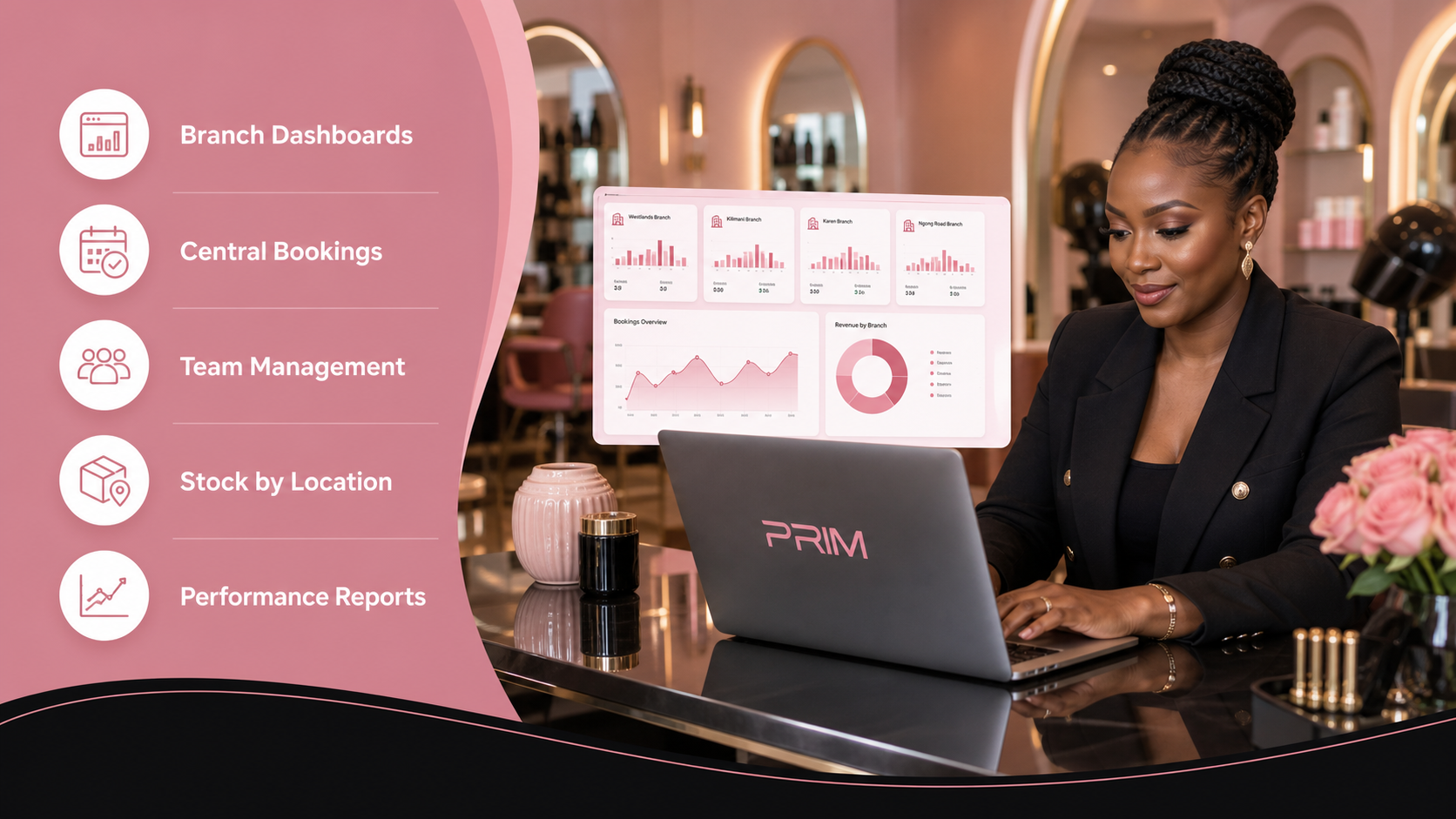
    Multi-branch salon management software by PRIM for staff, inventory and branch analytics
    Manage every salon branch from one connected PRIM dashboard.

    Opening a second salon branch is an exciting milestone. It also introduces new operational challenges. Owners must monitor different teams, stock levels, appointments and payments without being physically present at every location.

    Multi-branch salon management software makes this easier by bringing branch information into one connected platform.

    Standardize services and pricing

    Clients should receive a consistent experience regardless of the branch they visit. Maintain organized records of services, prices, estimated durations and available staff at each location. When a price or service changes, managers can keep branch information aligned.

    Monitor appointments by branch

    A shared booking system helps teams view branch availability, assign employees and manage scheduled clients or walk-ins. Online booking can also allow customers to choose a suitable branch, service and appointment time without calling reception.

    Track inventory at each location

    Each branch may have different stock requirements. Products that sell quickly in one location might move slowly in another. Branch-level inventory information helps managers reorder more intelligently and transfer products where they are needed. Learn more in our salon inventory management guide.

    Compare salon branch performance

    Revenue alone does not tell the full story. Owners should compare sales and expenses, appointment volume, customer retention, staff performance, product movement and commission costs. PRIM provides reporting tools for reviewing operations and comparing branch performance.

    Control employee access

    Multi-branch businesses need clear responsibilities. Role-based access allows owners to give managers, receptionists, accountants and service providers access to the information required for their work.

    Build a salon operation that can grow

    PRIM’s Business plan supports multi-branch operations alongside online booking, marketing automation, memberships and advanced analytics. Each branch follows a connected workflow while the owner retains visibility.

    Start your PRIM free trial or compare plans for growing salons.

    multi-branch salon management software: practical comparison checklist

    Before choosing multi-branch salon management software, compare the daily tasks the platform must support. The right system should be easy enough for reception and service teams while giving owners reliable controls, reports and accountability.

    • Appointments and walk-in management
    • Service and retail-product checkout
    • M-Pesa-ready payment records and receipts
    • Customer profiles, preferences and visit history
    • Staff assignments, permissions and performance
    • Inventory movement and low-stock visibility
    • Sales, expense and management reports
    • Tools that can grow with additional staff or branches

    How to introduce multi-branch salon management software to your team

    Start with clean business information. Confirm your services, prices, staff members, opening hours, products, payment methods and customer records before setup. Reliable starting data makes the system easier to trust.

    Train each employee on the tasks they perform every day. Receptionists need booking and checkout workflows. Service providers need assigned clients and service details. Managers need staff, stock and closing reports. Owners need revenue, expense and performance summaries.

    Use multi-branch salon management software consistently. Record bookings, walk-ins, products, discounts and payments when they happen instead of reconstructing the day later. Consistent records create useful reports and reduce disagreements.

    Questions to ask before choosing a system

    Does it support Kenyan payment workflows?

    Kenyan salons need clear M-Pesa and cash records. Review official M-Pesa information from Safaricom, then confirm how the software records payment methods, balances and receipts.

    Can it protect customer information?

    Customer profiles can contain names, phone numbers, preferences and visit history. Owners should use role-based access and follow guidance from Kenya’s Office of the Data Protection Commissioner.

    Will it work as the salon grows?

    Good multi-branch salon management software should support the business now and leave room for more staff, inventory, loyalty, reminders, online booking or multiple branches later.

    Frequently asked questions about multi-branch salon management software

    Is multi-branch salon management software useful for a small salon?

    Yes. Small salons benefit from organized bookings, customer records, checkout and daily sales visibility before manual processes become difficult to control.

    Can PRIM support salons and barbershops?

    Yes. PRIM is designed for salons, spas and barbershops that manage appointments, walk-ins, POS, M-Pesa-ready payments, customers, stock, staff commissions and reports.

    How quickly can a business get started?

    Most teams can begin by adding services, staff, products, opening hours and payment methods during guided setup. PRIM also provides a 14-day free trial with no credit card required.

    Choose multi-branch salon management software with confidence

    multi-branch salon management software should make daily work clearer, not more complicated. PRIM connects the customer journey from booking and service delivery to checkout, follow-up and owner reporting.

    Start your 14-day PRIM free trial and see how one connected workflow can help your beauty business operate with greater control.

  • Salon Commission Software Kenya: 9 Best Accuracy Tips

    Salon Commission Software Kenya: 9 Best Accuracy Tips

    salon commission software Kenya helps Kenyan beauty businesses organize daily work, improve customer service and make decisions from reliable records.

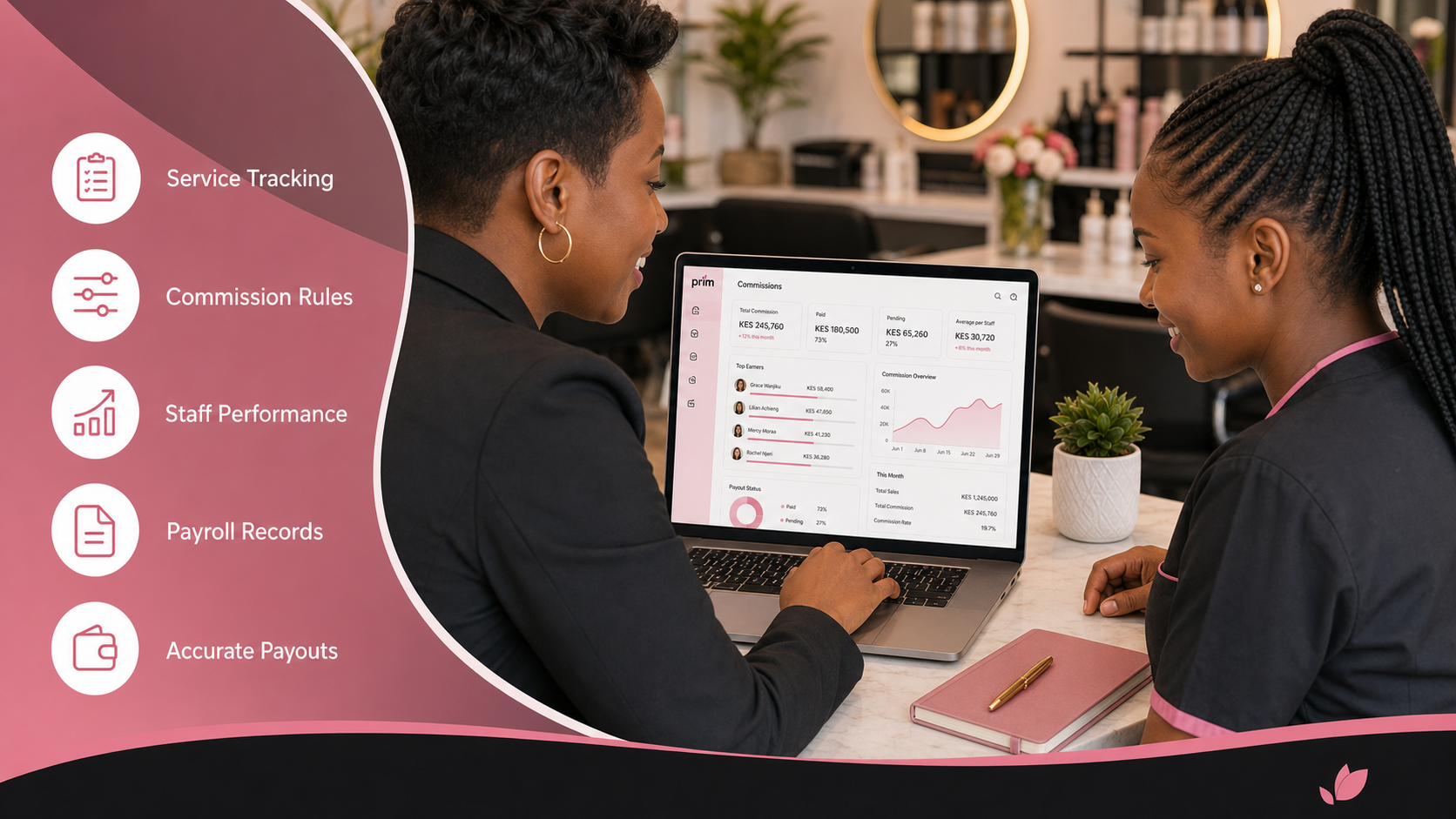
    Salon commission software Kenya by PRIM for staff sales, payroll and accurate payouts
    Salon staff commission and payroll tracking with PRIM.

    Staff commissions can motivate service providers and reward strong performance. However, manual calculations often create disagreements, especially when the salon handles many clients, services and employees.

    Salon commission software in Kenya creates a clearer connection between completed work, customer payments and staff earnings.

    Define your commission structure

    Every salon operates differently. Some pay a percentage of service revenue, while others use fixed amounts, targets or separate rates for product sales. Before calculating payments, document which services qualify, the applicable rate and whether discounts or refunds affect commission.

    Assign each service to the correct employee

    Accurate calculations depend on accurate service records. Every appointment or walk-in should show the customer served, service provided, responsible staff member, amount charged and payment status. PRIM lets salons assign staff during booking and service delivery, preserving this information through checkout.

    Calculate commissions from completed transactions

    Commissions should generally be based on services that were completed and correctly billed. Connecting commission tracking with the salon POS system reduces the risk of paying commissions for cancelled or unpaid appointments.

    Give managers a clear report

    At the end of the payment period, managers should be able to review the services and transactions behind each employee’s commission. Clear records make questions easier to resolve and improve trust between the business and its team.

    Review salon staff performance

    Commission reports can also reveal useful business trends. Owners can identify high-performing employees, popular services and periods that require additional staffing.

    Make salon commissions easier to verify

    PRIM combines staff management, bookings, checkout, commissions and reports in one platform. The Professional plan supports growing salons that need staff accounts, inventory and commission calculation.

    Try PRIM free for 14 days and manage your team with greater confidence.

    salon commission software Kenya: practical comparison checklist

    Before choosing salon commission software Kenya, compare the daily tasks the platform must support. The right system should be easy enough for reception and service teams while giving owners reliable controls, reports and accountability.

    • Appointments and walk-in management
    • Service and retail-product checkout
    • M-Pesa-ready payment records and receipts
    • Customer profiles, preferences and visit history
    • Staff assignments, permissions and performance
    • Inventory movement and low-stock visibility
    • Sales, expense and management reports
    • Tools that can grow with additional staff or branches

    How to introduce salon commission software Kenya to your team

    Start with clean business information. Confirm your services, prices, staff members, opening hours, products, payment methods and customer records before setup. Reliable starting data makes the system easier to trust.

    Train each employee on the tasks they perform every day. Receptionists need booking and checkout workflows. Service providers need assigned clients and service details. Managers need staff, stock and closing reports. Owners need revenue, expense and performance summaries.

    Use salon commission software Kenya consistently. Record bookings, walk-ins, products, discounts and payments when they happen instead of reconstructing the day later. Consistent records create useful reports and reduce disagreements.

    Questions to ask before choosing a system

    Does it support Kenyan payment workflows?

    Kenyan salons need clear M-Pesa and cash records. Review official M-Pesa information from Safaricom, then confirm how the software records payment methods, balances and receipts.

    Can it protect customer information?

    Customer profiles can contain names, phone numbers, preferences and visit history. Owners should use role-based access and follow guidance from Kenya’s Office of the Data Protection Commissioner.

    Will it work as the salon grows?

    Good salon commission software Kenya should support the business now and leave room for more staff, inventory, loyalty, reminders, online booking or multiple branches later.

    Frequently asked questions about salon commission software Kenya

    Is salon commission software Kenya useful for a small salon?

    Yes. Small salons benefit from organized bookings, customer records, checkout and daily sales visibility before manual processes become difficult to control.

    Can PRIM support salons and barbershops?

    Yes. PRIM is designed for salons, spas and barbershops that manage appointments, walk-ins, POS, M-Pesa-ready payments, customers, stock, staff commissions and reports.

    How quickly can a business get started?

    Most teams can begin by adding services, staff, products, opening hours and payment methods during guided setup. PRIM also provides a 14-day free trial with no credit card required.

    Choose salon commission software Kenya with confidence

    salon commission software Kenya should make daily work clearer, not more complicated. PRIM connects the customer journey from booking and service delivery to checkout, follow-up and owner reporting.

    Start your 14-day PRIM free trial and see how one connected workflow can help your beauty business operate with greater control.

  • Salon Inventory Management Software: 10 Smart Stock Tips

    Salon Inventory Management Software: 10 Smart Stock Tips

    salon inventory management software helps Kenyan beauty businesses organize daily work, improve customer service and make decisions from reliable records.

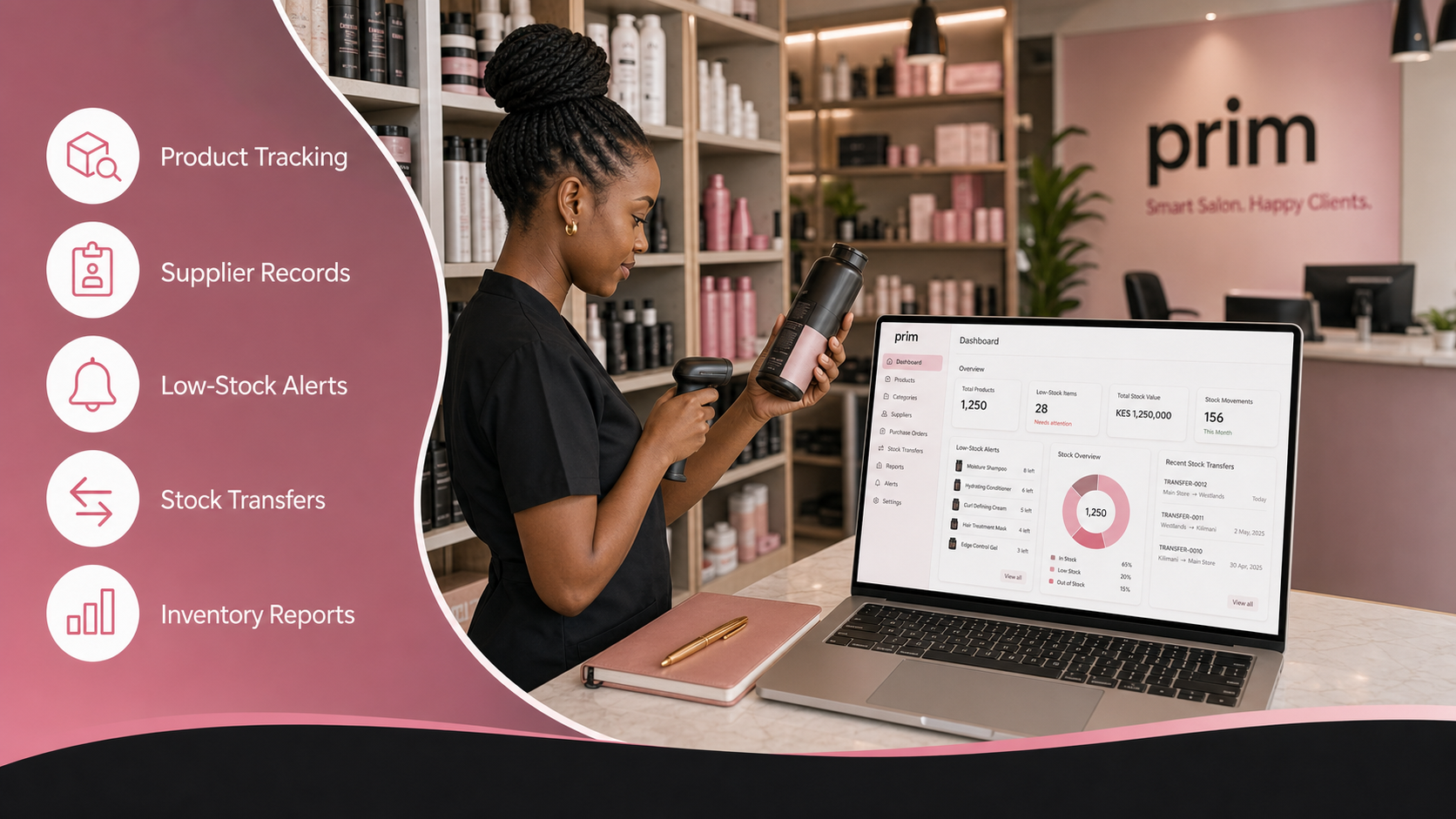
    Salon inventory management software by PRIM for products, suppliers and low-stock alerts
    Salon inventory, product and supplier management with PRIM.

    Salon products can represent a significant business expense. Shampoos, treatments, hair colour, nail supplies and retail products move quickly, but many salons still track them manually.

    Without accurate records, products may run out unexpectedly, expire on the shelf or disappear without explanation. Salon inventory management software helps connect stock with daily salon operations.

    Create a complete product list

    Begin by recording every product used or sold in the salon. Include the product name, category, supplier, cost, selling price and current quantity. A centralized product list gives your team one source of accurate stock information.

    Record salon stock movements

    Stock levels should change whenever products are purchased, sold, used or adjusted. Recording these movements helps the owner understand where products are going. Retail sales can also be connected to the POS so the system reflects the products purchased by customers.

    Use low-stock alerts

    Running out of an essential product can interrupt appointments and disappoint clients. PRIM helps businesses identify low-stock items so managers can reorder them before they run out. This is particularly useful for products used frequently or obtained from suppliers with longer delivery times.

    Monitor costs and retail sales

    Inventory management is not only about counting bottles. It can help you compare purchasing costs with retail revenue and identify products that sell slowly. These insights support better ordering decisions and reduce the amount of money tied up in unnecessary stock.

    Give employees appropriate access

    Not every staff member needs permission to change product quantities or view purchasing information. Role-based access helps owners decide what receptionists, managers, accountants and service providers can see or manage.

    Connect stock with the rest of the salon

    PRIM connects inventory with salon POS sales, expenses and business reports. This gives owners a clearer view of how stock affects profitability.

    Start using PRIM today and bring your salon products under control.

    salon inventory management software: practical comparison checklist

    Before choosing salon inventory management software, compare the daily tasks the platform must support. The right system should be easy enough for reception and service teams while giving owners reliable controls, reports and accountability.

    • Appointments and walk-in management
    • Service and retail-product checkout
    • M-Pesa-ready payment records and receipts
    • Customer profiles, preferences and visit history
    • Staff assignments, permissions and performance
    • Inventory movement and low-stock visibility
    • Sales, expense and management reports
    • Tools that can grow with additional staff or branches

    How to introduce salon inventory management software to your team

    Start with clean business information. Confirm your services, prices, staff members, opening hours, products, payment methods and customer records before setup. Reliable starting data makes the system easier to trust.

    Train each employee on the tasks they perform every day. Receptionists need booking and checkout workflows. Service providers need assigned clients and service details. Managers need staff, stock and closing reports. Owners need revenue, expense and performance summaries.

    Use salon inventory management software consistently. Record bookings, walk-ins, products, discounts and payments when they happen instead of reconstructing the day later. Consistent records create useful reports and reduce disagreements.

    Questions to ask before choosing a system

    Does it support Kenyan payment workflows?

    Kenyan salons need clear M-Pesa and cash records. Review official M-Pesa information from Safaricom, then confirm how the software records payment methods, balances and receipts.

    Can it protect customer information?

    Customer profiles can contain names, phone numbers, preferences and visit history. Owners should use role-based access and follow guidance from Kenya’s Office of the Data Protection Commissioner.

    Will it work as the salon grows?

    Good salon inventory management software should support the business now and leave room for more staff, inventory, loyalty, reminders, online booking or multiple branches later.

    Frequently asked questions about salon inventory management software

    Is salon inventory management software useful for a small salon?

    Yes. Small salons benefit from organized bookings, customer records, checkout and daily sales visibility before manual processes become difficult to control.

    Can PRIM support salons and barbershops?

    Yes. PRIM is designed for salons, spas and barbershops that manage appointments, walk-ins, POS, M-Pesa-ready payments, customers, stock, staff commissions and reports.

    How quickly can a business get started?

    Most teams can begin by adding services, staff, products, opening hours and payment methods during guided setup. PRIM also provides a 14-day free trial with no credit card required.

    Choose salon inventory management software with confidence

    salon inventory management software should make daily work clearer, not more complicated. PRIM connects the customer journey from booking and service delivery to checkout, follow-up and owner reporting.

    Start your 14-day PRIM free trial and see how one connected workflow can help your beauty business operate with greater control.

  • M-Pesa Salon POS System Kenya: 9 Powerful Sales Benefits

    M-Pesa Salon POS System Kenya: 9 Powerful Sales Benefits

    M-Pesa salon POS system Kenya helps Kenyan beauty businesses organize daily work, improve customer service and make decisions from reliable records.

    M-Pesa salon POS system Kenya by PRIM for billing, receipts and daily sales
    M-Pesa-ready salon POS and payment tracking with PRIM.

    A busy salon may process hair services, nail treatments, product sales and customer deposits during the same day. Without a reliable point-of-sale system, payments can be recorded incorrectly or missed completely.

    An M-Pesa salon POS system in Kenya gives owners a clearer checkout process by connecting services, products, customers, staff and payment records.

    Combine services and products in one bill

    With PRIM, your team can convert a completed appointment into a sale, add extra services and include products purchased by the client. For example, a customer may pay for braiding, a treatment and a bottle of shampoo in one transaction. Recording everything together makes the final bill easier to understand.

    Record M-Pesa payments

    PRIM supports M-Pesa-ready checkout, payment tracking and receipt actions. This creates a consistent process for reception while giving the owner better visibility into collected revenue. It also reduces dependence on handwritten payment notes that can be lost or misunderstood.

    Track balances and deposits

    Some salons request deposits for high-value or time-intensive appointments. A salon POS can help the team record the deposit and identify the customer’s remaining balance during checkout.

    Send convenient receipts

    After payment, PRIM supports receipt actions through email or WhatsApp. Customers receive a clear record of their purchases while the salon maintains an organized transaction history.

    Review daily salon sales

    A POS becomes even more valuable when connected to business reports. Owners can review daily sales, popular services, product revenue and staff activity without combining information from several notebooks. Accurate checkout records also support clearer salon commission calculations.

    Make every checkout easier to verify

    PRIM connects POS billing with bookings, customers, stock, staff commissions and reports, giving your salon one system for the entire customer journey.

    Start your 14-day free PRIM trial and improve your salon checkout workflow.

    M-Pesa salon POS system Kenya: practical comparison checklist

    Before choosing M-Pesa salon POS system Kenya, compare the daily tasks the platform must support. The right system should be easy enough for reception and service teams while giving owners reliable controls, reports and accountability.

    • Appointments and walk-in management
    • Service and retail-product checkout
    • M-Pesa-ready payment records and receipts
    • Customer profiles, preferences and visit history
    • Staff assignments, permissions and performance
    • Inventory movement and low-stock visibility
    • Sales, expense and management reports
    • Tools that can grow with additional staff or branches

    How to introduce M-Pesa salon POS system Kenya to your team

    Start with clean business information. Confirm your services, prices, staff members, opening hours, products, payment methods and customer records before setup. Reliable starting data makes the system easier to trust.

    Train each employee on the tasks they perform every day. Receptionists need booking and checkout workflows. Service providers need assigned clients and service details. Managers need staff, stock and closing reports. Owners need revenue, expense and performance summaries.

    Use M-Pesa salon POS system Kenya consistently. Record bookings, walk-ins, products, discounts and payments when they happen instead of reconstructing the day later. Consistent records create useful reports and reduce disagreements.

    Questions to ask before choosing a system

    Does it support Kenyan payment workflows?

    Kenyan salons need clear M-Pesa and cash records. Review official M-Pesa information from Safaricom, then confirm how the software records payment methods, balances and receipts.

    Can it protect customer information?

    Customer profiles can contain names, phone numbers, preferences and visit history. Owners should use role-based access and follow guidance from Kenya’s Office of the Data Protection Commissioner.

    Will it work as the salon grows?

    Good M-Pesa salon POS system Kenya should support the business now and leave room for more staff, inventory, loyalty, reminders, online booking or multiple branches later.

    Frequently asked questions about M-Pesa salon POS system Kenya

    Is M-Pesa salon POS system Kenya useful for a small salon?

    Yes. Small salons benefit from organized bookings, customer records, checkout and daily sales visibility before manual processes become difficult to control.

    Can PRIM support salons and barbershops?

    Yes. PRIM is designed for salons, spas and barbershops that manage appointments, walk-ins, POS, M-Pesa-ready payments, customers, stock, staff commissions and reports.

    How quickly can a business get started?

    Most teams can begin by adding services, staff, products, opening hours and payment methods during guided setup. PRIM also provides a 14-day free trial with no credit card required.

    Choose M-Pesa salon POS system Kenya with confidence

    M-Pesa salon POS system Kenya should make daily work clearer, not more complicated. PRIM connects the customer journey from booking and service delivery to checkout, follow-up and owner reporting.

    Start your 14-day PRIM free trial and see how one connected workflow can help your beauty business operate with greater control.

  • Salon Management Software Kenya: 10 Powerful Benefits

    Salon Management Software Kenya: 10 Powerful Benefits

    salon management software Kenya helps Kenyan beauty businesses organize daily work, improve customer service and make decisions from reliable records.

    Salon management software Kenya by PRIM for bookings, M-Pesa, clients, POS and inventory
    Complete salon management system for Kenyan salons using PRIM.

    Managing a salon involves much more than delivering excellent beauty services. You must coordinate appointments, serve walk-in clients, collect payments, monitor products, calculate staff commissions and keep customers coming back.

    Handling these activities through notebooks, spreadsheets and separate WhatsApp conversations can quickly become overwhelming. PRIM salon management software Kenya brings them together in one system built for Kenyan salons, spas and barbershops.

    Manage appointments and walk-ins

    PRIM gives your reception team one place to schedule appointments, register walk-ins and assign services to available staff. Your team can see the day’s bookings clearly, reduce scheduling conflicts and serve clients faster. Customer information is stored for future visits, making it easier to provide a consistent experience.

    Accept and track M-Pesa payments

    M-Pesa is an essential payment method for many Kenyan salons and barbershops. PRIM provides an M-Pesa-ready checkout workflow for billing services and products, tracking payments and issuing receipts. This helps owners compare completed services with the money received.

    Track staff and commissions

    Instead of calculating commissions manually, growing salons can use PRIM to record staff activity and calculate commissions from completed services. Managers gain better visibility into individual performance, attendance and payroll-related information.

    Control salon inventory

    PRIM helps you monitor retail products and supplies, record stock movements and identify items that are running low. This can reduce unexpected shortages and make purchasing decisions easier. Read our salon inventory management guide for practical stock-control advice.

    Understand business performance

    Built-in reports help owners review sales, expenses, bookings, commissions, inventory and customer activity. Multi-branch businesses can also monitor performance across different locations.

    Start managing your salon in one place

    PRIM offers local pricing and a 14-day free trial with no credit card required. Replace scattered records with a clear workflow your team can use every day.

    Start your free PRIM trial or compare PRIM pricing plans.

    salon management software Kenya: practical comparison checklist

    Before choosing salon management software Kenya, compare the daily tasks the platform must support. The right system should be easy enough for reception and service teams while giving owners reliable controls, reports and accountability.

    • Appointments and walk-in management
    • Service and retail-product checkout
    • M-Pesa-ready payment records and receipts
    • Customer profiles, preferences and visit history
    • Staff assignments, permissions and performance
    • Inventory movement and low-stock visibility
    • Sales, expense and management reports
    • Tools that can grow with additional staff or branches

    How to introduce salon management software Kenya to your team

    Start with clean business information. Confirm your services, prices, staff members, opening hours, products, payment methods and customer records before setup. Reliable starting data makes the system easier to trust.

    Train each employee on the tasks they perform every day. Receptionists need booking and checkout workflows. Service providers need assigned clients and service details. Managers need staff, stock and closing reports. Owners need revenue, expense and performance summaries.

    Use salon management software Kenya consistently. Record bookings, walk-ins, products, discounts and payments when they happen instead of reconstructing the day later. Consistent records create useful reports and reduce disagreements.

    Questions to ask before choosing a system

    Does it support Kenyan payment workflows?

    Kenyan salons need clear M-Pesa and cash records. Review official M-Pesa information from Safaricom, then confirm how the software records payment methods, balances and receipts.

    Can it protect customer information?

    Customer profiles can contain names, phone numbers, preferences and visit history. Owners should use role-based access and follow guidance from Kenya’s Office of the Data Protection Commissioner.

    Will it work as the salon grows?

    Good salon management software Kenya should support the business now and leave room for more staff, inventory, loyalty, reminders, online booking or multiple branches later.

    Frequently asked questions about salon management software Kenya

    Is salon management software Kenya useful for a small salon?

    Yes. Small salons benefit from organized bookings, customer records, checkout and daily sales visibility before manual processes become difficult to control.

    Can PRIM support salons and barbershops?

    Yes. PRIM is designed for salons, spas and barbershops that manage appointments, walk-ins, POS, M-Pesa-ready payments, customers, stock, staff commissions and reports.

    How quickly can a business get started?

    Most teams can begin by adding services, staff, products, opening hours and payment methods during guided setup. PRIM also provides a 14-day free trial with no credit card required.

    Choose salon management software Kenya with confidence

    salon management software Kenya should make daily work clearer, not more complicated. PRIM connects the customer journey from booking and service delivery to checkout, follow-up and owner reporting.

    Start your 14-day PRIM free trial and see how one connected workflow can help your beauty business operate with greater control.

  • Salon Management Software Kenya: 10 Powerful Benefits

    Salon Management Software Kenya: 10 Powerful Benefits

    salon management software Kenya helps Kenyan beauty businesses organize daily work, improve customer service and make decisions from reliable records.

    Salon management software Kenya by PRIM for bookings, M-Pesa, clients, POS and inventory
    Complete salon management system for Kenyan salons using PRIM.

    Managing a salon involves much more than delivering excellent beauty services. You must coordinate appointments, serve walk-in clients, collect payments, monitor products, calculate staff commissions and keep customers coming back.

    Handling these activities through notebooks, spreadsheets and separate WhatsApp conversations can quickly become overwhelming. PRIM salon management software Kenya brings them together in one system built for Kenyan salons, spas and barbershops.

    Manage appointments and walk-ins

    PRIM gives your reception team one place to schedule appointments, register walk-ins and assign services to available staff. Your team can see the day’s bookings clearly, reduce scheduling conflicts and serve clients faster. Customer information is stored for future visits, making it easier to provide a consistent experience.

    Accept and track M-Pesa payments

    M-Pesa is an essential payment method for many Kenyan salons and barbershops. PRIM provides an M-Pesa-ready checkout workflow for billing services and products, tracking payments and issuing receipts. This helps owners compare completed services with the money received.

    Track staff and commissions

    Instead of calculating commissions manually, growing salons can use PRIM to record staff activity and calculate commissions from completed services. Managers gain better visibility into individual performance, attendance and payroll-related information.

    Control salon inventory

    PRIM helps you monitor retail products and supplies, record stock movements and identify items that are running low. This can reduce unexpected shortages and make purchasing decisions easier. Read our salon inventory management guide for practical stock-control advice.

    Understand business performance

    Built-in reports help owners review sales, expenses, bookings, commissions, inventory and customer activity. Multi-branch businesses can also monitor performance across different locations.

    Start managing your salon in one place

    PRIM offers local pricing and a 14-day free trial with no credit card required. Replace scattered records with a clear workflow your team can use every day.

    Start your free PRIM trial or compare PRIM pricing plans.

    salon management software Kenya: practical comparison checklist

    Before choosing salon management software Kenya, compare the daily tasks the platform must support. The right system should be easy enough for reception and service teams while giving owners reliable controls, reports and accountability.

    • Appointments and walk-in management
    • Service and retail-product checkout
    • M-Pesa-ready payment records and receipts
    • Customer profiles, preferences and visit history
    • Staff assignments, permissions and performance
    • Inventory movement and low-stock visibility
    • Sales, expense and management reports
    • Tools that can grow with additional staff or branches

    How to introduce salon management software Kenya to your team

    Start with clean business information. Confirm your services, prices, staff members, opening hours, products, payment methods and customer records before setup. Reliable starting data makes the system easier to trust.

    Train each employee on the tasks they perform every day. Receptionists need booking and checkout workflows. Service providers need assigned clients and service details. Managers need staff, stock and closing reports. Owners need revenue, expense and performance summaries.

    Use salon management software Kenya consistently. Record bookings, walk-ins, products, discounts and payments when they happen instead of reconstructing the day later. Consistent records create useful reports and reduce disagreements.

    Questions to ask before choosing a system

    Does it support Kenyan payment workflows?

    Kenyan salons need clear M-Pesa and cash records. Review official M-Pesa information from Safaricom, then confirm how the software records payment methods, balances and receipts.

    Can it protect customer information?

    Customer profiles can contain names, phone numbers, preferences and visit history. Owners should use role-based access and follow guidance from Kenya’s Office of the Data Protection Commissioner.

    Will it work as the salon grows?

    Good salon management software Kenya should support the business now and leave room for more staff, inventory, loyalty, reminders, online booking or multiple branches later.

    Frequently asked questions about salon management software Kenya

    Is salon management software Kenya useful for a small salon?

    Yes. Small salons benefit from organized bookings, customer records, checkout and daily sales visibility before manual processes become difficult to control.

    Can PRIM support salons and barbershops?

    Yes. PRIM is designed for salons, spas and barbershops that manage appointments, walk-ins, POS, M-Pesa-ready payments, customers, stock, staff commissions and reports.

    How quickly can a business get started?

    Most teams can begin by adding services, staff, products, opening hours and payment methods during guided setup. PRIM also provides a 14-day free trial with no credit card required.

    Choose salon management software Kenya with confidence

    salon management software Kenya should make daily work clearer, not more complicated. PRIM connects the customer journey from booking and service delivery to checkout, follow-up and owner reporting.

    Start your 14-day PRIM free trial and see how one connected workflow can help your beauty business operate with greater control.

  • Beauty Business Analytics Kenya: Best Ultimate Reporting Guide

    beauty business analytics Kenya
    beauty business analytics Kenya guide for PRIM salon and beauty business teams.

    beauty business analytics Kenya: Best Ultimate Reporting Guide

    beauty business analytics Kenya is a high-intent search for Kenyan beauty businesses that want better control of bookings, walk-ins, customers, staff, payments, product sales, reminders, stock, and reports. It helps salon owners turn daily bookings, payments, staff activity, products, and customer records into useful business reports. PRIM helps salons, barbershops, spas, nail studios, and growing beauty brands replace scattered notebooks, screenshots, and spreadsheets with a practical daily workflow.

    Beauty businesses depend on service quality, timing, trust, and repeat customers. A good system does not replace personal service; it supports it. When the team can see bookings, client history, payments, staff work, and reports clearly, the whole business becomes easier to manage.

    Table of contents

    Why beauty business analytics Kenya matters in Kenya

    beauty business analytics Kenya helps owners move from manual follow-up to structured records. A busy beauty business may have scheduled clients, walk-ins, product sales, M-Pesa payments, cash payments, staff commissions, discounts, packages, and repeat customers all happening at the same time. Without a connected system, the owner may only understand the day after asking several people for updates.

    The value of beauty business analytics is clarity. Reception can manage bookings. Staff can serve clients. Managers can review performance. Owners can check reports. The business becomes more professional because information is not hidden inside notebooks, chats, or memory.

    PRIM is built around local salon operations, including M-Pesa-ready payment tracking, POS billing, inventory, staff roles, customer records, loyalty, reminders, and branch reports. That makes it practical for Kenyan beauty businesses that want growth without daily confusion.

    Common problems this solves

    Beauty businesses struggle when owners only know total cash but cannot see service performance, staff output, stock pressure, or repeat client trends. These issues can reduce revenue and customer trust. A missed booking can upset a loyal client. A product sale that is not recorded can distort inventory. A staff commission that is unclear can create tension. A report that is late can make the owner react instead of plan.

    PRIM helps by connecting the important parts of the business. A client can book, arrive, receive a service, pay, buy a product, receive a receipt, and appear in reports. The owner does not need to rebuild the story later because the workflow is already recorded.

    This is especially useful for beauty businesses that want to grow. The bigger the team becomes, the harder it is to manage everything manually. A clear system creates discipline before the business becomes too busy to control.

    Important features to compare

    Before choosing beauty business analytics, compare the features that affect daily work. A platform should be simple for the front desk but strong enough for owners and managers.

    • Daily sales dashboards
    • Service and product performance
    • Payment method reports
    • Staff productivity reports
    • Customer retention reports
    • Inventory movement summaries
    • Expenses and profit pressure
    • Branch and owner reports

    The best system should reduce repeated manual work. It should help the team serve clients faster, avoid missed records, and make the owner more confident about daily decisions.

    How PRIM improves workflow

    An analytics workflow should collect accurate records during the day and turn them into clear reports for owners and managers. A strong workflow starts before the client arrives. The team should know who is booked, what service is expected, which staff member is assigned, and whether any deposit or package information matters. During service, the business should record staff work, product use, and notes that help future visits.

    At checkout, the system should connect services, products, discounts, taxes where applicable, payment method, receipt, and staff performance. After checkout, the owner should be able to see the transaction in reports without waiting for manual totals.

    PRIM also helps with follow-up. Customer records, loyalty, reminders, and visit history can support repeat business. A salon that understands its clients can create better offers, improve retention, and build a more professional brand.

    Reports and growth decisions

    Analytics reports help owners review sales, expenses, service demand, payment methods, staff output, inventory movement, and client retention. Reports help the owner understand more than total sales. They can show service performance, product movement, busiest days, staff output, payment methods, pending balances, and stock pressure. These insights help the business make smarter decisions.

    For example, if a service is growing, the salon can promote related packages. If a product sells well after a service, the team can improve recommendations. If one day is quiet, the owner can create targeted offers. Better records create better marketing and management decisions.

    Good reports also improve accountability. When staff work, product sales, payments, and commissions are recorded, the business has fewer disputes and less confusion.

    Implementation plan

    Start by cleaning basic records. List services, prices, products, staff members, customer categories, payment methods, packages, and opening stock. Clean setup makes the system easier to use and helps the team trust the reports.

    Next, train the team by role. Receptionists need bookings and checkout. Service providers need assigned clients and service notes. Managers need reports, stock, and staff performance. Owners need dashboard visibility and business summaries. Training by role keeps adoption simple.

    Then create a daily routine. At opening time, check bookings and stock alerts. During the day, record walk-ins, services, products, and payments as they happen. At closing time, review sales, payment methods, pending balances, and staff activity.

    Common mistakes to avoid

    One mistake is waiting until the business is already too busy to organize. Another is recording incomplete information. If staff skip customer names, service assignments, product sales, or payment methods, reports become weaker. Consistency is what makes software valuable.

    Owners should also avoid comparing only price. The better question is whether the system helps the business reduce mistakes, improve customer service, and make decisions from real records.

    Practical use cases

    • An owner can see which services sell best.
    • A manager can compare staff performance.
    • A salon can plan promotions from quiet days.
    • A multi-branch business can review performance by location.

    Related resources

    For local payment context, review M-Pesa. You can also compare this guide with salon management software Kenya and salon POS system Kenya to understand how bookings, checkout, staff, inventory, and reporting work together in PRIM.

    Why choose PRIM

    PRIM is designed for salons and barbershops that want practical software without making the team feel overwhelmed. It brings appointments, walk-ins, customers, staff, POS, M-Pesa-ready payment tracking, inventory, loyalty, reminders, reports, and multi-branch controls into one workflow.

    If your beauty business still depends on notebooks, screenshots, or scattered spreadsheets, now is a good time to improve operations. PRIM helps the team work cleaner and helps owners see the business more clearly.

    beauty business analytics Kenya summary

    beauty business analytics Kenya is a smart investment for Kenyan beauty businesses that want better service, better records, and better growth decisions. With PRIM, the team can manage clients, payments, staff, stock, and reports from one place.

    Start with PRIM today and give your beauty business a more organized way to grow.