
Beauty Salon Software Embakasi is a commercial search made by an owner who wants fewer operational leaks, faster service and a clearer view of the business. PRIM is built for hair salons, beauty shops, nail studios, braiding businesses and mixed salon-and-cosmetics operations operating across Embakasi, Pipeline, Fedha, Tassia, Donholm, Umoja, Kayole, Utawala and surrounding eastern Nairobi areas.
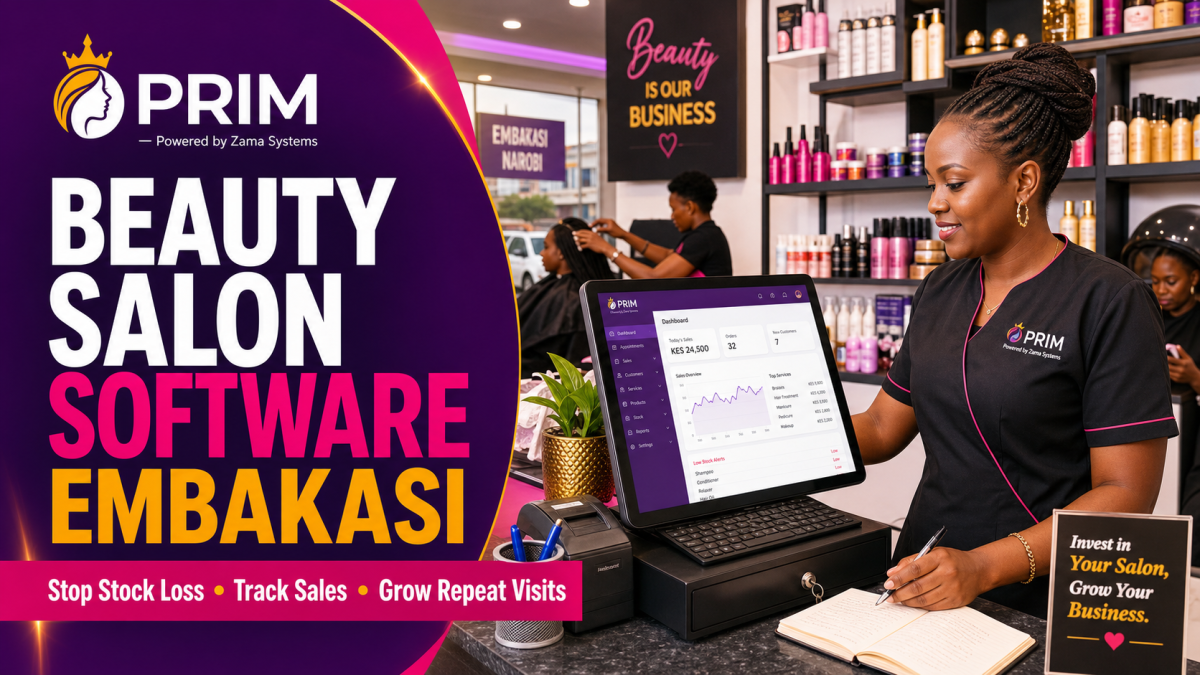
Powered by Zama Systems. PRIM combines beauty-business workflows with practical Kenyan software implementation, mobile-first access and local payment realities.
See PRIM with your own workflow
Bring your service list, staff roles, current booking method, payment methods and stock challenges. We will show how PRIM can organize the exact work your team performs every day.
Why Embakasi beauty salon owners search for management software
A growing beauty business can look busy and still lose money. The owner sees full chairs, frequent M-Pesa messages and shelves moving, yet the end-of-day figures remain uncertain. In Embakasi, common problems include products leaving without a recorded sale, handwritten cash totals, missing customer history, price inconsistency and staff disputes. These are not only accounting problems. They affect client experience, staff trust and the owner’s ability to grow.
PRIM brings appointments, sales, payments, products, employees and customers into one operating record. Instead of checking a diary, a WhatsApp phone, a till book, M-Pesa messages and several spreadsheets, the manager can review the business from one controlled platform.
What clients expect from Beauty Salon Software Embakasi
Buyers are rarely searching for software simply because they want technology. They want a practical result: fewer missed appointments, faster checkout, accurate stock, fair commissions, better follow-up and reports they can trust. The core capabilities for this workflow are POS, M-Pesa and cash records, service sales, retail-product sales, stock alerts, purchase records, client history, staff commissions and daily profit visibility.
One appointment calendar for the team
Bookings should show the client, service, expected duration, assigned professional and status. A shared calendar reduces double booking and helps the receptionist know what can still be sold today. Walk-ins can also be recorded so that the business does not measure only clients who booked in advance.
A customer record that supports repeat visits
A useful client profile can hold contact details, visit history, preferred services, package balance and follow-up notes. Staff should only access the information required for their work. The objective is better service and retention, not uncontrolled marketing.
POS and payment visibility
Every service and retail product should be recorded before payment is closed. Cash, M-Pesa and other accepted methods should be separated in reports. Managers can then investigate a mismatch using the transaction trail instead of relying on memory or screenshots.
Stock connected to real sales
Professional products are used during services while retail products are sold to clients. PRIM helps distinguish these movements, record purchases, flag low stock and show which items move fastest. A stock count still matters, but software makes variances visible earlier.
Transparent staff performance and commissions
Commission rules may differ by employee, service, product or branch. The system should attribute work consistently and allow a manager to review the underlying transactions before payroll. Clear records reduce end-of-month disagreements and make coaching more objective.
How PRIM fits a business in Embakasi
Businesses in Embakasi, Pipeline, Fedha, Tassia, Donholm, Umoja, Kayole, Utawala and surrounding eastern Nairobi areas range from independent owner-operated studios to busy multi-chair locations. PRIM should be configured around the real operating model. A small salon may need a quick appointment and POS workflow. A larger spa may require rooms, therapist availability, packages and deposits. A growing group may need branch comparison, user permissions and centralized stock oversight.
The best implementation begins with discovery. List every service, duration, price, employee role, stock item, payment method, commission rule and report currently used. Remove duplicate or outdated records before migration. Then test the most important journeys: a new booking, a walk-in, a reschedule, a partial payment, a retail sale, a product return, a staff absence and end-of-day closing.
Problems PRIM can help beauty salon owners solve
Missed appointments and no-shows
When bookings live in different phones and notebooks, the team cannot follow a consistent confirmation process. Central booking records make reminders, deposits and rescheduling easier to manage. No software can eliminate every no-show, but a clear process can reduce avoidable gaps.
Stock loss hidden inside a busy day
Stock loss may come from unrecorded sales, excessive service usage, incorrect receiving, damaged items or weak access control. PRIM supplies the transaction evidence needed to identify patterns. Owners should combine this with physical counts and clear responsibility for receiving and issuing products.
Unclear M-Pesa and cash reconciliation
An M-Pesa confirmation proves a payment occurred, but the business still needs to know which client, service, employee and branch produced it. Linking operational records to payment records makes daily reconciliation faster and supports management review.
No reliable way to measure client retention
Revenue from repeat clients is usually more predictable than depending entirely on new walk-ins. Visit history can show who has not returned, which services bring clients back and which packages remain unused. Follow-up should be relevant, consent-aware and easy to opt out of.
Buyer checklist: choosing salon or spa software in Nairobi
- Workflow fit: can it handle appointments, walk-ins, packages, retail sales and the business’s actual commission model?
- Ease of use: can receptionists, stylists, therapists, barbers and managers complete their daily tasks without confusion?
- Permissions: can owners limit discounts, refunds, reports, stock changes and sensitive client data by role?
- Payment records: can the business separate and reconcile cash, M-Pesa and other payment methods?
- Stock controls: can the system record purchases, sales, service consumption, adjustments and low-stock warnings?
- Reporting: can the owner see sales by day, service, employee, payment method, product and branch?
- Support: is there a clear onboarding, training and issue-resolution process?
- Growth: can the system support more staff, services, locations and reports without starting again?
A practical PRIM rollout plan
Step 1: Map the current day
Follow a client from enquiry to booking, arrival, service, checkout and follow-up. Note where staff repeat work, wait for information or create an unofficial workaround.
Step 2: Clean services, prices and products
Agree on names, durations, prices, categories, units and starting quantities. Good reports depend on clean source records.
Step 3: Define roles and approvals
Decide who can create discounts, cancel sales, change prices, adjust stock, view payroll information and export data. Do not give every account full administrator access.
Step 4: Train with realistic transactions
Practice with the situations that create pressure: a late client, a changed service, split payment, package redemption, staff substitution and an end-of-day mismatch.
Step 5: Review the first weeks
Compare software reports with physical stock, M-Pesa and cash. Fix setup errors quickly, coach users and agree on a repeatable closing routine.
Frequently asked questions
Is PRIM suitable for a small salon in Embakasi?
Yes. The implementation can begin with essential booking, POS, client, staff and stock workflows, then add more controls as the business grows.
Can PRIM support both appointments and walk-ins?
Yes. A beauty business needs both. Recording walk-ins ensures staff performance, sales and client history are not limited to pre-booked customers.
Can PRIM record M-Pesa and cash separately?
PRIM can organize transactions by payment method so the manager can review closing totals. The exact integration or reconciliation setup should be confirmed during the demo.
Does PRIM calculate staff commissions?
PRIM can support commission tracking based on configured business rules. Complex rules should be documented and tested before going live.
Can one owner manage multiple branches?
PRIM is intended to support growing beauty and wellness operations. Ask for a demonstration of branch access, consolidated reporting and stock oversight for the required setup.
How quickly can a business start?
Timing depends on data quality, number of users, service and stock lists, integrations and training needs. A clean small-business setup is faster than a multi-branch migration with custom rules.
Related PRIM Nairobi guides
- Salon Management Software Westlands
- Spa Management Software Kilimani
- Barber Shop Software Kasarani
- Salon POS Software Nairobi CBD
For a county-wide overview, see PRIM salon, spa, barber, beauty, wellness and gym management software. For enterprise automation and integration expertise, visit Zama Systems.
Ready to control bookings, sales, stock and staff?
Request a focused PRIM demonstration using your actual beauty salon workflow in Embakasi. Start with PRIM.