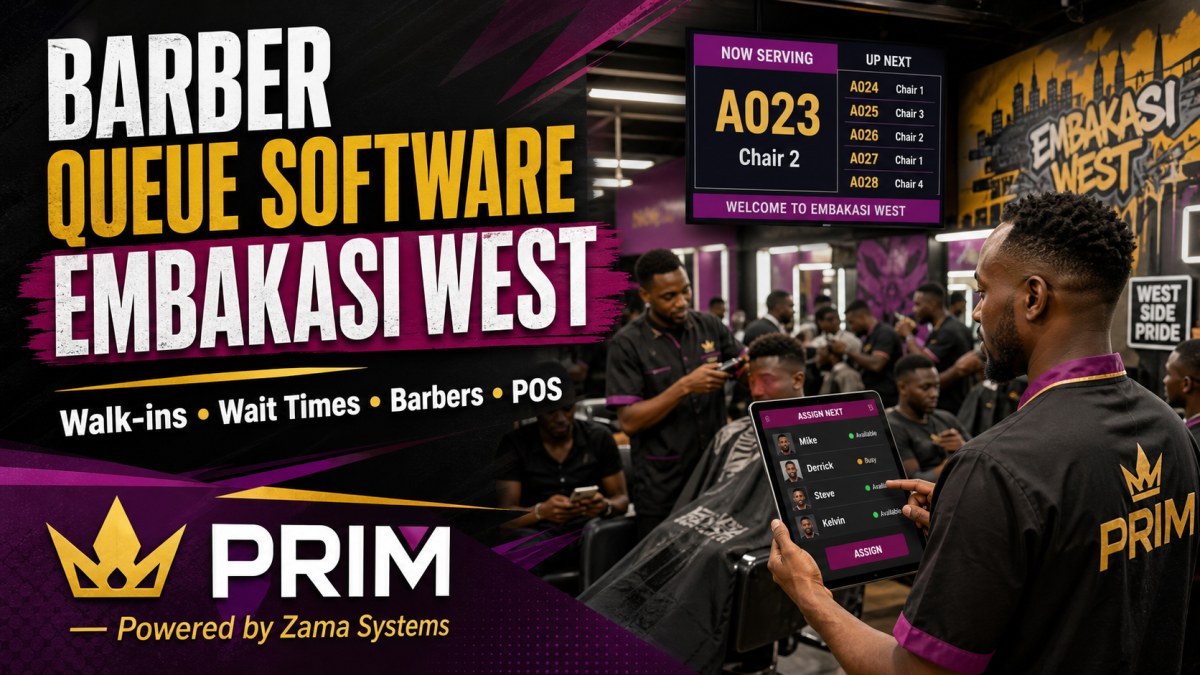
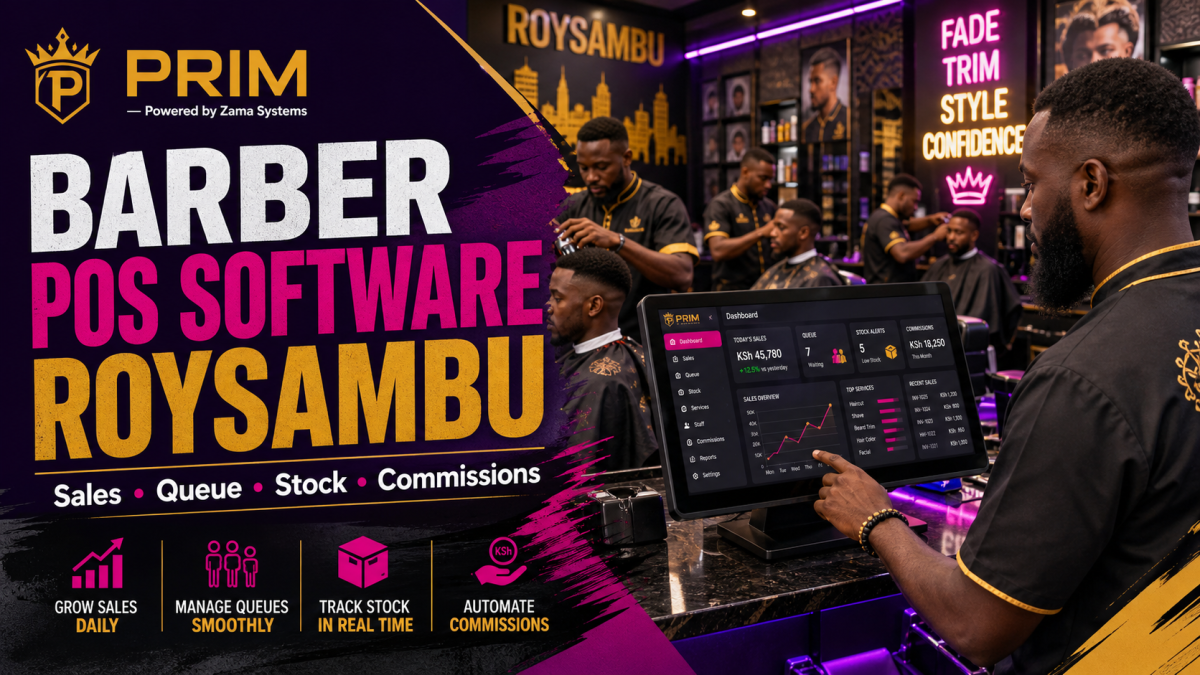
Barber Queue Software Embakasi West is a purchase-intent search from an owner who wants a practical way to control walk-in queues, wait times, barber assignment and POS. PRIM supports barber shop businesses serving Umoja I, Umoja II, Mowlem and nearby neighbourhoods with one operating record for clients, work, money, products and management decisions.
Barber Queue Software Embakasi West guide by PRIM, Powered by Zama Systems.
Powered by Zama Systems. PRIM combines beauty-industry workflows with Kenyan software implementation, mobile-first operations and support for local payment realities.
Why Embakasi West business owners look for this software
The visible sign of a successful barber shop is a busy team, but activity alone does not guarantee profit. A recurring local problem is customers not knowing who is next, uneven barber workloads and walk-ins leaving during busy periods. When records sit in notebooks, private phones, M-Pesa messages and memory, the owner receives answers late and employees follow different processes.
PRIM creates a consistent path from enquiry to appointment, service delivery, checkout, stock movement and follow-up. This makes daily work easier to review without forcing the owner to be physically present at every transaction.
Make walk-in waiting fair and visible
A queue should show arrival order, requested service, expected duration and available barber. Staff can then balance fairness with skill requirements. Clients receive a clearer expectation instead of repeatedly asking who is next.
Queue records also reveal peak periods, abandoned waits and the number of chairs required at different times.
Features buyers should test in a live PRIM demo
Real workflow fit: test walk-in queues, wait times, barber assignment and POS, not only the dashboard.
Role permissions: reception, service staff, storekeepers and owners should see only what they need.
M-Pesa and cash visibility: payment method totals should connect to real sales records.
Audit trail: managers should be able to review changes, discounts, reversals and stock adjustments.
Useful reports: daily reports should answer operational questions without spreadsheet reconstruction.
Training and support: confirm how employees are onboarded and how issues are escalated.
How to prepare your Embakasi West business for implementation
Document the current client journey
Follow one client from first enquiry to booking, arrival, service, payment and next visit. Mark every duplicate entry, delay and decision that depends on one employee’s memory.
Clean services, prices and durations
Use consistent names and categories. Confirm which services require deposits, special skills, rooms or more time. Clean data prevents a confusing calendar and misleading reports.
Count stock and define units
Record a verified opening quantity. Distinguish items sold whole from products consumed across several services. Assign responsibility for receiving, adjustment and physical count approval.
Agree staff rules
Write permissions, discount limits, commission rules, attendance expectations and closing responsibilities before configuration. Software cannot resolve a rule the business has never agreed.
Train with real scenarios
Practice a walk-in, reschedule, partial payment, discount, product sale, stock adjustment and closing mismatch. Staff remember realistic exercises better than a generic feature tour.
What success should look like after launch
The owner should spend less time reconstructing yesterday. Reception should answer booking questions faster. Employees should understand how sales and commissions are recorded. Stock shortages should be noticed earlier, and client follow-up should use accurate visit history.
Review the first weeks closely. Compare PRIM reports with M-Pesa, cash and physical stock, then correct setup or training gaps. A system becomes valuable through disciplined daily use, not merely because it was installed.
Questions to ask before choosing Barber Queue Software Embakasi West
Can it handle both appointments and walk-ins?
Can it record the exact services, durations and prices used by this business?
Can managers restrict refunds, discounts and stock changes?
Can payments be reviewed by method during closing?
Can commissions be traced to completed transactions?
Can the business add staff, services or branches later?
What onboarding, training and support are included?
Frequently asked questions
Is PRIM suitable for a small barber shop in Embakasi West?
Yes. A small business can start with the essential workflow and add controls as the team, service list and client volume grow.
Does PRIM support M-Pesa?
PRIM can organize payment records by method. The exact M-Pesa integration or reconciliation scope should be confirmed during the demonstration.
Can PRIM calculate commissions?
PRIM can support configured commission rules and transaction-level review. Complex or changing rules should be documented and tested before launch.
Can owners check reports away from the business?
PRIM is designed to improve management visibility. Ask the demonstration team to show the access, permission and reporting setup suitable for your operation.
How long does setup take?
Timing depends on the cleanliness of services and stock data, number of users, integrations, branches and training requirements. A focused discovery produces a more reliable estimate.
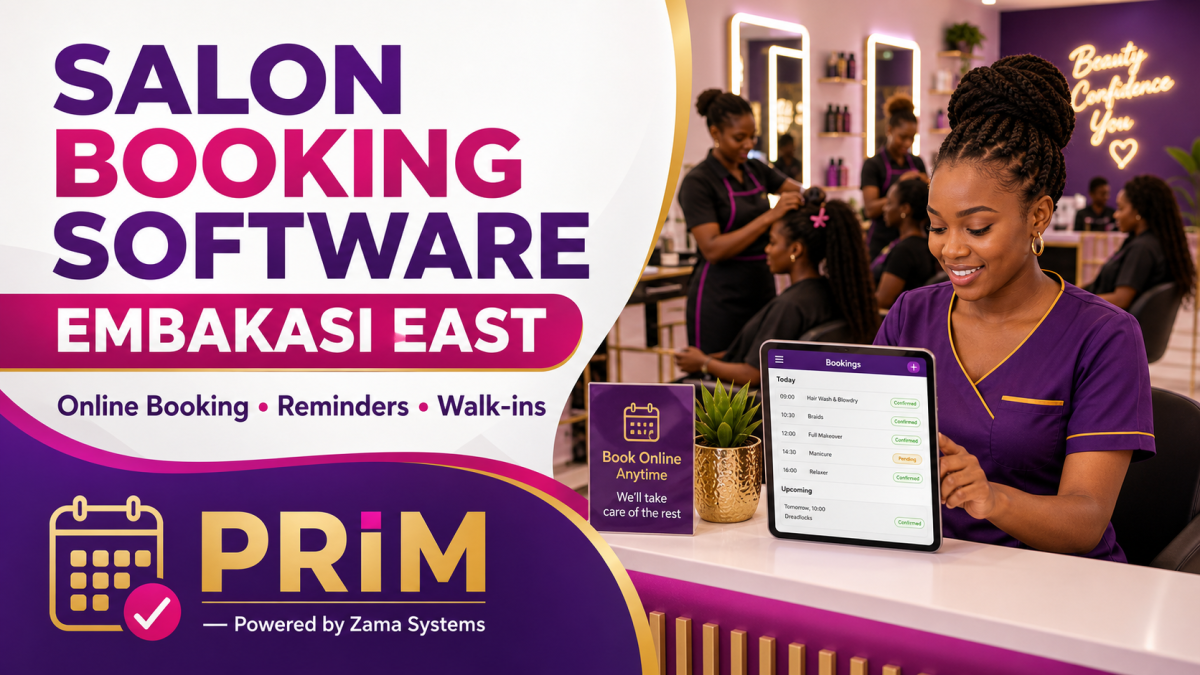
Salon Booking Software Embakasi East is a purchase-intent search from an owner who wants a practical way to control online requests, confirmations, reminders and walk-ins. PRIM supports salon businesses serving Utawala, Mihango, Embakasi and surrounding eastern Nairobi areas with one operating record for clients, work, money, products and management decisions.
Salon Booking Software Embakasi East guide by PRIM, Powered by Zama Systems.
Powered by Zama Systems. PRIM combines beauty-industry workflows with Kenyan software implementation, mobile-first operations and support for local payment realities.
Why Embakasi East business owners look for this software
The visible sign of a successful salon is a busy team, but activity alone does not guarantee profit. A recurring local problem is bookings spread across personal WhatsApp phones, forgotten reschedules and reception staff lacking one calendar. When records sit in notebooks, private phones, M-Pesa messages and memory, the owner receives answers late and employees follow different processes.
PRIM creates a consistent path from enquiry to appointment, service delivery, checkout, stock movement and follow-up. This makes daily work easier to review without forcing the owner to be physically present at every transaction.
Build a booking process clients can trust
The calendar should capture requested time, service duration, assigned professional, confirmation status and any deposit. Reception staff need to see appointments and walk-ins together. When a client reschedules, the old slot should become available without leaving duplicate entries.
Reminders are most effective when the original booking record is accurate. The team should agree when a booking becomes confirmed, how late arrivals are handled and what happens to a deposit after cancellation.
Features buyers should test in a live PRIM demo
Real workflow fit: test online requests, confirmations, reminders and walk-ins, not only the dashboard.
Role permissions: reception, service staff, storekeepers and owners should see only what they need.
M-Pesa and cash visibility: payment method totals should connect to real sales records.
Audit trail: managers should be able to review changes, discounts, reversals and stock adjustments.
Useful reports: daily reports should answer operational questions without spreadsheet reconstruction.
Training and support: confirm how employees are onboarded and how issues are escalated.
How to prepare your Embakasi East business for implementation
Document the current client journey
Follow one client from first enquiry to booking, arrival, service, payment and next visit. Mark every duplicate entry, delay and decision that depends on one employee’s memory.
Clean services, prices and durations
Use consistent names and categories. Confirm which services require deposits, special skills, rooms or more time. Clean data prevents a confusing calendar and misleading reports.
Count stock and define units
Record a verified opening quantity. Distinguish items sold whole from products consumed across several services. Assign responsibility for receiving, adjustment and physical count approval.
Agree staff rules
Write permissions, discount limits, commission rules, attendance expectations and closing responsibilities before configuration. Software cannot resolve a rule the business has never agreed.
Train with real scenarios
Practice a walk-in, reschedule, partial payment, discount, product sale, stock adjustment and closing mismatch. Staff remember realistic exercises better than a generic feature tour.
What success should look like after launch
The owner should spend less time reconstructing yesterday. Reception should answer booking questions faster. Employees should understand how sales and commissions are recorded. Stock shortages should be noticed earlier, and client follow-up should use accurate visit history.
Review the first weeks closely. Compare PRIM reports with M-Pesa, cash and physical stock, then correct setup or training gaps. A system becomes valuable through disciplined daily use, not merely because it was installed.
Questions to ask before choosing Salon Booking Software Embakasi East
Can it handle both appointments and walk-ins?
Can it record the exact services, durations and prices used by this business?
Can managers restrict refunds, discounts and stock changes?
Can payments be reviewed by method during closing?
Can commissions be traced to completed transactions?
Can the business add staff, services or branches later?
What onboarding, training and support are included?
Frequently asked questions
Is PRIM suitable for a small salon in Embakasi East?
Yes. A small business can start with the essential workflow and add controls as the team, service list and client volume grow.
Does PRIM support M-Pesa?
PRIM can organize payment records by method. The exact M-Pesa integration or reconciliation scope should be confirmed during the demonstration.
Can PRIM calculate commissions?
PRIM can support configured commission rules and transaction-level review. Complex or changing rules should be documented and tested before launch.
Can owners check reports away from the business?
PRIM is designed to improve management visibility. Ask the demonstration team to show the access, permission and reporting setup suitable for your operation.
How long does setup take?
Timing depends on the cleanliness of services and stock data, number of users, integrations, branches and training requirements. A focused discovery produces a more reliable estimate.
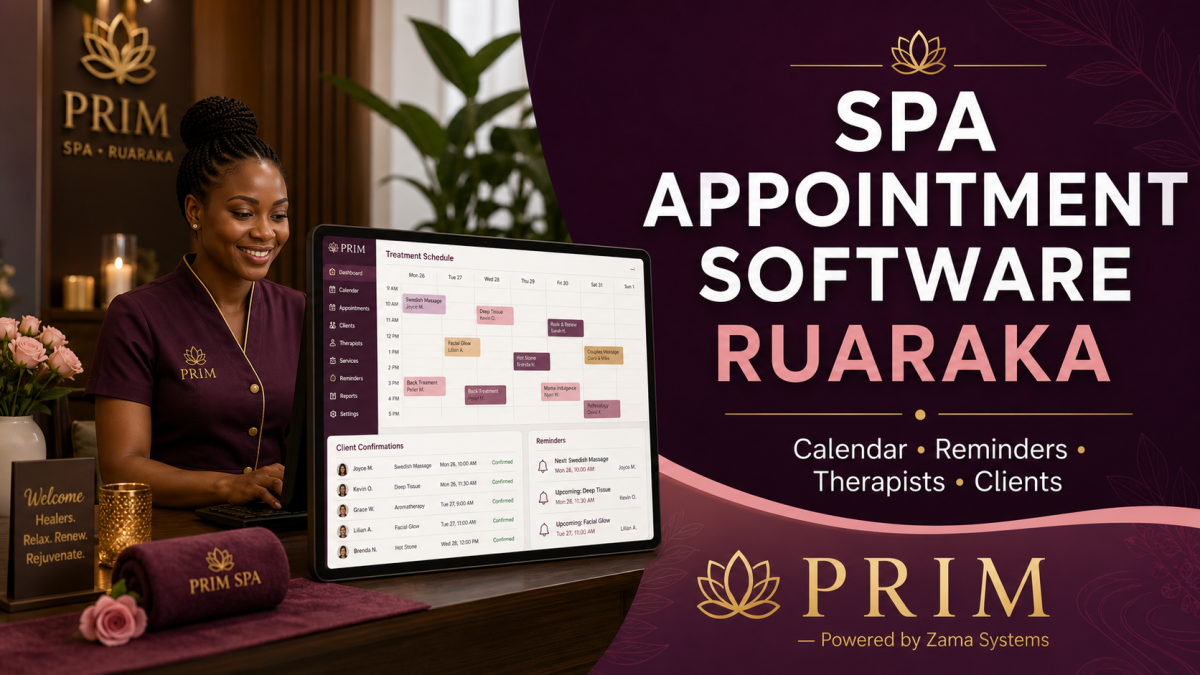
Spa Appointment Software Ruaraka is a purchase-intent search from an owner who wants a practical way to control calendar, reminders, therapist schedules and client records. PRIM supports spa businesses serving Ruaraka, Baba Dogo, Lucky Summer and nearby neighbourhoods with one operating record for clients, work, money, products and management decisions.
Spa Appointment Software Ruaraka guide by PRIM, Powered by Zama Systems.
Powered by Zama Systems. PRIM combines beauty-industry workflows with Kenyan software implementation, mobile-first operations and support for local payment realities.
Why Ruaraka business owners look for this software
The visible sign of a successful spa is a busy team, but activity alone does not guarantee profit. A recurring local problem is clients waiting for replies, appointment gaps, treatment overruns and inconsistent follow-up. When records sit in notebooks, private phones, M-Pesa messages and memory, the owner receives answers late and employees follow different processes.
PRIM creates a consistent path from enquiry to appointment, service delivery, checkout, stock movement and follow-up. This makes daily work easier to review without forcing the owner to be physically present at every transaction.
Build a booking process clients can trust
The calendar should capture requested time, service duration, assigned professional, confirmation status and any deposit. Reception staff need to see appointments and walk-ins together. When a client reschedules, the old slot should become available without leaving duplicate entries.
Reminders are most effective when the original booking record is accurate. The team should agree when a booking becomes confirmed, how late arrivals are handled and what happens to a deposit after cancellation.
Features buyers should test in a live PRIM demo
Real workflow fit: test calendar, reminders, therapist schedules and client records, not only the dashboard.
Role permissions: reception, service staff, storekeepers and owners should see only what they need.
M-Pesa and cash visibility: payment method totals should connect to real sales records.
Audit trail: managers should be able to review changes, discounts, reversals and stock adjustments.
Useful reports: daily reports should answer operational questions without spreadsheet reconstruction.
Training and support: confirm how employees are onboarded and how issues are escalated.
How to prepare your Ruaraka business for implementation
Document the current client journey
Follow one client from first enquiry to booking, arrival, service, payment and next visit. Mark every duplicate entry, delay and decision that depends on one employee’s memory.
Clean services, prices and durations
Use consistent names and categories. Confirm which services require deposits, special skills, rooms or more time. Clean data prevents a confusing calendar and misleading reports.
Count stock and define units
Record a verified opening quantity. Distinguish items sold whole from products consumed across several services. Assign responsibility for receiving, adjustment and physical count approval.
Agree staff rules
Write permissions, discount limits, commission rules, attendance expectations and closing responsibilities before configuration. Software cannot resolve a rule the business has never agreed.
Train with real scenarios
Practice a walk-in, reschedule, partial payment, discount, product sale, stock adjustment and closing mismatch. Staff remember realistic exercises better than a generic feature tour.
What success should look like after launch
The owner should spend less time reconstructing yesterday. Reception should answer booking questions faster. Employees should understand how sales and commissions are recorded. Stock shortages should be noticed earlier, and client follow-up should use accurate visit history.
Review the first weeks closely. Compare PRIM reports with M-Pesa, cash and physical stock, then correct setup or training gaps. A system becomes valuable through disciplined daily use, not merely because it was installed.
Questions to ask before choosing Spa Appointment Software Ruaraka
Can it handle both appointments and walk-ins?
Can it record the exact services, durations and prices used by this business?
Can managers restrict refunds, discounts and stock changes?
Can payments be reviewed by method during closing?
Can commissions be traced to completed transactions?
Can the business add staff, services or branches later?
What onboarding, training and support are included?
Frequently asked questions
Is PRIM suitable for a small spa in Ruaraka?
Yes. A small business can start with the essential workflow and add controls as the team, service list and client volume grow.
Does PRIM support M-Pesa?
PRIM can organize payment records by method. The exact M-Pesa integration or reconciliation scope should be confirmed during the demonstration.
Can PRIM calculate commissions?
PRIM can support configured commission rules and transaction-level review. Complex or changing rules should be documented and tested before launch.
Can owners check reports away from the business?
PRIM is designed to improve management visibility. Ask the demonstration team to show the access, permission and reporting setup suitable for your operation.
How long does setup take?
Timing depends on the cleanliness of services and stock data, number of users, integrations, branches and training requirements. A focused discovery produces a more reliable estimate.
Beauty Salon POS Makadara is a purchase-intent search from an owner who wants a practical way to control M-Pesa, cash, service sales, retail stock and daily reports. PRIM supports beauty salon businesses serving Buruburu, Hamza, Maringo, Viwandani and surrounding Makadara areas with one operating record for clients, work, money, products and management decisions.
Beauty Salon POS Makadara guide by PRIM, Powered by Zama Systems.
Powered by Zama Systems. PRIM combines beauty-industry workflows with Kenyan software implementation, mobile-first operations and support for local payment realities.
Why Makadara business owners look for this software
The visible sign of a successful beauty salon is a busy team, but activity alone does not guarantee profit. A recurring local problem is M-Pesa messages not matching the service book, missing product sales and unclear closing totals. When records sit in notebooks, private phones, M-Pesa messages and memory, the owner receives answers late and employees follow different processes.
PRIM creates a consistent path from enquiry to appointment, service delivery, checkout, stock movement and follow-up. This makes daily work easier to review without forcing the owner to be physically present at every transaction.
Connect every payment to a real service or product
A POS record should answer four questions: what was sold, who served the client, how the client paid and which stock moved. Separating cash and M-Pesa makes closing easier, while employee attribution supports fair performance review.
Discounts, refunds and voids should require appropriate permission. This protects revenue without slowing ordinary checkout.
Features buyers should test in a live PRIM demo
Real workflow fit: test M-Pesa, cash, service sales, retail stock and daily reports, not only the dashboard.
Role permissions: reception, service staff, storekeepers and owners should see only what they need.
M-Pesa and cash visibility: payment method totals should connect to real sales records.
Audit trail: managers should be able to review changes, discounts, reversals and stock adjustments.
Useful reports: daily reports should answer operational questions without spreadsheet reconstruction.
Training and support: confirm how employees are onboarded and how issues are escalated.
How to prepare your Makadara business for implementation
Document the current client journey
Follow one client from first enquiry to booking, arrival, service, payment and next visit. Mark every duplicate entry, delay and decision that depends on one employee’s memory.
Clean services, prices and durations
Use consistent names and categories. Confirm which services require deposits, special skills, rooms or more time. Clean data prevents a confusing calendar and misleading reports.
Count stock and define units
Record a verified opening quantity. Distinguish items sold whole from products consumed across several services. Assign responsibility for receiving, adjustment and physical count approval.
Agree staff rules
Write permissions, discount limits, commission rules, attendance expectations and closing responsibilities before configuration. Software cannot resolve a rule the business has never agreed.
Train with real scenarios
Practice a walk-in, reschedule, partial payment, discount, product sale, stock adjustment and closing mismatch. Staff remember realistic exercises better than a generic feature tour.
What success should look like after launch
The owner should spend less time reconstructing yesterday. Reception should answer booking questions faster. Employees should understand how sales and commissions are recorded. Stock shortages should be noticed earlier, and client follow-up should use accurate visit history.
Review the first weeks closely. Compare PRIM reports with M-Pesa, cash and physical stock, then correct setup or training gaps. A system becomes valuable through disciplined daily use, not merely because it was installed.
Questions to ask before choosing Beauty Salon POS Makadara
Can it handle both appointments and walk-ins?
Can it record the exact services, durations and prices used by this business?
Can managers restrict refunds, discounts and stock changes?
Can payments be reviewed by method during closing?
Can commissions be traced to completed transactions?
Can the business add staff, services or branches later?
What onboarding, training and support are included?
Frequently asked questions
Is PRIM suitable for a small beauty salon in Makadara?
Yes. A small business can start with the essential workflow and add controls as the team, service list and client volume grow.
Does PRIM support M-Pesa?
PRIM can organize payment records by method. The exact M-Pesa integration or reconciliation scope should be confirmed during the demonstration.
Can PRIM calculate commissions?
PRIM can support configured commission rules and transaction-level review. Complex or changing rules should be documented and tested before launch.
Can owners check reports away from the business?
PRIM is designed to improve management visibility. Ask the demonstration team to show the access, permission and reporting setup suitable for your operation.
How long does setup take?
Timing depends on the cleanliness of services and stock data, number of users, integrations, branches and training requirements. A focused discovery produces a more reliable estimate.
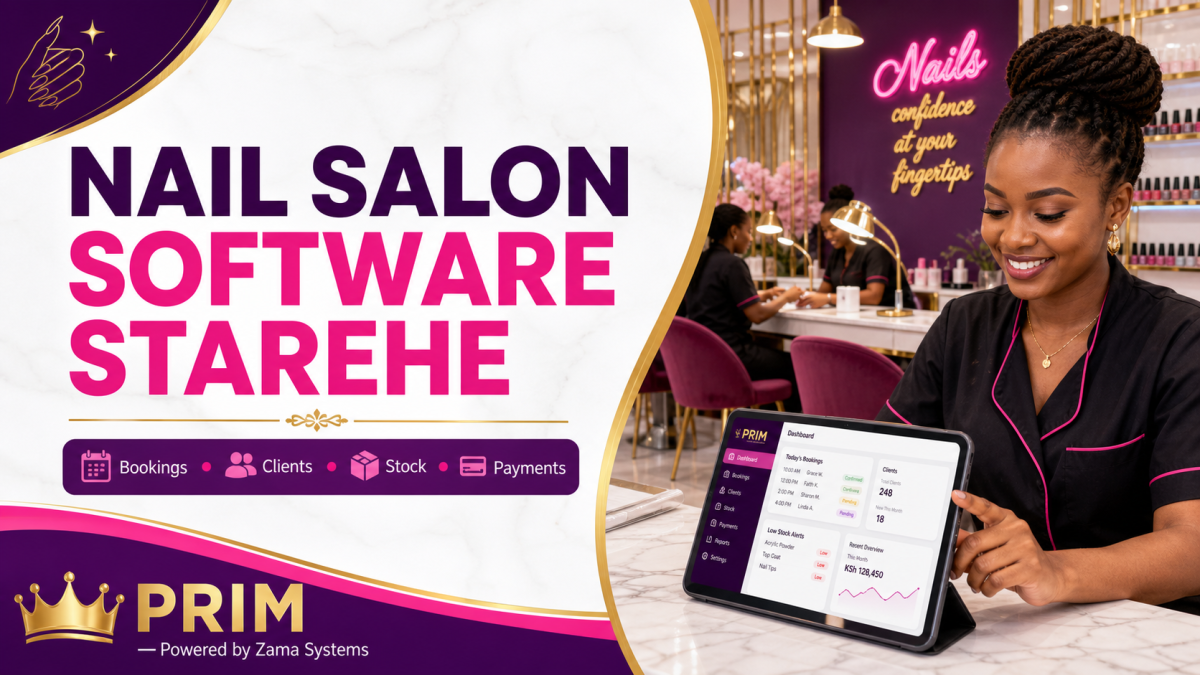
Nail Salon Software Starehe is a purchase-intent search from an owner who wants a practical way to control manicure bookings, client profiles, polish stock and payments. PRIM supports nail salon businesses serving Nairobi CBD, Ngara, Pangani, Ziwani and nearby central areas with one operating record for clients, work, money, products and management decisions.
Nail Salon Software Starehe guide by PRIM, Powered by Zama Systems.
Powered by Zama Systems. PRIM combines beauty-industry workflows with Kenyan software implementation, mobile-first operations and support for local payment realities.
Why Starehe business owners look for this software
The visible sign of a successful nail salon is a busy team, but activity alone does not guarantee profit. A recurring local problem is short appointment slots overlapping, technician availability changing and colours or consumables running out unexpectedly. When records sit in notebooks, private phones, M-Pesa messages and memory, the owner receives answers late and employees follow different processes.
PRIM creates a consistent path from enquiry to appointment, service delivery, checkout, stock movement and follow-up. This makes daily work easier to review without forcing the owner to be physically present at every transaction.
Bring daily operations into one reliable system
PRIM connects the client journey from enquiry and appointment to service, payment, stock movement and follow-up. The owner can review the same record the team created during normal work.
Implementation should simplify the day. Remove duplicate steps and agree which record is authoritative before staff training begins.
Features buyers should test in a live PRIM demo
Real workflow fit: test manicure bookings, client profiles, polish stock and payments, not only the dashboard.
Role permissions: reception, service staff, storekeepers and owners should see only what they need.
M-Pesa and cash visibility: payment method totals should connect to real sales records.
Audit trail: managers should be able to review changes, discounts, reversals and stock adjustments.
Useful reports: daily reports should answer operational questions without spreadsheet reconstruction.
Training and support: confirm how employees are onboarded and how issues are escalated.
How to prepare your Starehe business for implementation
Document the current client journey
Follow one client from first enquiry to booking, arrival, service, payment and next visit. Mark every duplicate entry, delay and decision that depends on one employee’s memory.
Clean services, prices and durations
Use consistent names and categories. Confirm which services require deposits, special skills, rooms or more time. Clean data prevents a confusing calendar and misleading reports.
Count stock and define units
Record a verified opening quantity. Distinguish items sold whole from products consumed across several services. Assign responsibility for receiving, adjustment and physical count approval.
Agree staff rules
Write permissions, discount limits, commission rules, attendance expectations and closing responsibilities before configuration. Software cannot resolve a rule the business has never agreed.
Train with real scenarios
Practice a walk-in, reschedule, partial payment, discount, product sale, stock adjustment and closing mismatch. Staff remember realistic exercises better than a generic feature tour.
What success should look like after launch
The owner should spend less time reconstructing yesterday. Reception should answer booking questions faster. Employees should understand how sales and commissions are recorded. Stock shortages should be noticed earlier, and client follow-up should use accurate visit history.
Review the first weeks closely. Compare PRIM reports with M-Pesa, cash and physical stock, then correct setup or training gaps. A system becomes valuable through disciplined daily use, not merely because it was installed.
Questions to ask before choosing Nail Salon Software Starehe
Can it handle both appointments and walk-ins?
Can it record the exact services, durations and prices used by this business?
Can managers restrict refunds, discounts and stock changes?
Can payments be reviewed by method during closing?
Can commissions be traced to completed transactions?
Can the business add staff, services or branches later?
What onboarding, training and support are included?
Frequently asked questions
Is PRIM suitable for a small nail salon in Starehe?
Yes. A small business can start with the essential workflow and add controls as the team, service list and client volume grow.
Does PRIM support M-Pesa?
PRIM can organize payment records by method. The exact M-Pesa integration or reconciliation scope should be confirmed during the demonstration.
Can PRIM calculate commissions?
PRIM can support configured commission rules and transaction-level review. Complex or changing rules should be documented and tested before launch.
Can owners check reports away from the business?
PRIM is designed to improve management visibility. Ask the demonstration team to show the access, permission and reporting setup suitable for your operation.
How long does setup take?
Timing depends on the cleanliness of services and stock data, number of users, integrations, branches and training requirements. A focused discovery produces a more reliable estimate.
Barber POS Software Roysambu is a purchase-intent search from an owner who wants a practical way to control service sales, queue, stock and barber commissions. PRIM supports barber shop businesses serving Roysambu, Zimmerman, Githurai, Kahawa West and nearby Thika Road estates with one operating record for clients, work, money, products and management decisions.
Barber POS Software Roysambu guide by PRIM, Powered by Zama Systems.
Powered by Zama Systems. PRIM combines beauty-industry workflows with Kenyan software implementation, mobile-first operations and support for local payment realities.
Why Roysambu business owners look for this software
The visible sign of a successful barber shop is a busy team, but activity alone does not guarantee profit. A recurring local problem is busy chairs without reliable sales records, products leaving unrecorded and commission totals that are difficult to verify. When records sit in notebooks, private phones, M-Pesa messages and memory, the owner receives answers late and employees follow different processes.
PRIM creates a consistent path from enquiry to appointment, service delivery, checkout, stock movement and follow-up. This makes daily work easier to review without forcing the owner to be physically present at every transaction.
Connect every payment to a real service or product
A POS record should answer four questions: what was sold, who served the client, how the client paid and which stock moved. Separating cash and M-Pesa makes closing easier, while employee attribution supports fair performance review.
Discounts, refunds and voids should require appropriate permission. This protects revenue without slowing ordinary checkout.
Features buyers should test in a live PRIM demo
Real workflow fit: test service sales, queue, stock and barber commissions, not only the dashboard.
Role permissions: reception, service staff, storekeepers and owners should see only what they need.
M-Pesa and cash visibility: payment method totals should connect to real sales records.
Audit trail: managers should be able to review changes, discounts, reversals and stock adjustments.
Useful reports: daily reports should answer operational questions without spreadsheet reconstruction.
Training and support: confirm how employees are onboarded and how issues are escalated.
How to prepare your Roysambu business for implementation
Document the current client journey
Follow one client from first enquiry to booking, arrival, service, payment and next visit. Mark every duplicate entry, delay and decision that depends on one employee’s memory.
Clean services, prices and durations
Use consistent names and categories. Confirm which services require deposits, special skills, rooms or more time. Clean data prevents a confusing calendar and misleading reports.
Count stock and define units
Record a verified opening quantity. Distinguish items sold whole from products consumed across several services. Assign responsibility for receiving, adjustment and physical count approval.
Agree staff rules
Write permissions, discount limits, commission rules, attendance expectations and closing responsibilities before configuration. Software cannot resolve a rule the business has never agreed.
Train with real scenarios
Practice a walk-in, reschedule, partial payment, discount, product sale, stock adjustment and closing mismatch. Staff remember realistic exercises better than a generic feature tour.
What success should look like after launch
The owner should spend less time reconstructing yesterday. Reception should answer booking questions faster. Employees should understand how sales and commissions are recorded. Stock shortages should be noticed earlier, and client follow-up should use accurate visit history.
Review the first weeks closely. Compare PRIM reports with M-Pesa, cash and physical stock, then correct setup or training gaps. A system becomes valuable through disciplined daily use, not merely because it was installed.
Questions to ask before choosing Barber POS Software Roysambu
Can it handle both appointments and walk-ins?
Can it record the exact services, durations and prices used by this business?
Can managers restrict refunds, discounts and stock changes?
Can payments be reviewed by method during closing?
Can commissions be traced to completed transactions?
Can the business add staff, services or branches later?
What onboarding, training and support are included?
Frequently asked questions
Is PRIM suitable for a small barber shop in Roysambu?
Yes. A small business can start with the essential workflow and add controls as the team, service list and client volume grow.
Does PRIM support M-Pesa?
PRIM can organize payment records by method. The exact M-Pesa integration or reconciliation scope should be confirmed during the demonstration.
Can PRIM calculate commissions?
PRIM can support configured commission rules and transaction-level review. Complex or changing rules should be documented and tested before launch.
Can owners check reports away from the business?
PRIM is designed to improve management visibility. Ask the demonstration team to show the access, permission and reporting setup suitable for your operation.
How long does setup take?
Timing depends on the cleanliness of services and stock data, number of users, integrations, branches and training requirements. A focused discovery produces a more reliable estimate.
Spa Booking Software Langata is a purchase-intent search from an owner who wants a practical way to control appointments, treatment rooms, therapists and payments. PRIM supports spa businesses serving Langata, Karen, South C, Nairobi West and nearby areas with one operating record for clients, work, money, products and management decisions.
Spa Booking Software Langata guide by PRIM, Powered by Zama Systems.
Powered by Zama Systems. PRIM combines beauty-industry workflows with Kenyan software implementation, mobile-first operations and support for local payment realities.
Why Langata business owners look for this software
The visible sign of a successful spa is a busy team, but activity alone does not guarantee profit. A recurring local problem is room conflicts, unused appointment gaps, forgotten confirmations and therapists being assigned twice. When records sit in notebooks, private phones, M-Pesa messages and memory, the owner receives answers late and employees follow different processes.
PRIM creates a consistent path from enquiry to appointment, service delivery, checkout, stock movement and follow-up. This makes daily work easier to review without forcing the owner to be physically present at every transaction.
Build a booking process clients can trust
The calendar should capture requested time, service duration, assigned professional, confirmation status and any deposit. Reception staff need to see appointments and walk-ins together. When a client reschedules, the old slot should become available without leaving duplicate entries.
Reminders are most effective when the original booking record is accurate. The team should agree when a booking becomes confirmed, how late arrivals are handled and what happens to a deposit after cancellation.
Features buyers should test in a live PRIM demo
Real workflow fit: test appointments, treatment rooms, therapists and payments, not only the dashboard.
Role permissions: reception, service staff, storekeepers and owners should see only what they need.
M-Pesa and cash visibility: payment method totals should connect to real sales records.
Audit trail: managers should be able to review changes, discounts, reversals and stock adjustments.
Useful reports: daily reports should answer operational questions without spreadsheet reconstruction.
Training and support: confirm how employees are onboarded and how issues are escalated.
How to prepare your Langata business for implementation
Document the current client journey
Follow one client from first enquiry to booking, arrival, service, payment and next visit. Mark every duplicate entry, delay and decision that depends on one employee’s memory.
Clean services, prices and durations
Use consistent names and categories. Confirm which services require deposits, special skills, rooms or more time. Clean data prevents a confusing calendar and misleading reports.
Count stock and define units
Record a verified opening quantity. Distinguish items sold whole from products consumed across several services. Assign responsibility for receiving, adjustment and physical count approval.
Agree staff rules
Write permissions, discount limits, commission rules, attendance expectations and closing responsibilities before configuration. Software cannot resolve a rule the business has never agreed.
Train with real scenarios
Practice a walk-in, reschedule, partial payment, discount, product sale, stock adjustment and closing mismatch. Staff remember realistic exercises better than a generic feature tour.
What success should look like after launch
The owner should spend less time reconstructing yesterday. Reception should answer booking questions faster. Employees should understand how sales and commissions are recorded. Stock shortages should be noticed earlier, and client follow-up should use accurate visit history.
Review the first weeks closely. Compare PRIM reports with M-Pesa, cash and physical stock, then correct setup or training gaps. A system becomes valuable through disciplined daily use, not merely because it was installed.
Questions to ask before choosing Spa Booking Software Langata
Can it handle both appointments and walk-ins?
Can it record the exact services, durations and prices used by this business?
Can managers restrict refunds, discounts and stock changes?
Can payments be reviewed by method during closing?
Can commissions be traced to completed transactions?
Can the business add staff, services or branches later?
What onboarding, training and support are included?
Frequently asked questions
Is PRIM suitable for a small spa in Langata?
Yes. A small business can start with the essential workflow and add controls as the team, service list and client volume grow.
Does PRIM support M-Pesa?
PRIM can organize payment records by method. The exact M-Pesa integration or reconciliation scope should be confirmed during the demonstration.
Can PRIM calculate commissions?
PRIM can support configured commission rules and transaction-level review. Complex or changing rules should be documented and tested before launch.
Can owners check reports away from the business?
PRIM is designed to improve management visibility. Ask the demonstration team to show the access, permission and reporting setup suitable for your operation.
How long does setup take?
Timing depends on the cleanliness of services and stock data, number of users, integrations, branches and training requirements. A focused discovery produces a more reliable estimate.
Salon Management Software Dagoretti North is a purchase-intent search from an owner who wants a practical way to control bookings, POS, stock, employees and clients. PRIM supports salon businesses serving Kilimani, Kileleshwa, Lavington, Gatina, Kawangware and surrounding neighbourhoods with one operating record for clients, work, money, products and management decisions.
Salon Management Software Dagoretti North guide by PRIM, Powered by Zama Systems.
Powered by Zama Systems. PRIM combines beauty-industry workflows with Kenyan software implementation, mobile-first operations and support for local payment realities.
Why Dagoretti North business owners look for this software
The visible sign of a successful salon is a busy team, but activity alone does not guarantee profit. A recurring local problem is double bookings, stock uncertainty, commission disputes and end-of-day totals that depend on handwritten records. When records sit in notebooks, private phones, M-Pesa messages and memory, the owner receives answers late and employees follow different processes.
PRIM creates a consistent path from enquiry to appointment, service delivery, checkout, stock movement and follow-up. This makes daily work easier to review without forcing the owner to be physically present at every transaction.
Bring daily operations into one reliable system
PRIM connects the client journey from enquiry and appointment to service, payment, stock movement and follow-up. The owner can review the same record the team created during normal work.
Implementation should simplify the day. Remove duplicate steps and agree which record is authoritative before staff training begins.
Features buyers should test in a live PRIM demo
Real workflow fit: test bookings, POS, stock, employees and clients, not only the dashboard.
Role permissions: reception, service staff, storekeepers and owners should see only what they need.
M-Pesa and cash visibility: payment method totals should connect to real sales records.
Audit trail: managers should be able to review changes, discounts, reversals and stock adjustments.
Useful reports: daily reports should answer operational questions without spreadsheet reconstruction.
Training and support: confirm how employees are onboarded and how issues are escalated.
How to prepare your Dagoretti North business for implementation
Document the current client journey
Follow one client from first enquiry to booking, arrival, service, payment and next visit. Mark every duplicate entry, delay and decision that depends on one employee’s memory.
Clean services, prices and durations
Use consistent names and categories. Confirm which services require deposits, special skills, rooms or more time. Clean data prevents a confusing calendar and misleading reports.
Count stock and define units
Record a verified opening quantity. Distinguish items sold whole from products consumed across several services. Assign responsibility for receiving, adjustment and physical count approval.
Agree staff rules
Write permissions, discount limits, commission rules, attendance expectations and closing responsibilities before configuration. Software cannot resolve a rule the business has never agreed.
Train with real scenarios
Practice a walk-in, reschedule, partial payment, discount, product sale, stock adjustment and closing mismatch. Staff remember realistic exercises better than a generic feature tour.
What success should look like after launch
The owner should spend less time reconstructing yesterday. Reception should answer booking questions faster. Employees should understand how sales and commissions are recorded. Stock shortages should be noticed earlier, and client follow-up should use accurate visit history.
Review the first weeks closely. Compare PRIM reports with M-Pesa, cash and physical stock, then correct setup or training gaps. A system becomes valuable through disciplined daily use, not merely because it was installed.
Questions to ask before choosing Salon Management Software Dagoretti North
Can it handle both appointments and walk-ins?
Can it record the exact services, durations and prices used by this business?
Can managers restrict refunds, discounts and stock changes?
Can payments be reviewed by method during closing?
Can commissions be traced to completed transactions?
Can the business add staff, services or branches later?
What onboarding, training and support are included?
Frequently asked questions
Is PRIM suitable for a small salon in Dagoretti North?
Yes. A small business can start with the essential workflow and add controls as the team, service list and client volume grow.
Does PRIM support M-Pesa?
PRIM can organize payment records by method. The exact M-Pesa integration or reconciliation scope should be confirmed during the demonstration.
Can PRIM calculate commissions?
PRIM can support configured commission rules and transaction-level review. Complex or changing rules should be documented and tested before launch.
Can owners check reports away from the business?
PRIM is designed to improve management visibility. Ask the demonstration team to show the access, permission and reporting setup suitable for your operation.
How long does setup take?
Timing depends on the cleanliness of services and stock data, number of users, integrations, branches and training requirements. A focused discovery produces a more reliable estimate.
Salon Management Software Kenya: 10 Smart Things Buyers Should Compare in 2026
Salon Management Software Kenya by PRIM
Salon Management Software Kenya is a strong buyer-intent keyword because the visitor is usually comparing providers, prices, features, timelines, and proof before making a decision.
Salon Management Software Kenya is one of the fresh buyer-focused topics PRIM should publish around today because it matches what serious buyers are searching before they request a demo, quote, rollout plan, or implementation support.
For buyers, students, business owners, managers, administrators, founders, and decision makers looking for a practical solution, the real problem is manual work, unclear communication, weak records, missed deadlines, poor visibility, and difficulty comparing trusted providers. A useful article should answer the questions that serious buyers ask before they contact a provider or request a quotation.
Powered by Zama Systems. This solution is backed by Zama Systems’ practical software-delivery and automation experience.
This search usually comes from a person who already feels the pain. They may be losing enquiries, wasting time with manual work, struggling with deadlines, missing records, or comparing suppliers before paying.
The right content should make the decision easier. It should explain the problem clearly, show the features that matter, reduce fear, and give the visitor a simple next step.
PRIM can use this topic to attract qualified visitors who are closer to buying because they are searching around a real need.
Important Features Buyers Should Expect
clear onboarding – helps buyers get a clearer, faster, and more reliable outcome.
secure records – helps buyers get a clearer, faster, and more reliable outcome.
fast communication – helps buyers get a clearer, faster, and more reliable outcome.
mobile access – helps buyers get a clearer, faster, and more reliable outcome.
reports and updates – helps buyers get a clearer, faster, and more reliable outcome.
support after delivery – helps buyers get a clearer, faster, and more reliable outcome.
clear process – buyers should understand what happens before, during, and after delivery.
mobile friendly experience – users should be able to access the service or platform comfortably on phones.
useful reports or updates – clients should see progress, records, or results without repeated follow-up.
reliable support – the provider should support improvements after launch or delivery.
How to Compare Providers
Start with workflow fit. The provider should understand the exact users, tasks, deadlines, records, communication channels, payments, and reports involved.
Next, compare trust. Look for clear service pages, examples, practical explanations, realistic promises, visible contacts, and content that answers real questions.
Then compare long-term value. The best option is not always the lowest quote. The right provider should save time, reduce confusion, improve experience, and make future growth easier.
Mistakes to Avoid
Choosing Only by Price
Cheap work can become expensive if it creates weak design, unclear communication, poor support, missing features, or repeated revisions.
Ignoring the Real User
A solution must work for the people who use it daily. If users find it confusing, the project loses value quickly.
Publishing Thin Content
SEO pages should not only repeat keywords. They should answer buyer questions and explain the next step clearly.
How to Get Started
Write down the exact result you want. Include the users, current problem, documents, deadlines, records, payments, reports, and the main action you want visitors or customers to take.
Then contact a provider with a clear request. Share the pain points and ask for a practical plan, timeline, and support process.
Why Choose PRIM?
PRIM focuses on salon, spa, barber, beauty, wellness, and gym business management workflows, including bookings, staff, inventory, packages, and customer follow-up.
Salon Management Software Kenya is useful for buyers, students, business owners, managers, administrators, founders, and decision makers looking for a practical solution, especially when the current process is manual, unclear, slow, or hard to scale.
What should buyers compare first?
Compare workflow fit, support, examples, communication, features, timelines, and whether the provider understands the real problem.
Can the solution be customized?
Yes. A serious provider should shape the solution around users, records, reports, content, communication, and growth plans.
Conclusion
Salon Management Software Kenya is worth targeting because it connects to real buying intent. The best content should educate the visitor, build confidence, and make the next enquiry easy.
Deep Buyer Guide for Salon Management Software Kenya
Before making a decision, buyers should separate must-have requirements from nice-to-have extras. The must-have items are the features that protect revenue, save time, improve communication, or prevent operational confusion. A buyer searching for Salon Management Software Kenya is rarely looking for a vague overview. They normally want a practical answer that helps them choose a provider, compare options, understand implementation, and avoid a poor purchase.
The first useful step is to define the current workflow. Write down who starts the request, who approves it, where records are stored, how payments or submissions are confirmed, and which reports management needs at the end of the week or month. This exercise exposes gaps quickly. If the current process depends on scattered spreadsheets, WhatsApp screenshots, email attachments, or one person who remembers everything, the buyer should prioritize a solution that brings those records into one controlled workflow.
The second step is to compare accountability. Good providers explain how the work will be planned, who owns each stage, what information is needed before kickoff, and how progress will be reviewed. Weak providers often jump straight to price without clarifying the operating problem. For PRIM, the strongest content should help the reader think like a serious buyer: define the result, protect the user experience, check the support model, and make sure the final solution can keep improving after launch.
The third step is to check reporting and visibility. Many organizations do not only need a service; they need evidence that the service is working. Reports, dashboards, status updates, audit trails, and clear records reduce conflict because teams can see what happened, when it happened, and what still needs attention. This is especially important when the topic affects money, customers, students, members, tenants, voters, staff, stock, or compliance.
Future growth also matters. A good solution should allow more users, more records, more requests, more services, and better reports without forcing the organization to start again from zero. Buyers should ask whether the solution can handle new branches, new counties, new departments, new roles, new payment methods, or new reporting needs. The cheapest first option can become expensive if it blocks growth six months later.
Strong SEO content supports both trust and rankings. A long article should not fill space with repeated claims. It should answer real questions, explain trade-offs, use the focus keyword naturally, link to useful pages, and give the reader a clear next step. When visitors feel that the article understands their problem, they are more likely to enquire, request a quote, book a demo, or compare the provider seriously.
Implementation Checklist
Problem definition: describe the current bottleneck and the measurable result the buyer wants.
User roles: list administrators, managers, customers, students, members, tenants, staff, or external users who will interact with the process.
Data records: define the records, documents, payments, messages, reports, and approvals that must be captured.
Security: decide who can view, edit, approve, export, or delete sensitive records.
Support: confirm how training, bug fixes, updates, and improvements will be handled after launch.
These details make the buying conversation more productive. Instead of asking only for a general quote, the buyer can explain the workflow and ask for a practical rollout plan. That gives the provider enough context to recommend a sensible scope, timeline, and support path. It also helps the buyer avoid vague proposals that look cheap but leave critical work undefined.
Questions Buyers Should Ask
Buyers should ask how long implementation will take, what content or data must be prepared, how user training will work, and what happens after publishing or launch. They should also ask for examples of similar work, a clear contact path, and an explanation of what is included in the first delivery versus future improvements. These questions protect both sides because they make expectations clear before money changes hands.
Another useful question is how success will be measured. For some buyers, success means more enquiries. For others, it means faster reconciliation, fewer missing records, lower admin workload, better tenant communication, smoother elections, stronger academic support workflows, better farm records, more reliable connectivity, or clearer executive reporting. The right metric depends on the business problem, so the article should connect the keyword to outcomes that matter.
Finally, buyers should check whether the provider understands the local context. In Kenya and surrounding markets, details like M-Pesa, county operations, mobile-first users, WhatsApp communication, school and SACCO structures, landlord workflows, rural connectivity, and small-team administration can shape the success of a project. A generic solution may look good but fail in daily use if it ignores these realities.
Deep Buyer Guide for Salon Management Software Kenya
Before making a decision, buyers should separate must-have requirements from nice-to-have extras. The must-have items are the features that protect revenue, save time, improve communication, or prevent operational confusion. A buyer searching for Salon Management Software Kenya is rarely looking for a vague overview. They normally want a practical answer that helps them choose a provider, compare options, understand implementation, and avoid a poor purchase.
The first useful step is to define the current workflow. Write down who starts the request, who approves it, where records are stored, how payments or submissions are confirmed, and which reports management needs at the end of the week or month. This exercise exposes gaps quickly. If the current process depends on scattered spreadsheets, WhatsApp screenshots, email attachments, or one person who remembers everything, the buyer should prioritize a solution that brings those records into one controlled workflow.
The second step is to compare accountability. Good providers explain how the work will be planned, who owns each stage, what information is needed before kickoff, and how progress will be reviewed. Weak providers often jump straight to price without clarifying the operating problem. For PRIM, the strongest content should help the reader think like a serious buyer: define the result, protect the user experience, check the support model, and make sure the final solution can keep improving after launch.
The third step is to check reporting and visibility. Many organizations do not only need a service; they need evidence that the service is working. Reports, dashboards, status updates, audit trails, and clear records reduce conflict because teams can see what happened, when it happened, and what still needs attention. This is especially important when the topic affects money, customers, students, members, tenants, voters, staff, stock, or compliance.
Future growth also matters. A good solution should allow more users, more records, more requests, more services, and better reports without forcing the organization to start again from zero. Buyers should ask whether the solution can handle new branches, new counties, new departments, new roles, new payment methods, or new reporting needs. The cheapest first option can become expensive if it blocks growth six months later.
Strong SEO content supports both trust and rankings. A long article should not fill space with repeated claims. It should answer real questions, explain trade-offs, use the focus keyword naturally, link to useful pages, and give the reader a clear next step. When visitors feel that the article understands their problem, they are more likely to enquire, request a quote, book a demo, or compare the provider seriously.
Implementation Checklist
Problem definition: describe the current bottleneck and the measurable result the buyer wants.
User roles: list administrators, managers, customers, students, members, tenants, staff, or external users who will interact with the process.
Data records: define the records, documents, payments, messages, reports, and approvals that must be captured.
Security: decide who can view, edit, approve, export, or delete sensitive records.
Support: confirm how training, bug fixes, updates, and improvements will be handled after launch.
These details make the buying conversation more productive. Instead of asking only for a general quote, the buyer can explain the workflow and ask for a practical rollout plan. That gives the provider enough context to recommend a sensible scope, timeline, and support path. It also helps the buyer avoid vague proposals that look cheap but leave critical work undefined.
Questions Buyers Should Ask
Buyers should ask how long implementation will take, what content or data must be prepared, how user training will work, and what happens after publishing or launch. They should also ask for examples of similar work, a clear contact path, and an explanation of what is included in the first delivery versus future improvements. These questions protect both sides because they make expectations clear before money changes hands.
Another useful question is how success will be measured. For some buyers, success means more enquiries. For others, it means faster reconciliation, fewer missing records, lower admin workload, better tenant communication, smoother elections, stronger academic support workflows, better farm records, more reliable connectivity, or clearer executive reporting. The right metric depends on the business problem, so the article should connect the keyword to outcomes that matter.
Finally, buyers should check whether the provider understands the local context. In Kenya and surrounding markets, details like M-Pesa, county operations, mobile-first users, WhatsApp communication, school and SACCO structures, landlord workflows, rural connectivity, and small-team administration can shape the success of a project. A generic solution may look good but fail in daily use if it ignores these realities.
Deep Buyer Guide for Salon Management Software Kenya
Before making a decision, buyers should separate must-have requirements from nice-to-have extras. The must-have items are the features that protect revenue, save time, improve communication, or prevent operational confusion. A buyer searching for Salon Management Software Kenya is rarely looking for a vague overview. They normally want a practical answer that helps them choose a provider, compare options, understand implementation, and avoid a poor purchase.
The first useful step is to define the current workflow. Write down who starts the request, who approves it, where records are stored, how payments or submissions are confirmed, and which reports management needs at the end of the week or month. This exercise exposes gaps quickly. If the current process depends on scattered spreadsheets, WhatsApp screenshots, email attachments, or one person who remembers everything, the buyer should prioritize a solution that brings those records into one controlled workflow.
The second step is to compare accountability. Good providers explain how the work will be planned, who owns each stage, what information is needed before kickoff, and how progress will be reviewed. Weak providers often jump straight to price without clarifying the operating problem. For PRIM, the strongest content should help the reader think like a serious buyer: define the result, protect the user experience, check the support model, and make sure the final solution can keep improving after launch.
The third step is to check reporting and visibility. Many organizations do not only need a service; they need evidence that the service is working. Reports, dashboards, status updates, audit trails, and clear records reduce conflict because teams can see what happened, when it happened, and what still needs attention. This is especially important when the topic affects money, customers, students, members, tenants, voters, staff, stock, or compliance.
Future growth also matters. A good solution should allow more users, more records, more requests, more services, and better reports without forcing the organization to start again from zero. Buyers should ask whether the solution can handle new branches, new counties, new departments, new roles, new payment methods, or new reporting needs. The cheapest first option can become expensive if it blocks growth six months later.
Strong SEO content supports both trust and rankings. A long article should not fill space with repeated claims. It should answer real questions, explain trade-offs, use the focus keyword naturally, link to useful pages, and give the reader a clear next step. When visitors feel that the article understands their problem, they are more likely to enquire, request a quote, book a demo, or compare the provider seriously.
Implementation Checklist
Problem definition: describe the current bottleneck and the measurable result the buyer wants.
User roles: list administrators, managers, customers, students, members, tenants, staff, or external users who will interact with the process.
Data records: define the records, documents, payments, messages, reports, and approvals that must be captured.
Security: decide who can view, edit, approve, export, or delete sensitive records.
Support: confirm how training, bug fixes, updates, and improvements will be handled after launch.
These details make the buying conversation more productive. Instead of asking only for a general quote, the buyer can explain the workflow and ask for a practical rollout plan. That gives the provider enough context to recommend a sensible scope, timeline, and support path. It also helps the buyer avoid vague proposals that look cheap but leave critical work undefined.
Questions Buyers Should Ask
Buyers should ask how long implementation will take, what content or data must be prepared, how user training will work, and what happens after publishing or launch. They should also ask for examples of similar work, a clear contact path, and an explanation of what is included in the first delivery versus future improvements. These questions protect both sides because they make expectations clear before money changes hands.
Another useful question is how success will be measured. For some buyers, success means more enquiries. For others, it means faster reconciliation, fewer missing records, lower admin workload, better tenant communication, smoother elections, stronger academic support workflows, better farm records, more reliable connectivity, or clearer executive reporting. The right metric depends on the business problem, so the article should connect the keyword to outcomes that matter.
Finally, buyers should check whether the provider understands the local context. In Kenya and surrounding markets, details like M-Pesa, county operations, mobile-first users, WhatsApp communication, school and SACCO structures, landlord workflows, rural connectivity, and small-team administration can shape the success of a project. A generic solution may look good but fail in daily use if it ignores these realities.
Deep Buyer Guide for Salon Management Software Kenya
Before making a decision, buyers should separate must-have requirements from nice-to-have extras. The must-have items are the features that protect revenue, save time, improve communication, or prevent operational confusion. A buyer searching for Salon Management Software Kenya is rarely looking for a vague overview. They normally want a practical answer that helps them choose a provider, compare options, understand implementation, and avoid a poor purchase.
The first useful step is to define the current workflow. Write down who starts the request, who approves it, where records are stored, how payments or submissions are confirmed, and which reports management needs at the end of the week or month. This exercise exposes gaps quickly. If the current process depends on scattered spreadsheets, WhatsApp screenshots, email attachments, or one person who remembers everything, the buyer should prioritize a solution that brings those records into one controlled workflow.
The second step is to compare accountability. Good providers explain how the work will be planned, who owns each stage, what information is needed before kickoff, and how progress will be reviewed. Weak providers often jump straight to price without clarifying the operating problem. For PRIM, the strongest content should help the reader think like a serious buyer: define the result, protect the user experience, check the support model, and make sure the final solution can keep improving after launch.
The third step is to check reporting and visibility. Many organizations do not only need a service; they need evidence that the service is working. Reports, dashboards, status updates, audit trails, and clear records reduce conflict because teams can see what happened, when it happened, and what still needs attention. This is especially important when the topic affects money, customers, students, members, tenants, voters, staff, stock, or compliance.
Future growth also matters. A good solution should allow more users, more records, more requests, more services, and better reports without forcing the organization to start again from zero. Buyers should ask whether the solution can handle new branches, new counties, new departments, new roles, new payment methods, or new reporting needs. The cheapest first option can become expensive if it blocks growth six months later.
Strong SEO content supports both trust and rankings. A long article should not fill space with repeated claims. It should answer real questions, explain trade-offs, use the focus keyword naturally, link to useful pages, and give the reader a clear next step. When visitors feel that the article understands their problem, they are more likely to enquire, request a quote, book a demo, or compare the provider seriously.
Implementation Checklist
Problem definition: describe the current bottleneck and the measurable result the buyer wants.
User roles: list administrators, managers, customers, students, members, tenants, staff, or external users who will interact with the process.
Data records: define the records, documents, payments, messages, reports, and approvals that must be captured.
Security: decide who can view, edit, approve, export, or delete sensitive records.
Support: confirm how training, bug fixes, updates, and improvements will be handled after launch.
These details make the buying conversation more productive. Instead of asking only for a general quote, the buyer can explain the workflow and ask for a practical rollout plan. That gives the provider enough context to recommend a sensible scope, timeline, and support path. It also helps the buyer avoid vague proposals that look cheap but leave critical work undefined.
Questions Buyers Should Ask
Buyers should ask how long implementation will take, what content or data must be prepared, how user training will work, and what happens after publishing or launch. They should also ask for examples of similar work, a clear contact path, and an explanation of what is included in the first delivery versus future improvements. These questions protect both sides because they make expectations clear before money changes hands.
Another useful question is how success will be measured. For some buyers, success means more enquiries. For others, it means faster reconciliation, fewer missing records, lower admin workload, better tenant communication, smoother elections, stronger academic support workflows, better farm records, more reliable connectivity, or clearer executive reporting. The right metric depends on the business problem, so the article should connect the keyword to outcomes that matter.
Finally, buyers should check whether the provider understands the local context. In Kenya and surrounding markets, details like M-Pesa, county operations, mobile-first users, WhatsApp communication, school and SACCO structures, landlord workflows, rural connectivity, and small-team administration can shape the success of a project. A generic solution may look good but fail in daily use if it ignores these realities.
Deep Buyer Guide for Salon Management Software Kenya
Before making a decision, buyers should separate must-have requirements from nice-to-have extras. The must-have items are the features that protect revenue, save time, improve communication, or prevent operational confusion. A buyer searching for Salon Management Software Kenya is rarely looking for a vague overview. They normally want a practical answer that helps them choose a provider, compare options, understand implementation, and avoid a poor purchase.
The first useful step is to define the current workflow. Write down who starts the request, who approves it, where records are stored, how payments or submissions are confirmed, and which reports management needs at the end of the week or month. This exercise exposes gaps quickly. If the current process depends on scattered spreadsheets, WhatsApp screenshots, email attachments, or one person who remembers everything, the buyer should prioritize a solution that brings those records into one controlled workflow.
The second step is to compare accountability. Good providers explain how the work will be planned, who owns each stage, what information is needed before kickoff, and how progress will be reviewed. Weak providers often jump straight to price without clarifying the operating problem. For PRIM, the strongest content should help the reader think like a serious buyer: define the result, protect the user experience, check the support model, and make sure the final solution can keep improving after launch.
The third step is to check reporting and visibility. Many organizations do not only need a service; they need evidence that the service is working. Reports, dashboards, status updates, audit trails, and clear records reduce conflict because teams can see what happened, when it happened, and what still needs attention. This is especially important when the topic affects money, customers, students, members, tenants, voters, staff, stock, or compliance.
Future growth also matters. A good solution should allow more users, more records, more requests, more services, and better reports without forcing the organization to start again from zero. Buyers should ask whether the solution can handle new branches, new counties, new departments, new roles, new payment methods, or new reporting needs. The cheapest first option can become expensive if it blocks growth six months later.
Strong SEO content supports both trust and rankings. A long article should not fill space with repeated claims. It should answer real questions, explain trade-offs, use the focus keyword naturally, link to useful pages, and give the reader a clear next step. When visitors feel that the article understands their problem, they are more likely to enquire, request a quote, book a demo, or compare the provider seriously.
Implementation Checklist
Problem definition: describe the current bottleneck and the measurable result the buyer wants.
User roles: list administrators, managers, customers, students, members, tenants, staff, or external users who will interact with the process.
Data records: define the records, documents, payments, messages, reports, and approvals that must be captured.
Security: decide who can view, edit, approve, export, or delete sensitive records.
Support: confirm how training, bug fixes, updates, and improvements will be handled after launch.
These details make the buying conversation more productive. Instead of asking only for a general quote, the buyer can explain the workflow and ask for a practical rollout plan. That gives the provider enough context to recommend a sensible scope, timeline, and support path. It also helps the buyer avoid vague proposals that look cheap but leave critical work undefined.
Questions Buyers Should Ask
Buyers should ask how long implementation will take, what content or data must be prepared, how user training will work, and what happens after publishing or launch. They should also ask for examples of similar work, a clear contact path, and an explanation of what is included in the first delivery versus future improvements. These questions protect both sides because they make expectations clear before money changes hands.
Another useful question is how success will be measured. For some buyers, success means more enquiries. For others, it means faster reconciliation, fewer missing records, lower admin workload, better tenant communication, smoother elections, stronger academic support workflows, better farm records, more reliable connectivity, or clearer executive reporting. The right metric depends on the business problem, so the article should connect the keyword to outcomes that matter.
Finally, buyers should check whether the provider understands the local context. In Kenya and surrounding markets, details like M-Pesa, county operations, mobile-first users, WhatsApp communication, school and SACCO structures, landlord workflows, rural connectivity, and small-team administration can shape the success of a project. A generic solution may look good but fail in daily use if it ignores these realities.
Salon Management Software Kenya: 10 Smart Things Buyers Should Compare in 2026
Salon Management Software Kenya by PRIM
Salon Management Software Kenya is a strong buyer-intent keyword because the visitor is usually comparing providers, prices, features, timelines, and proof before making a decision.
Salon Management Software Kenya is one of the fresh buyer-focused topics PRIM should publish around today because it matches what serious buyers are searching before they request a demo, quote, rollout plan, or implementation support.
For buyers, students, business owners, managers, administrators, founders, and decision makers looking for a practical solution, the real problem is manual work, unclear communication, weak records, missed deadlines, poor visibility, and difficulty comparing trusted providers. A useful article should answer the questions that serious buyers ask before they contact a provider or request a quotation.
Powered by Zama Systems. This solution is backed by Zama Systems’ practical software-delivery and automation experience.
This search usually comes from a person who already feels the pain. They may be losing enquiries, wasting time with manual work, struggling with deadlines, missing records, or comparing suppliers before paying.
The right content should make the decision easier. It should explain the problem clearly, show the features that matter, reduce fear, and give the visitor a simple next step.
PRIM can use this topic to attract qualified visitors who are closer to buying because they are searching around a real need.
Important Features Buyers Should Expect
clear onboarding – helps buyers get a clearer, faster, and more reliable outcome.
secure records – helps buyers get a clearer, faster, and more reliable outcome.
fast communication – helps buyers get a clearer, faster, and more reliable outcome.
mobile access – helps buyers get a clearer, faster, and more reliable outcome.
reports and updates – helps buyers get a clearer, faster, and more reliable outcome.
support after delivery – helps buyers get a clearer, faster, and more reliable outcome.
clear process – buyers should understand what happens before, during, and after delivery.
mobile friendly experience – users should be able to access the service or platform comfortably on phones.
useful reports or updates – clients should see progress, records, or results without repeated follow-up.
reliable support – the provider should support improvements after launch or delivery.
How to Compare Providers
Start with workflow fit. The provider should understand the exact users, tasks, deadlines, records, communication channels, payments, and reports involved.
Next, compare trust. Look for clear service pages, examples, practical explanations, realistic promises, visible contacts, and content that answers real questions.
Then compare long-term value. The best option is not always the lowest quote. The right provider should save time, reduce confusion, improve experience, and make future growth easier.
Mistakes to Avoid
Choosing Only by Price
Cheap work can become expensive if it creates weak design, unclear communication, poor support, missing features, or repeated revisions.
Ignoring the Real User
A solution must work for the people who use it daily. If users find it confusing, the project loses value quickly.
Publishing Thin Content
SEO pages should not only repeat keywords. They should answer buyer questions and explain the next step clearly.
How to Get Started
Write down the exact result you want. Include the users, current problem, documents, deadlines, records, payments, reports, and the main action you want visitors or customers to take.
Then contact a provider with a clear request. Share the pain points and ask for a practical plan, timeline, and support process.
Why Choose PRIM?
PRIM focuses on salon, spa, barber, beauty, wellness, and gym business management workflows, including bookings, staff, inventory, packages, and customer follow-up.
Salon Management Software Kenya is useful for buyers, students, business owners, managers, administrators, founders, and decision makers looking for a practical solution, especially when the current process is manual, unclear, slow, or hard to scale.
What should buyers compare first?
Compare workflow fit, support, examples, communication, features, timelines, and whether the provider understands the real problem.
Can the solution be customized?
Yes. A serious provider should shape the solution around users, records, reports, content, communication, and growth plans.
Conclusion
Salon Management Software Kenya is worth targeting because it connects to real buying intent. The best content should educate the visitor, build confidence, and make the next enquiry easy.
Deep Buyer Guide for Salon Management Software Kenya
Before making a decision, buyers should separate must-have requirements from nice-to-have extras. The must-have items are the features that protect revenue, save time, improve communication, or prevent operational confusion. A buyer searching for Salon Management Software Kenya is rarely looking for a vague overview. They normally want a practical answer that helps them choose a provider, compare options, understand implementation, and avoid a poor purchase.
The first useful step is to define the current workflow. Write down who starts the request, who approves it, where records are stored, how payments or submissions are confirmed, and which reports management needs at the end of the week or month. This exercise exposes gaps quickly. If the current process depends on scattered spreadsheets, WhatsApp screenshots, email attachments, or one person who remembers everything, the buyer should prioritize a solution that brings those records into one controlled workflow.
The second step is to compare accountability. Good providers explain how the work will be planned, who owns each stage, what information is needed before kickoff, and how progress will be reviewed. Weak providers often jump straight to price without clarifying the operating problem. For PRIM, the strongest content should help the reader think like a serious buyer: define the result, protect the user experience, check the support model, and make sure the final solution can keep improving after launch.
The third step is to check reporting and visibility. Many organizations do not only need a service; they need evidence that the service is working. Reports, dashboards, status updates, audit trails, and clear records reduce conflict because teams can see what happened, when it happened, and what still needs attention. This is especially important when the topic affects money, customers, students, members, tenants, voters, staff, stock, or compliance.
Future growth also matters. A good solution should allow more users, more records, more requests, more services, and better reports without forcing the organization to start again from zero. Buyers should ask whether the solution can handle new branches, new counties, new departments, new roles, new payment methods, or new reporting needs. The cheapest first option can become expensive if it blocks growth six months later.
Strong SEO content supports both trust and rankings. A long article should not fill space with repeated claims. It should answer real questions, explain trade-offs, use the focus keyword naturally, link to useful pages, and give the reader a clear next step. When visitors feel that the article understands their problem, they are more likely to enquire, request a quote, book a demo, or compare the provider seriously.
Implementation Checklist
Problem definition: describe the current bottleneck and the measurable result the buyer wants.
User roles: list administrators, managers, customers, students, members, tenants, staff, or external users who will interact with the process.
Data records: define the records, documents, payments, messages, reports, and approvals that must be captured.
Security: decide who can view, edit, approve, export, or delete sensitive records.
Support: confirm how training, bug fixes, updates, and improvements will be handled after launch.
These details make the buying conversation more productive. Instead of asking only for a general quote, the buyer can explain the workflow and ask for a practical rollout plan. That gives the provider enough context to recommend a sensible scope, timeline, and support path. It also helps the buyer avoid vague proposals that look cheap but leave critical work undefined.
Questions Buyers Should Ask
Buyers should ask how long implementation will take, what content or data must be prepared, how user training will work, and what happens after publishing or launch. They should also ask for examples of similar work, a clear contact path, and an explanation of what is included in the first delivery versus future improvements. These questions protect both sides because they make expectations clear before money changes hands.
Another useful question is how success will be measured. For some buyers, success means more enquiries. For others, it means faster reconciliation, fewer missing records, lower admin workload, better tenant communication, smoother elections, stronger academic support workflows, better farm records, more reliable connectivity, or clearer executive reporting. The right metric depends on the business problem, so the article should connect the keyword to outcomes that matter.
Finally, buyers should check whether the provider understands the local context. In Kenya and surrounding markets, details like M-Pesa, county operations, mobile-first users, WhatsApp communication, school and SACCO structures, landlord workflows, rural connectivity, and small-team administration can shape the success of a project. A generic solution may look good but fail in daily use if it ignores these realities.
Deep Buyer Guide for Salon Management Software Kenya
Before making a decision, buyers should separate must-have requirements from nice-to-have extras. The must-have items are the features that protect revenue, save time, improve communication, or prevent operational confusion. A buyer searching for Salon Management Software Kenya is rarely looking for a vague overview. They normally want a practical answer that helps them choose a provider, compare options, understand implementation, and avoid a poor purchase.
The first useful step is to define the current workflow. Write down who starts the request, who approves it, where records are stored, how payments or submissions are confirmed, and which reports management needs at the end of the week or month. This exercise exposes gaps quickly. If the current process depends on scattered spreadsheets, WhatsApp screenshots, email attachments, or one person who remembers everything, the buyer should prioritize a solution that brings those records into one controlled workflow.
The second step is to compare accountability. Good providers explain how the work will be planned, who owns each stage, what information is needed before kickoff, and how progress will be reviewed. Weak providers often jump straight to price without clarifying the operating problem. For PRIM, the strongest content should help the reader think like a serious buyer: define the result, protect the user experience, check the support model, and make sure the final solution can keep improving after launch.
The third step is to check reporting and visibility. Many organizations do not only need a service; they need evidence that the service is working. Reports, dashboards, status updates, audit trails, and clear records reduce conflict because teams can see what happened, when it happened, and what still needs attention. This is especially important when the topic affects money, customers, students, members, tenants, voters, staff, stock, or compliance.
Future growth also matters. A good solution should allow more users, more records, more requests, more services, and better reports without forcing the organization to start again from zero. Buyers should ask whether the solution can handle new branches, new counties, new departments, new roles, new payment methods, or new reporting needs. The cheapest first option can become expensive if it blocks growth six months later.
Strong SEO content supports both trust and rankings. A long article should not fill space with repeated claims. It should answer real questions, explain trade-offs, use the focus keyword naturally, link to useful pages, and give the reader a clear next step. When visitors feel that the article understands their problem, they are more likely to enquire, request a quote, book a demo, or compare the provider seriously.
Implementation Checklist
Problem definition: describe the current bottleneck and the measurable result the buyer wants.
User roles: list administrators, managers, customers, students, members, tenants, staff, or external users who will interact with the process.
Data records: define the records, documents, payments, messages, reports, and approvals that must be captured.
Security: decide who can view, edit, approve, export, or delete sensitive records.
Support: confirm how training, bug fixes, updates, and improvements will be handled after launch.
These details make the buying conversation more productive. Instead of asking only for a general quote, the buyer can explain the workflow and ask for a practical rollout plan. That gives the provider enough context to recommend a sensible scope, timeline, and support path. It also helps the buyer avoid vague proposals that look cheap but leave critical work undefined.
Questions Buyers Should Ask
Buyers should ask how long implementation will take, what content or data must be prepared, how user training will work, and what happens after publishing or launch. They should also ask for examples of similar work, a clear contact path, and an explanation of what is included in the first delivery versus future improvements. These questions protect both sides because they make expectations clear before money changes hands.
Another useful question is how success will be measured. For some buyers, success means more enquiries. For others, it means faster reconciliation, fewer missing records, lower admin workload, better tenant communication, smoother elections, stronger academic support workflows, better farm records, more reliable connectivity, or clearer executive reporting. The right metric depends on the business problem, so the article should connect the keyword to outcomes that matter.
Finally, buyers should check whether the provider understands the local context. In Kenya and surrounding markets, details like M-Pesa, county operations, mobile-first users, WhatsApp communication, school and SACCO structures, landlord workflows, rural connectivity, and small-team administration can shape the success of a project. A generic solution may look good but fail in daily use if it ignores these realities.
Deep Buyer Guide for Salon Management Software Kenya
Before making a decision, buyers should separate must-have requirements from nice-to-have extras. The must-have items are the features that protect revenue, save time, improve communication, or prevent operational confusion. A buyer searching for Salon Management Software Kenya is rarely looking for a vague overview. They normally want a practical answer that helps them choose a provider, compare options, understand implementation, and avoid a poor purchase.
The first useful step is to define the current workflow. Write down who starts the request, who approves it, where records are stored, how payments or submissions are confirmed, and which reports management needs at the end of the week or month. This exercise exposes gaps quickly. If the current process depends on scattered spreadsheets, WhatsApp screenshots, email attachments, or one person who remembers everything, the buyer should prioritize a solution that brings those records into one controlled workflow.
The second step is to compare accountability. Good providers explain how the work will be planned, who owns each stage, what information is needed before kickoff, and how progress will be reviewed. Weak providers often jump straight to price without clarifying the operating problem. For PRIM, the strongest content should help the reader think like a serious buyer: define the result, protect the user experience, check the support model, and make sure the final solution can keep improving after launch.
The third step is to check reporting and visibility. Many organizations do not only need a service; they need evidence that the service is working. Reports, dashboards, status updates, audit trails, and clear records reduce conflict because teams can see what happened, when it happened, and what still needs attention. This is especially important when the topic affects money, customers, students, members, tenants, voters, staff, stock, or compliance.
Future growth also matters. A good solution should allow more users, more records, more requests, more services, and better reports without forcing the organization to start again from zero. Buyers should ask whether the solution can handle new branches, new counties, new departments, new roles, new payment methods, or new reporting needs. The cheapest first option can become expensive if it blocks growth six months later.
Strong SEO content supports both trust and rankings. A long article should not fill space with repeated claims. It should answer real questions, explain trade-offs, use the focus keyword naturally, link to useful pages, and give the reader a clear next step. When visitors feel that the article understands their problem, they are more likely to enquire, request a quote, book a demo, or compare the provider seriously.
Implementation Checklist
Problem definition: describe the current bottleneck and the measurable result the buyer wants.
User roles: list administrators, managers, customers, students, members, tenants, staff, or external users who will interact with the process.
Data records: define the records, documents, payments, messages, reports, and approvals that must be captured.
Security: decide who can view, edit, approve, export, or delete sensitive records.
Support: confirm how training, bug fixes, updates, and improvements will be handled after launch.
These details make the buying conversation more productive. Instead of asking only for a general quote, the buyer can explain the workflow and ask for a practical rollout plan. That gives the provider enough context to recommend a sensible scope, timeline, and support path. It also helps the buyer avoid vague proposals that look cheap but leave critical work undefined.
Questions Buyers Should Ask
Buyers should ask how long implementation will take, what content or data must be prepared, how user training will work, and what happens after publishing or launch. They should also ask for examples of similar work, a clear contact path, and an explanation of what is included in the first delivery versus future improvements. These questions protect both sides because they make expectations clear before money changes hands.
Another useful question is how success will be measured. For some buyers, success means more enquiries. For others, it means faster reconciliation, fewer missing records, lower admin workload, better tenant communication, smoother elections, stronger academic support workflows, better farm records, more reliable connectivity, or clearer executive reporting. The right metric depends on the business problem, so the article should connect the keyword to outcomes that matter.
Finally, buyers should check whether the provider understands the local context. In Kenya and surrounding markets, details like M-Pesa, county operations, mobile-first users, WhatsApp communication, school and SACCO structures, landlord workflows, rural connectivity, and small-team administration can shape the success of a project. A generic solution may look good but fail in daily use if it ignores these realities.
Deep Buyer Guide for Salon Management Software Kenya
Before making a decision, buyers should separate must-have requirements from nice-to-have extras. The must-have items are the features that protect revenue, save time, improve communication, or prevent operational confusion. A buyer searching for Salon Management Software Kenya is rarely looking for a vague overview. They normally want a practical answer that helps them choose a provider, compare options, understand implementation, and avoid a poor purchase.
The first useful step is to define the current workflow. Write down who starts the request, who approves it, where records are stored, how payments or submissions are confirmed, and which reports management needs at the end of the week or month. This exercise exposes gaps quickly. If the current process depends on scattered spreadsheets, WhatsApp screenshots, email attachments, or one person who remembers everything, the buyer should prioritize a solution that brings those records into one controlled workflow.
The second step is to compare accountability. Good providers explain how the work will be planned, who owns each stage, what information is needed before kickoff, and how progress will be reviewed. Weak providers often jump straight to price without clarifying the operating problem. For PRIM, the strongest content should help the reader think like a serious buyer: define the result, protect the user experience, check the support model, and make sure the final solution can keep improving after launch.
The third step is to check reporting and visibility. Many organizations do not only need a service; they need evidence that the service is working. Reports, dashboards, status updates, audit trails, and clear records reduce conflict because teams can see what happened, when it happened, and what still needs attention. This is especially important when the topic affects money, customers, students, members, tenants, voters, staff, stock, or compliance.
Future growth also matters. A good solution should allow more users, more records, more requests, more services, and better reports without forcing the organization to start again from zero. Buyers should ask whether the solution can handle new branches, new counties, new departments, new roles, new payment methods, or new reporting needs. The cheapest first option can become expensive if it blocks growth six months later.
Strong SEO content supports both trust and rankings. A long article should not fill space with repeated claims. It should answer real questions, explain trade-offs, use the focus keyword naturally, link to useful pages, and give the reader a clear next step. When visitors feel that the article understands their problem, they are more likely to enquire, request a quote, book a demo, or compare the provider seriously.
Implementation Checklist
Problem definition: describe the current bottleneck and the measurable result the buyer wants.
User roles: list administrators, managers, customers, students, members, tenants, staff, or external users who will interact with the process.
Data records: define the records, documents, payments, messages, reports, and approvals that must be captured.
Security: decide who can view, edit, approve, export, or delete sensitive records.
Support: confirm how training, bug fixes, updates, and improvements will be handled after launch.
These details make the buying conversation more productive. Instead of asking only for a general quote, the buyer can explain the workflow and ask for a practical rollout plan. That gives the provider enough context to recommend a sensible scope, timeline, and support path. It also helps the buyer avoid vague proposals that look cheap but leave critical work undefined.
Questions Buyers Should Ask
Buyers should ask how long implementation will take, what content or data must be prepared, how user training will work, and what happens after publishing or launch. They should also ask for examples of similar work, a clear contact path, and an explanation of what is included in the first delivery versus future improvements. These questions protect both sides because they make expectations clear before money changes hands.
Another useful question is how success will be measured. For some buyers, success means more enquiries. For others, it means faster reconciliation, fewer missing records, lower admin workload, better tenant communication, smoother elections, stronger academic support workflows, better farm records, more reliable connectivity, or clearer executive reporting. The right metric depends on the business problem, so the article should connect the keyword to outcomes that matter.
Finally, buyers should check whether the provider understands the local context. In Kenya and surrounding markets, details like M-Pesa, county operations, mobile-first users, WhatsApp communication, school and SACCO structures, landlord workflows, rural connectivity, and small-team administration can shape the success of a project. A generic solution may look good but fail in daily use if it ignores these realities.
Deep Buyer Guide for Salon Management Software Kenya
Before making a decision, buyers should separate must-have requirements from nice-to-have extras. The must-have items are the features that protect revenue, save time, improve communication, or prevent operational confusion. A buyer searching for Salon Management Software Kenya is rarely looking for a vague overview. They normally want a practical answer that helps them choose a provider, compare options, understand implementation, and avoid a poor purchase.
The first useful step is to define the current workflow. Write down who starts the request, who approves it, where records are stored, how payments or submissions are confirmed, and which reports management needs at the end of the week or month. This exercise exposes gaps quickly. If the current process depends on scattered spreadsheets, WhatsApp screenshots, email attachments, or one person who remembers everything, the buyer should prioritize a solution that brings those records into one controlled workflow.
The second step is to compare accountability. Good providers explain how the work will be planned, who owns each stage, what information is needed before kickoff, and how progress will be reviewed. Weak providers often jump straight to price without clarifying the operating problem. For PRIM, the strongest content should help the reader think like a serious buyer: define the result, protect the user experience, check the support model, and make sure the final solution can keep improving after launch.
The third step is to check reporting and visibility. Many organizations do not only need a service; they need evidence that the service is working. Reports, dashboards, status updates, audit trails, and clear records reduce conflict because teams can see what happened, when it happened, and what still needs attention. This is especially important when the topic affects money, customers, students, members, tenants, voters, staff, stock, or compliance.
Future growth also matters. A good solution should allow more users, more records, more requests, more services, and better reports without forcing the organization to start again from zero. Buyers should ask whether the solution can handle new branches, new counties, new departments, new roles, new payment methods, or new reporting needs. The cheapest first option can become expensive if it blocks growth six months later.
Strong SEO content supports both trust and rankings. A long article should not fill space with repeated claims. It should answer real questions, explain trade-offs, use the focus keyword naturally, link to useful pages, and give the reader a clear next step. When visitors feel that the article understands their problem, they are more likely to enquire, request a quote, book a demo, or compare the provider seriously.
Implementation Checklist
Problem definition: describe the current bottleneck and the measurable result the buyer wants.
User roles: list administrators, managers, customers, students, members, tenants, staff, or external users who will interact with the process.
Data records: define the records, documents, payments, messages, reports, and approvals that must be captured.
Security: decide who can view, edit, approve, export, or delete sensitive records.
Support: confirm how training, bug fixes, updates, and improvements will be handled after launch.
These details make the buying conversation more productive. Instead of asking only for a general quote, the buyer can explain the workflow and ask for a practical rollout plan. That gives the provider enough context to recommend a sensible scope, timeline, and support path. It also helps the buyer avoid vague proposals that look cheap but leave critical work undefined.
Questions Buyers Should Ask
Buyers should ask how long implementation will take, what content or data must be prepared, how user training will work, and what happens after publishing or launch. They should also ask for examples of similar work, a clear contact path, and an explanation of what is included in the first delivery versus future improvements. These questions protect both sides because they make expectations clear before money changes hands.
Another useful question is how success will be measured. For some buyers, success means more enquiries. For others, it means faster reconciliation, fewer missing records, lower admin workload, better tenant communication, smoother elections, stronger academic support workflows, better farm records, more reliable connectivity, or clearer executive reporting. The right metric depends on the business problem, so the article should connect the keyword to outcomes that matter.
Finally, buyers should check whether the provider understands the local context. In Kenya and surrounding markets, details like M-Pesa, county operations, mobile-first users, WhatsApp communication, school and SACCO structures, landlord workflows, rural connectivity, and small-team administration can shape the success of a project. A generic solution may look good but fail in daily use if it ignores these realities.