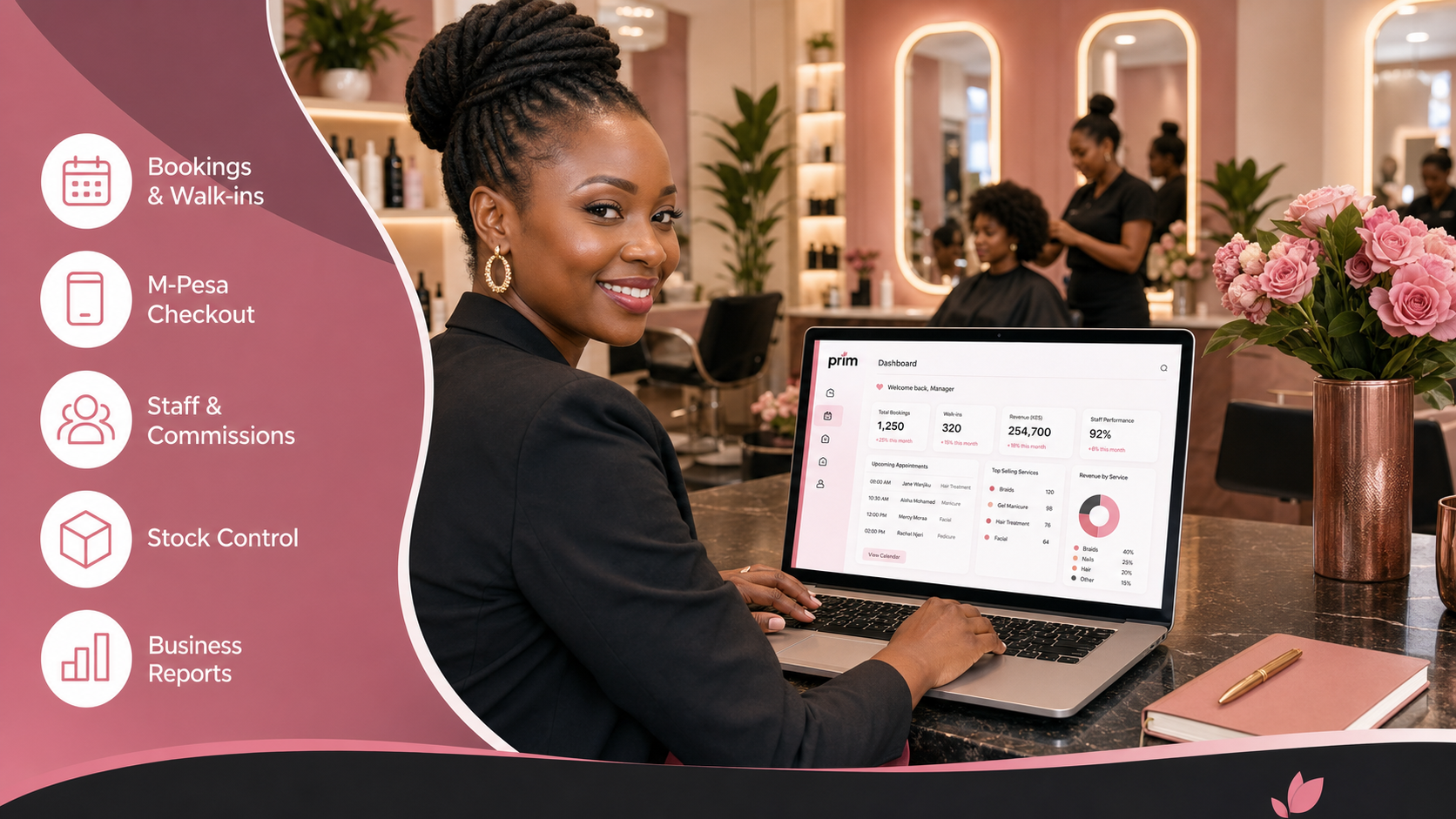
Tag: best Salon Management Software Kenya

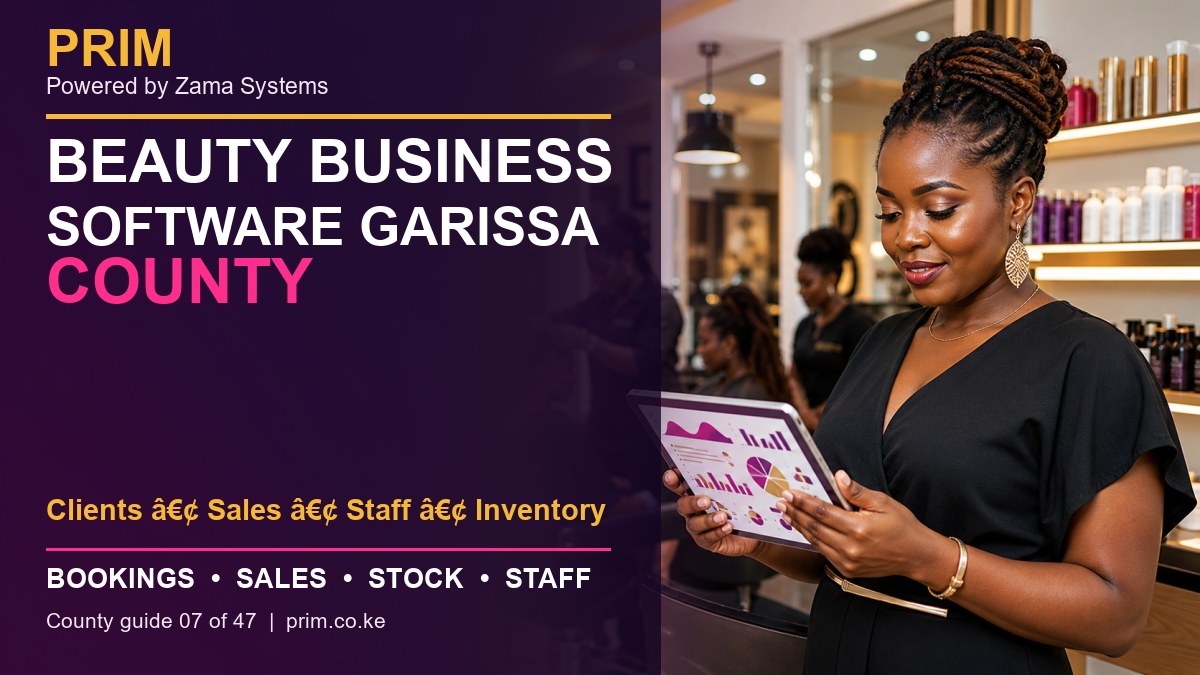
  • Beauty Business Software Garissa County: Bookings, POS, Stock and Staff

    Beauty Business Software Garissa County: Bookings, POS, Stock and Staff

    Beauty Business Software Garissa County is designed for owners searching for a practical way to manage clients, sales, staff, inventory across Garissa Town, Dadaab, Balambala and Hulugho. PRIM gives beauty business businesses a mobile-first operating system for the daily work that protects revenue and client trust.
    Beauty Business Software Garissa County
    Beauty Business Software Garissa County county guide by PRIM, Powered by Zama Systems.

    Powered by Zama Systems. PRIM combines beauty and wellness workflows with Kenyan implementation experience, role-based access, local payment realities and scalable business automation.

    Request a PRIM demo for Garissa County

    Bring your service list, staff structure, payment methods, stock challenges and current booking process. See PRIM using your own workflow.

    Why businesses in Garissa County need management software

    growing beauty businesses need one place to control customer records, employee work, sales and fast-moving products. The problem is rarely a lack of effort. It is that appointments, payments, products and employee work are recorded in different places.

    Businesses serving Garissa Town, Dadaab, Balambala and Hulugho need fast answers: who is booked, which professional is available, what the client bought, how they paid, what stock moved and whether the day closed correctly. PRIM brings those answers into one system.

    Connect the full salon client journey

    PRIM links enquiry, appointment, arrival, service, payment, stock movement and follow-up. Reception, service staff and management work from one controlled record rather than separate diaries, phones and spreadsheets.

    Services can be assigned to employees, payments separated by method, products deducted and repeat-client history retained for better service.

    What buyers should expect from Beauty Business Software Garissa County

    • Shared booking calendar: appointments, reschedules, confirmations and walk-ins should be visible to authorized team members.
    • Client profiles: visit history and preferences help teams provide consistent service and relevant follow-up.
    • POS and M-Pesa records: services and products should connect to the payment method and employee responsible.
    • Stock control: purchases, retail sales, service consumption and adjustments should create a reviewable trail.
    • Staff accountability: schedules, service totals and commissions should come from completed transactions.
    • Owner reports: managers should see sales, payments, stock and performance without rebuilding spreadsheets.

    Local rollout plan for a Garissa business

    1. Map the current day

    Follow one client from enquiry to booking, arrival, service, checkout and next visit. Mark every delay, duplicate entry and decision that depends on one person’s memory.

    2. Clean the service menu

    Confirm service names, prices, duration, required skills and whether a deposit is needed. Consistent setup prevents calendar conflicts and misleading reports.

    3. Verify products and opening stock

    Separate products sold to clients from products consumed during services. Count the opening balance and assign responsibility for receiving and adjustments.

    4. Define roles

    Decide who can discount, refund, edit stock, view commissions, export reports and change prices. Do not give every user full administrator access.

    5. Train with real scenarios

    Practice a walk-in, reschedule, split payment, package redemption, staff substitution, product sale and closing mismatch before going live.

    How PRIM reduces common revenue leaks

    Missed bookings reduce chair or room utilization. Unrecorded services weaken sales reports. Product usage without stock entries hides loss. Informal commission calculations create disputes. PRIM provides a transaction trail so management can identify the process causing the problem.

    Software does not replace leadership. Owners should review the first weeks closely, compare reports with M-Pesa, cash and physical stock, then correct setup or training gaps quickly.

    Questions to ask during the demonstration

    • Can PRIM handle both appointments and walk-ins?
    • Can services have different durations, prices and skill requirements?
    • How are cash, M-Pesa and other payment methods separated?
    • Can stock used during services be distinguished from retail sales?
    • Can commission reports be traced to individual transactions?
    • Can the platform support a future branch elsewhere in Garissa County?
    • What onboarding, training and support are included?

    Frequently asked questions

    Is PRIM suitable for a small business?

    Yes. A small team can begin with essential booking, POS, client and stock workflows, then add more controls as the business grows.

    Does PRIM support M-Pesa?

    PRIM can organize payment records by method. The exact integration or reconciliation scope should be confirmed during the demo.

    Can PRIM manage commissions?

    PRIM can support documented commission rules and transaction-level review. Complex rules should be tested before launch.

    Can an owner check reports remotely?

    PRIM is built to improve management visibility. Access and permissions should be configured around the owner’s security requirements.

    How long does setup take?

    Timing depends on data quality, number of users, stock items, integrations, branches and training needs. A focused discovery produces the most reliable estimate.

    Explore PRIM in other counties

    View the national PRIM salon, spa, barber, beauty, wellness and gym management platform. PRIM is Powered by Zama Systems.

    Grow with better records

    Request a focused demonstration of Beauty Business Software Garissa County. Start with PRIM.
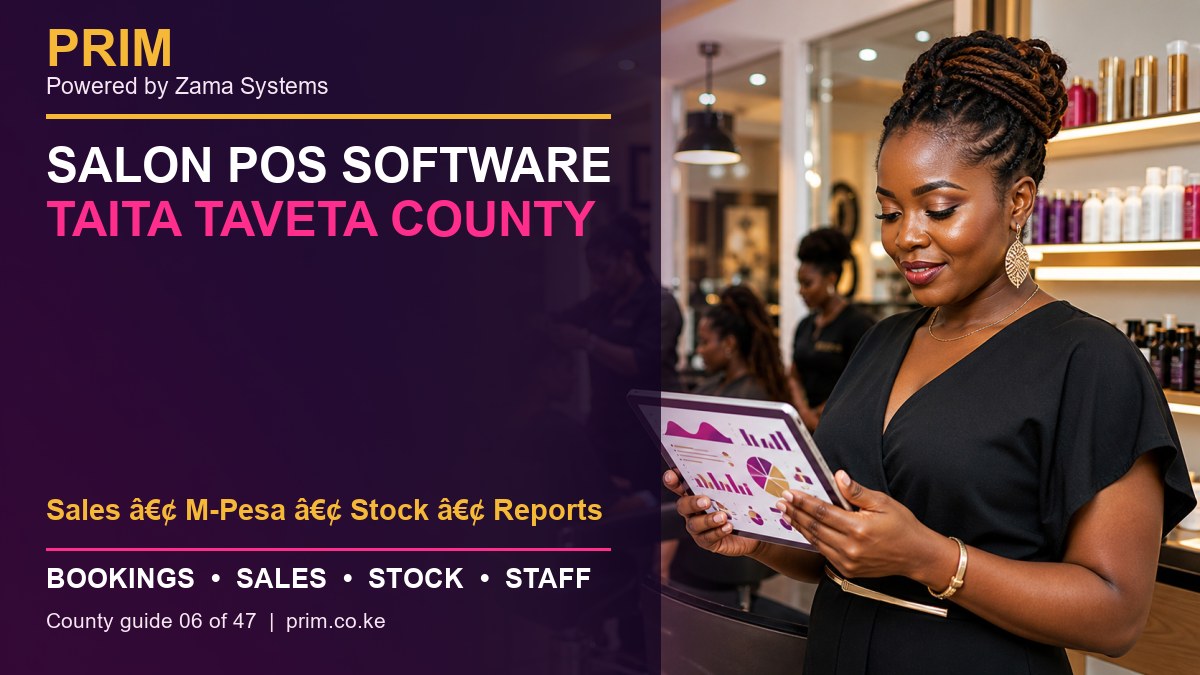
  • Salon POS Software Taita Taveta County: Bookings, POS, Stock and Staff

    Salon POS Software Taita Taveta County: Bookings, POS, Stock and Staff

    Salon POS Software Taita Taveta County is designed for owners searching for a practical way to manage sales, m-pesa, stock, reports across Voi, Taveta, Mwatate and Wundanyi. PRIM gives salon businesses a mobile-first operating system for the daily work that protects revenue and client trust.

    Salon POS Software Taita Taveta County
    Salon POS Software Taita Taveta County county guide by PRIM, Powered by Zama Systems.

    Powered by Zama Systems. PRIM combines beauty and wellness workflows with Kenyan implementation experience, role-based access, local payment realities and scalable business automation.

    Request a PRIM demo for Taita Taveta County

    Bring your service list, staff structure, payment methods, stock challenges and current booking process. See PRIM using your own workflow.

    Why businesses in Taita Taveta County need management software

    owners need service and retail sales connected to M-Pesa, cash, stock movements and daily closing reports. The problem is rarely a lack of effort. It is that appointments, payments, products and employee work are recorded in different places.

    Businesses serving Voi, Taveta, Mwatate and Wundanyi need fast answers: who is booked, which professional is available, what the client bought, how they paid, what stock moved and whether the day closed correctly. PRIM brings those answers into one system.

    Connect the full salon client journey

    PRIM links enquiry, appointment, arrival, service, payment, stock movement and follow-up. Reception, service staff and management work from one controlled record rather than separate diaries, phones and spreadsheets.

    Services can be assigned to employees, payments separated by method, products deducted and repeat-client history retained for better service.

    What buyers should expect from Salon POS Software Taita Taveta County

    • Shared booking calendar: appointments, reschedules, confirmations and walk-ins should be visible to authorized team members.
    • Client profiles: visit history and preferences help teams provide consistent service and relevant follow-up.
    • POS and M-Pesa records: services and products should connect to the payment method and employee responsible.
    • Stock control: purchases, retail sales, service consumption and adjustments should create a reviewable trail.
    • Staff accountability: schedules, service totals and commissions should come from completed transactions.
    • Owner reports: managers should see sales, payments, stock and performance without rebuilding spreadsheets.

    Local rollout plan for a Taita Taveta business

    1. Map the current day

    Follow one client from enquiry to booking, arrival, service, checkout and next visit. Mark every delay, duplicate entry and decision that depends on one person’s memory.

    2. Clean the service menu

    Confirm service names, prices, duration, required skills and whether a deposit is needed. Consistent setup prevents calendar conflicts and misleading reports.

    3. Verify products and opening stock

    Separate products sold to clients from products consumed during services. Count the opening balance and assign responsibility for receiving and adjustments.

    4. Define roles

    Decide who can discount, refund, edit stock, view commissions, export reports and change prices. Do not give every user full administrator access.

    5. Train with real scenarios

    Practice a walk-in, reschedule, split payment, package redemption, staff substitution, product sale and closing mismatch before going live.

    How PRIM reduces common revenue leaks

    Missed bookings reduce chair or room utilization. Unrecorded services weaken sales reports. Product usage without stock entries hides loss. Informal commission calculations create disputes. PRIM provides a transaction trail so management can identify the process causing the problem.

    Software does not replace leadership. Owners should review the first weeks closely, compare reports with M-Pesa, cash and physical stock, then correct setup or training gaps quickly.

    Questions to ask during the demonstration

    • Can PRIM handle both appointments and walk-ins?
    • Can services have different durations, prices and skill requirements?
    • How are cash, M-Pesa and other payment methods separated?
    • Can stock used during services be distinguished from retail sales?
    • Can commission reports be traced to individual transactions?
    • Can the platform support a future branch elsewhere in Taita Taveta County?
    • What onboarding, training and support are included?

    Frequently asked questions

    Is PRIM suitable for a small business?

    Yes. A small team can begin with essential booking, POS, client and stock workflows, then add more controls as the business grows.

    Does PRIM support M-Pesa?

    PRIM can organize payment records by method. The exact integration or reconciliation scope should be confirmed during the demo.

    Can PRIM manage commissions?

    PRIM can support documented commission rules and transaction-level review. Complex rules should be tested before launch.

    Can an owner check reports remotely?

    PRIM is built to improve management visibility. Access and permissions should be configured around the owner’s security requirements.

    How long does setup take?

    Timing depends on data quality, number of users, stock items, integrations, branches and training needs. A focused discovery produces the most reliable estimate.

    Explore PRIM in other counties

    View the national PRIM salon, spa, barber, beauty, wellness and gym management platform. PRIM is Powered by Zama Systems.

    Grow with better records

    Request a focused demonstration of Salon POS Software Taita Taveta County. Start with PRIM.

  • Spa Booking Software Lamu County: Bookings, POS, Stock and Staff

    Spa Booking Software Lamu County: Bookings, POS, Stock and Staff

    Spa Booking Software Lamu County is designed for owners searching for a practical way to manage treatments, rooms, guests, packages across Lamu Town, Mpeketoni, Mokowe and Shela. PRIM gives spa businesses a mobile-first operating system for the daily work that protects revenue and client trust.

    Spa Booking Software Lamu County
    Spa Booking Software Lamu County county guide by PRIM, Powered by Zama Systems.

    Powered by Zama Systems. PRIM combines beauty and wellness workflows with Kenyan implementation experience, role-based access, local payment realities and scalable business automation.

    Request a PRIM demo for Lamu County

    Bring your service list, staff structure, payment methods, stock challenges and current booking process. See PRIM using your own workflow.

    Why businesses in Lamu County need management software

    boutique spas and wellness providers need to coordinate guest bookings, rooms, therapists and packages without relying on separate diaries. The problem is rarely a lack of effort. It is that appointments, payments, products and employee work are recorded in different places.

    Businesses serving Lamu Town, Mpeketoni, Mokowe and Shela need fast answers: who is booked, which professional is available, what the client bought, how they paid, what stock moved and whether the day closed correctly. PRIM brings those answers into one system.

    Coordinate treatments, therapists, rooms and packages

    A spa booking reserves more than a time slot. It may require a qualified therapist, treatment room, equipment and consumable products. PRIM helps reception confirm availability before promising a client a specific time.

    Package and membership balances should update when a treatment is completed. Role permissions protect private client information while managers retain the reporting needed to run the business.

    What buyers should expect from Spa Booking Software Lamu County

    • Shared booking calendar: appointments, reschedules, confirmations and walk-ins should be visible to authorized team members.
    • Client profiles: visit history and preferences help teams provide consistent service and relevant follow-up.
    • POS and M-Pesa records: services and products should connect to the payment method and employee responsible.
    • Stock control: purchases, retail sales, service consumption and adjustments should create a reviewable trail.
    • Staff accountability: schedules, service totals and commissions should come from completed transactions.
    • Owner reports: managers should see sales, payments, stock and performance without rebuilding spreadsheets.

    Local rollout plan for a Lamu business

    1. Map the current day

    Follow one client from enquiry to booking, arrival, service, checkout and next visit. Mark every delay, duplicate entry and decision that depends on one person’s memory.

    2. Clean the service menu

    Confirm service names, prices, duration, required skills and whether a deposit is needed. Consistent setup prevents calendar conflicts and misleading reports.

    3. Verify products and opening stock

    Separate products sold to clients from products consumed during services. Count the opening balance and assign responsibility for receiving and adjustments.

    4. Define roles

    Decide who can discount, refund, edit stock, view commissions, export reports and change prices. Do not give every user full administrator access.

    5. Train with real scenarios

    Practice a walk-in, reschedule, split payment, package redemption, staff substitution, product sale and closing mismatch before going live.

    How PRIM reduces common revenue leaks

    Missed bookings reduce chair or room utilization. Unrecorded services weaken sales reports. Product usage without stock entries hides loss. Informal commission calculations create disputes. PRIM provides a transaction trail so management can identify the process causing the problem.

    Software does not replace leadership. Owners should review the first weeks closely, compare reports with M-Pesa, cash and physical stock, then correct setup or training gaps quickly.

    Questions to ask during the demonstration

    • Can PRIM handle both appointments and walk-ins?
    • Can services have different durations, prices and skill requirements?
    • How are cash, M-Pesa and other payment methods separated?
    • Can stock used during services be distinguished from retail sales?
    • Can commission reports be traced to individual transactions?
    • Can the platform support a future branch elsewhere in Lamu County?
    • What onboarding, training and support are included?

    Frequently asked questions

    Is PRIM suitable for a small business?

    Yes. A small team can begin with essential booking, POS, client and stock workflows, then add more controls as the business grows.

    Does PRIM support M-Pesa?

    PRIM can organize payment records by method. The exact integration or reconciliation scope should be confirmed during the demo.

    Can PRIM manage commissions?

    PRIM can support documented commission rules and transaction-level review. Complex rules should be tested before launch.

    Can an owner check reports remotely?

    PRIM is built to improve management visibility. Access and permissions should be configured around the owner’s security requirements.

    How long does setup take?

    Timing depends on data quality, number of users, stock items, integrations, branches and training needs. A focused discovery produces the most reliable estimate.

    Explore PRIM in other counties

    View the national PRIM salon, spa, barber, beauty, wellness and gym management platform. PRIM is Powered by Zama Systems.

    Grow with better records

    Request a focused demonstration of Spa Booking Software Lamu County. Start with PRIM.

  • Salon Booking Software Tana River County: Bookings, POS, Stock and Staff

    Salon Booking Software Tana River County: Bookings, POS, Stock and Staff

    Salon Booking Software Tana River County is designed for owners searching for a practical way to manage appointments, walk-ins, clients, payments across Hola, Garsen, Bura and surrounding trading centres. PRIM gives salon businesses a mobile-first operating system for the daily work that protects revenue and client trust.

    Salon Booking Software Tana River County
    Salon Booking Software Tana River County county guide by PRIM, Powered by Zama Systems.

    Powered by Zama Systems. PRIM combines beauty and wellness workflows with Kenyan implementation experience, role-based access, local payment realities and scalable business automation.

    Request a PRIM demo for Tana River County

    Bring your service list, staff structure, payment methods, stock challenges and current booking process. See PRIM using your own workflow.

    Why businesses in Tana River County need management software

    small teams need a simple mobile-first calendar that works for advance appointments, walk-ins and customer follow-up. The problem is rarely a lack of effort. It is that appointments, payments, products and employee work are recorded in different places.

    Businesses serving Hola, Garsen, Bura and surrounding trading centres need fast answers: who is booked, which professional is available, what the client bought, how they paid, what stock moved and whether the day closed correctly. PRIM brings those answers into one system.

    Connect the full salon client journey

    PRIM links enquiry, appointment, arrival, service, payment, stock movement and follow-up. Reception, service staff and management work from one controlled record rather than separate diaries, phones and spreadsheets.

    Services can be assigned to employees, payments separated by method, products deducted and repeat-client history retained for better service.

    What buyers should expect from Salon Booking Software Tana River County

    • Shared booking calendar: appointments, reschedules, confirmations and walk-ins should be visible to authorized team members.
    • Client profiles: visit history and preferences help teams provide consistent service and relevant follow-up.
    • POS and M-Pesa records: services and products should connect to the payment method and employee responsible.
    • Stock control: purchases, retail sales, service consumption and adjustments should create a reviewable trail.
    • Staff accountability: schedules, service totals and commissions should come from completed transactions.
    • Owner reports: managers should see sales, payments, stock and performance without rebuilding spreadsheets.

    Local rollout plan for a Tana River business

    1. Map the current day

    Follow one client from enquiry to booking, arrival, service, checkout and next visit. Mark every delay, duplicate entry and decision that depends on one person’s memory.

    2. Clean the service menu

    Confirm service names, prices, duration, required skills and whether a deposit is needed. Consistent setup prevents calendar conflicts and misleading reports.

    3. Verify products and opening stock

    Separate products sold to clients from products consumed during services. Count the opening balance and assign responsibility for receiving and adjustments.

    4. Define roles

    Decide who can discount, refund, edit stock, view commissions, export reports and change prices. Do not give every user full administrator access.

    5. Train with real scenarios

    Practice a walk-in, reschedule, split payment, package redemption, staff substitution, product sale and closing mismatch before going live.

    How PRIM reduces common revenue leaks

    Missed bookings reduce chair or room utilization. Unrecorded services weaken sales reports. Product usage without stock entries hides loss. Informal commission calculations create disputes. PRIM provides a transaction trail so management can identify the process causing the problem.

    Software does not replace leadership. Owners should review the first weeks closely, compare reports with M-Pesa, cash and physical stock, then correct setup or training gaps quickly.

    Questions to ask during the demonstration

    • Can PRIM handle both appointments and walk-ins?
    • Can services have different durations, prices and skill requirements?
    • How are cash, M-Pesa and other payment methods separated?
    • Can stock used during services be distinguished from retail sales?
    • Can commission reports be traced to individual transactions?
    • Can the platform support a future branch elsewhere in Tana River County?
    • What onboarding, training and support are included?

    Frequently asked questions

    Is PRIM suitable for a small business?

    Yes. A small team can begin with essential booking, POS, client and stock workflows, then add more controls as the business grows.

    Does PRIM support M-Pesa?

    PRIM can organize payment records by method. The exact integration or reconciliation scope should be confirmed during the demo.

    Can PRIM manage commissions?

    PRIM can support documented commission rules and transaction-level review. Complex rules should be tested before launch.

    Can an owner check reports remotely?

    PRIM is built to improve management visibility. Access and permissions should be configured around the owner’s security requirements.

    How long does setup take?

    Timing depends on data quality, number of users, stock items, integrations, branches and training needs. A focused discovery produces the most reliable estimate.

    Explore PRIM in other counties

    View the national PRIM salon, spa, barber, beauty, wellness and gym management platform. PRIM is Powered by Zama Systems.

    Grow with better records

    Request a focused demonstration of Salon Booking Software Tana River County. Start with PRIM.

  • Salon Management Software Kilifi County: Bookings, POS, Stock and Staff

    Salon Management Software Kilifi County: Bookings, POS, Stock and Staff

    Salon Management Software Kilifi County is designed for owners searching for a practical way to manage bookings, pos, stock, staff across Kilifi Town, Malindi, Mtwapa, Mariakani and Watamu. PRIM gives salon businesses a mobile-first operating system for the daily work that protects revenue and client trust.

    Salon Management Software Kilifi County
    Salon Management Software Kilifi County county guide by PRIM, Powered by Zama Systems.

    Powered by Zama Systems. PRIM combines beauty and wellness workflows with Kenyan implementation experience, role-based access, local payment realities and scalable business automation.

    Request a PRIM demo for Kilifi County

    Bring your service list, staff structure, payment methods, stock challenges and current booking process. See PRIM using your own workflow.

    Why businesses in Kilifi County need management software

    salons spread across growing coastal towns need consistent prices, staff accountability, stock visibility and customer history. The problem is rarely a lack of effort. It is that appointments, payments, products and employee work are recorded in different places.

    Businesses serving Kilifi Town, Malindi, Mtwapa, Mariakani and Watamu need fast answers: who is booked, which professional is available, what the client bought, how they paid, what stock moved and whether the day closed correctly. PRIM brings those answers into one system.

    Connect the full salon client journey

    PRIM links enquiry, appointment, arrival, service, payment, stock movement and follow-up. Reception, service staff and management work from one controlled record rather than separate diaries, phones and spreadsheets.

    Services can be assigned to employees, payments separated by method, products deducted and repeat-client history retained for better service.

    What buyers should expect from Salon Management Software Kilifi County

    • Shared booking calendar: appointments, reschedules, confirmations and walk-ins should be visible to authorized team members.
    • Client profiles: visit history and preferences help teams provide consistent service and relevant follow-up.
    • POS and M-Pesa records: services and products should connect to the payment method and employee responsible.
    • Stock control: purchases, retail sales, service consumption and adjustments should create a reviewable trail.
    • Staff accountability: schedules, service totals and commissions should come from completed transactions.
    • Owner reports: managers should see sales, payments, stock and performance without rebuilding spreadsheets.

    Local rollout plan for a Kilifi business

    1. Map the current day

    Follow one client from enquiry to booking, arrival, service, checkout and next visit. Mark every delay, duplicate entry and decision that depends on one person’s memory.

    2. Clean the service menu

    Confirm service names, prices, duration, required skills and whether a deposit is needed. Consistent setup prevents calendar conflicts and misleading reports.

    3. Verify products and opening stock

    Separate products sold to clients from products consumed during services. Count the opening balance and assign responsibility for receiving and adjustments.

    4. Define roles

    Decide who can discount, refund, edit stock, view commissions, export reports and change prices. Do not give every user full administrator access.

    5. Train with real scenarios

    Practice a walk-in, reschedule, split payment, package redemption, staff substitution, product sale and closing mismatch before going live.

    How PRIM reduces common revenue leaks

    Missed bookings reduce chair or room utilization. Unrecorded services weaken sales reports. Product usage without stock entries hides loss. Informal commission calculations create disputes. PRIM provides a transaction trail so management can identify the process causing the problem.

    Software does not replace leadership. Owners should review the first weeks closely, compare reports with M-Pesa, cash and physical stock, then correct setup or training gaps quickly.

    Questions to ask during the demonstration

    • Can PRIM handle both appointments and walk-ins?
    • Can services have different durations, prices and skill requirements?
    • How are cash, M-Pesa and other payment methods separated?
    • Can stock used during services be distinguished from retail sales?
    • Can commission reports be traced to individual transactions?
    • Can the platform support a future branch elsewhere in Kilifi County?
    • What onboarding, training and support are included?

    Frequently asked questions

    Is PRIM suitable for a small business?

    Yes. A small team can begin with essential booking, POS, client and stock workflows, then add more controls as the business grows.

    Does PRIM support M-Pesa?

    PRIM can organize payment records by method. The exact integration or reconciliation scope should be confirmed during the demo.

    Can PRIM manage commissions?

    PRIM can support documented commission rules and transaction-level review. Complex rules should be tested before launch.

    Can an owner check reports remotely?

    PRIM is built to improve management visibility. Access and permissions should be configured around the owner’s security requirements.

    How long does setup take?

    Timing depends on data quality, number of users, stock items, integrations, branches and training needs. A focused discovery produces the most reliable estimate.

    Explore PRIM in other counties

    View the national PRIM salon, spa, barber, beauty, wellness and gym management platform. PRIM is Powered by Zama Systems.

    Grow with better records

    Request a focused demonstration of Salon Management Software Kilifi County. Start with PRIM.

  • Beauty Salon Software Kwale County: Bookings, POS, Stock and Staff

    Beauty Salon Software Kwale County: Bookings, POS, Stock and Staff

    Beauty Salon Software Kwale County is designed for owners searching for a practical way to manage bookings, clients, stock, m-pesa across Ukunda, Diani, Msambweni, Kinango and Kwale Town. PRIM gives beauty salon businesses a mobile-first operating system for the daily work that protects revenue and client trust.

    Beauty Salon Software Kwale County
    Beauty Salon Software Kwale County county guide by PRIM, Powered by Zama Systems.

    Powered by Zama Systems. PRIM combines beauty and wellness workflows with Kenyan implementation experience, role-based access, local payment realities and scalable business automation.

    Request a PRIM demo for Kwale County

    Bring your service list, staff structure, payment methods, stock challenges and current booking process. See PRIM using your own workflow.

    Why businesses in Kwale County need management software

    salons serving residents and tourism-linked customers need reliable bookings, product control and follow-up across busy and quiet seasons. The problem is rarely a lack of effort. It is that appointments, payments, products and employee work are recorded in different places.

    Businesses serving Ukunda, Diani, Msambweni, Kinango and Kwale Town need fast answers: who is booked, which professional is available, what the client bought, how they paid, what stock moved and whether the day closed correctly. PRIM brings those answers into one system.

    Connect the full salon client journey

    PRIM links enquiry, appointment, arrival, service, payment, stock movement and follow-up. Reception, service staff and management work from one controlled record rather than separate diaries, phones and spreadsheets.

    Services can be assigned to employees, payments separated by method, products deducted and repeat-client history retained for better service.

    What buyers should expect from Beauty Salon Software Kwale County

    • Shared booking calendar: appointments, reschedules, confirmations and walk-ins should be visible to authorized team members.
    • Client profiles: visit history and preferences help teams provide consistent service and relevant follow-up.
    • POS and M-Pesa records: services and products should connect to the payment method and employee responsible.
    • Stock control: purchases, retail sales, service consumption and adjustments should create a reviewable trail.
    • Staff accountability: schedules, service totals and commissions should come from completed transactions.
    • Owner reports: managers should see sales, payments, stock and performance without rebuilding spreadsheets.

    Local rollout plan for a Kwale business

    1. Map the current day

    Follow one client from enquiry to booking, arrival, service, checkout and next visit. Mark every delay, duplicate entry and decision that depends on one person’s memory.

    2. Clean the service menu

    Confirm service names, prices, duration, required skills and whether a deposit is needed. Consistent setup prevents calendar conflicts and misleading reports.

    3. Verify products and opening stock

    Separate products sold to clients from products consumed during services. Count the opening balance and assign responsibility for receiving and adjustments.

    4. Define roles

    Decide who can discount, refund, edit stock, view commissions, export reports and change prices. Do not give every user full administrator access.

    5. Train with real scenarios

    Practice a walk-in, reschedule, split payment, package redemption, staff substitution, product sale and closing mismatch before going live.

    How PRIM reduces common revenue leaks

    Missed bookings reduce chair or room utilization. Unrecorded services weaken sales reports. Product usage without stock entries hides loss. Informal commission calculations create disputes. PRIM provides a transaction trail so management can identify the process causing the problem.

    Software does not replace leadership. Owners should review the first weeks closely, compare reports with M-Pesa, cash and physical stock, then correct setup or training gaps quickly.

    Questions to ask during the demonstration

    • Can PRIM handle both appointments and walk-ins?
    • Can services have different durations, prices and skill requirements?
    • How are cash, M-Pesa and other payment methods separated?
    • Can stock used during services be distinguished from retail sales?
    • Can commission reports be traced to individual transactions?
    • Can the platform support a future branch elsewhere in Kwale County?
    • What onboarding, training and support are included?

    Frequently asked questions

    Is PRIM suitable for a small business?

    Yes. A small team can begin with essential booking, POS, client and stock workflows, then add more controls as the business grows.

    Does PRIM support M-Pesa?

    PRIM can organize payment records by method. The exact integration or reconciliation scope should be confirmed during the demo.

    Can PRIM manage commissions?

    PRIM can support documented commission rules and transaction-level review. Complex rules should be tested before launch.

    Can an owner check reports remotely?

    PRIM is built to improve management visibility. Access and permissions should be configured around the owner’s security requirements.

    How long does setup take?

    Timing depends on data quality, number of users, stock items, integrations, branches and training needs. A focused discovery produces the most reliable estimate.

    Explore PRIM in other counties

    View the national PRIM salon, spa, barber, beauty, wellness and gym management platform. PRIM is Powered by Zama Systems.

    Grow with better records

    Request a focused demonstration of Beauty Salon Software Kwale County. Start with PRIM.

  • Spa Management Software Mombasa County: Bookings, POS, Stock and Staff

    Spa Management Software Mombasa County: Bookings, POS, Stock and Staff

    Spa Management Software Mombasa County is designed for owners searching for a practical way to manage appointments, therapists, packages, payments across Mombasa Island, Nyali, Likoni, Changamwe and Mvita. PRIM gives spa businesses a mobile-first operating system for the daily work that protects revenue and client trust.

    Spa Management Software Mombasa County
    Spa Management Software Mombasa County county guide by PRIM, Powered by Zama Systems.

    Powered by Zama Systems. PRIM combines beauty and wellness workflows with Kenyan implementation experience, role-based access, local payment realities and scalable business automation.

    Request a PRIM demo for Mombasa County

    Bring your service list, staff structure, payment methods, stock challenges and current booking process. See PRIM using your own workflow.

    Why businesses in Mombasa County need management software

    coastal spas and hotel wellness businesses need room schedules, therapist availability, guest packages and retail sales in one record. The problem is rarely a lack of effort. It is that appointments, payments, products and employee work are recorded in different places.

    Businesses serving Mombasa Island, Nyali, Likoni, Changamwe and Mvita need fast answers: who is booked, which professional is available, what the client bought, how they paid, what stock moved and whether the day closed correctly. PRIM brings those answers into one system.

    Coordinate treatments, therapists, rooms and packages

    A spa booking reserves more than a time slot. It may require a qualified therapist, treatment room, equipment and consumable products. PRIM helps reception confirm availability before promising a client a specific time.

    Package and membership balances should update when a treatment is completed. Role permissions protect private client information while managers retain the reporting needed to run the business.

    What buyers should expect from Spa Management Software Mombasa County

    • Shared booking calendar: appointments, reschedules, confirmations and walk-ins should be visible to authorized team members.
    • Client profiles: visit history and preferences help teams provide consistent service and relevant follow-up.
    • POS and M-Pesa records: services and products should connect to the payment method and employee responsible.
    • Stock control: purchases, retail sales, service consumption and adjustments should create a reviewable trail.
    • Staff accountability: schedules, service totals and commissions should come from completed transactions.
    • Owner reports: managers should see sales, payments, stock and performance without rebuilding spreadsheets.

    Local rollout plan for a Mombasa business

    1. Map the current day

    Follow one client from enquiry to booking, arrival, service, checkout and next visit. Mark every delay, duplicate entry and decision that depends on one person’s memory.

    2. Clean the service menu

    Confirm service names, prices, duration, required skills and whether a deposit is needed. Consistent setup prevents calendar conflicts and misleading reports.

    3. Verify products and opening stock

    Separate products sold to clients from products consumed during services. Count the opening balance and assign responsibility for receiving and adjustments.

    4. Define roles

    Decide who can discount, refund, edit stock, view commissions, export reports and change prices. Do not give every user full administrator access.

    5. Train with real scenarios

    Practice a walk-in, reschedule, split payment, package redemption, staff substitution, product sale and closing mismatch before going live.

    How PRIM reduces common revenue leaks

    Missed bookings reduce chair or room utilization. Unrecorded services weaken sales reports. Product usage without stock entries hides loss. Informal commission calculations create disputes. PRIM provides a transaction trail so management can identify the process causing the problem.

    Software does not replace leadership. Owners should review the first weeks closely, compare reports with M-Pesa, cash and physical stock, then correct setup or training gaps quickly.

    Questions to ask during the demonstration

    • Can PRIM handle both appointments and walk-ins?
    • Can services have different durations, prices and skill requirements?
    • How are cash, M-Pesa and other payment methods separated?
    • Can stock used during services be distinguished from retail sales?
    • Can commission reports be traced to individual transactions?
    • Can the platform support a future branch elsewhere in Mombasa County?
    • What onboarding, training and support are included?

    Frequently asked questions

    Is PRIM suitable for a small business?

    Yes. A small team can begin with essential booking, POS, client and stock workflows, then add more controls as the business grows.

    Does PRIM support M-Pesa?

    PRIM can organize payment records by method. The exact integration or reconciliation scope should be confirmed during the demo.

    Can PRIM manage commissions?

    PRIM can support documented commission rules and transaction-level review. Complex rules should be tested before launch.

    Can an owner check reports remotely?

    PRIM is built to improve management visibility. Access and permissions should be configured around the owner’s security requirements.

    How long does setup take?

    Timing depends on data quality, number of users, stock items, integrations, branches and training needs. A focused discovery produces the most reliable estimate.

    Explore PRIM in other counties

    View the national PRIM salon, spa, barber, beauty, wellness and gym management platform. PRIM is Powered by Zama Systems.

    Grow with better records

    Request a focused demonstration of Spa Management Software Mombasa County. Start with PRIM.

  • Salon Management Software: Buyer’s Guide for Kenya

    Salon Management Software: Buyer’s Guide for Kenya

    Salon management software buyer guide for Kenyan businesses by PRIM
    Compare the salon software features that matter before you buy. Call PRIM on 0725345345.

    salon management software can improve bookings, checkout and reporting, but only when it matches the way your salon works. A long feature list is not enough. The platform must be practical for receptionists, service providers, managers and owners during a busy day.

    This buyer’s guide shows Kenyan salon owners how to compare systems, test important workflows and avoid paying for software that creates more work than it removes.

    Begin with the problems you need to solve

    PRIM demonstrates how salon management software can connect appointments, checkout, staff, stock and management reporting in one workflow.

    Write down the problems that cost the salon time or money. Common examples include double bookings, missing customer details, unclear M-Pesa payments, stock shortages, slow commission calculations and reports that arrive too late.

    Rank the problems by business impact. Your first demonstration should focus on those workflows instead of allowing the vendor to show only attractive dashboard screens.

    Appointment and walk-in features

    When assessing salon management software, retail platforms such as Vega offer useful comparisons for checkout, inventory and daily sales controls.

    The calendar should show service duration, assigned staff and current status. Reception must be able to add a walk-in without disrupting scheduled appointments. Ask whether changing one booking updates employee availability immediately.

    PRIM connects scheduling with online salon booking, customer profiles and checkout so that information follows the client journey.

    POS, products and payment methods

    A broader review of salon management software can also consider how Awasam structures specialized records and operational workflows.

    Test a realistic bill containing two services, one retail product and a discount. Confirm that the system assigns the correct employee, updates stock and records the chosen payment method. A good salon POS system should make the transaction easier to verify later.

    For local payment context, salon owners can consult Safaricom’s official M-Pesa for Business resources. Software should not claim to replace the merchant’s own payment-service obligations.

    Customer records and privacy

    Good salon management software should provide the same kind of clear records and reporting visibility that RentalDesk emphasizes for property operations.

    Profiles help employees recognize returning clients and review visit history. Ask who can export, edit or delete customer information. The provider should support appropriate access controls and responsible data handling.

    The Office of the Data Protection Commissioner publishes Kenya’s data-protection laws and regulations. Review these resources when designing your customer-data process.

    Staff roles, schedules and commissions

    Reliable connectivity also affects salon management software, particularly when teams depend on cloud access across reception, service areas or branches.

    Different employees need different access. A receptionist may require bookings and checkout, while an owner needs financial and performance reports. Test role-based permissions using sample employee accounts.

    If your team earns commission, ask how refunds, discounts, shared services and incomplete payments affect calculations. PRIM’s guide to salon staff commissions explains why the underlying transaction records matter.

    Inventory and supplier control

    Owners comparing salon management software can learn from FAMA’s approach to centralized operational records, stock visibility and performance tracking.

    Salon stock includes retail products and supplies used during services. Compare how each system records purchasing, sales, stock adjustments, transfers and reorder levels. Ask whether employees can change quantities without approval.

    Reports owners should request

    Flexible salon management software may require integrations or workflow customization, areas covered by Zama’s business-systems expertise.

    • Sales by service, product, employee and payment method
    • Appointment, cancellation and no-show activity
    • Daily closing and outstanding balances
    • Product movement and low-stock items
    • Expenses, commissions and branch performance
    • Returning-customer and service-demand trends

    Ask the vendor to generate each report from the transactions entered during the demonstration. That proves the workflow and report are genuinely connected.

    Evaluate usability and support

    Consistent task and order visibility is another useful standard when selecting salon management software, as demonstrated by workflow platforms such as Saseni.

    Let the employees who will use the system participate in testing. Count how many steps it takes to book, move and check out a client. Ask what happens during setup, how data is imported and where the team gets help.

    Compare cost with business value

    Price matters, but the cheapest subscription may become expensive if it wastes employee time or lacks necessary controls. Compare the complete cost, including setup, additional users, branches, messaging, support and payment-related services.

    Warning signs to avoid

    • The provider cannot demonstrate a complete transaction.
    • Employees share one administrator account.
    • Reports do not match checkout records.
    • There is no clear process for exporting your data.
    • Every important correction requires technical support.
    • The system cannot grow beyond one employee or branch.

    Frequently asked questions

    What is the most important feature?

    The most important feature is a dependable connection between appointments, services, checkout and reports. Individual tools are less valuable when they create isolated records.

    Should a small salon buy software?

    Yes, if the salon is losing time or visibility through manual booking, payment or stock processes. Start with essential features and expand as operations grow.

    Can PRIM support multiple branches?

    PRIM provides plans for different business stages, including growing operations that require more advanced staff, inventory and branch controls.

    Choose salon software with evidence

    Good salon management software should be easy to test and easy to explain. Use your own workflow during the demonstration and require reports that reflect every sample transaction.

    Call 0725345345, start your free PRIM trial or compare PRIM plans.

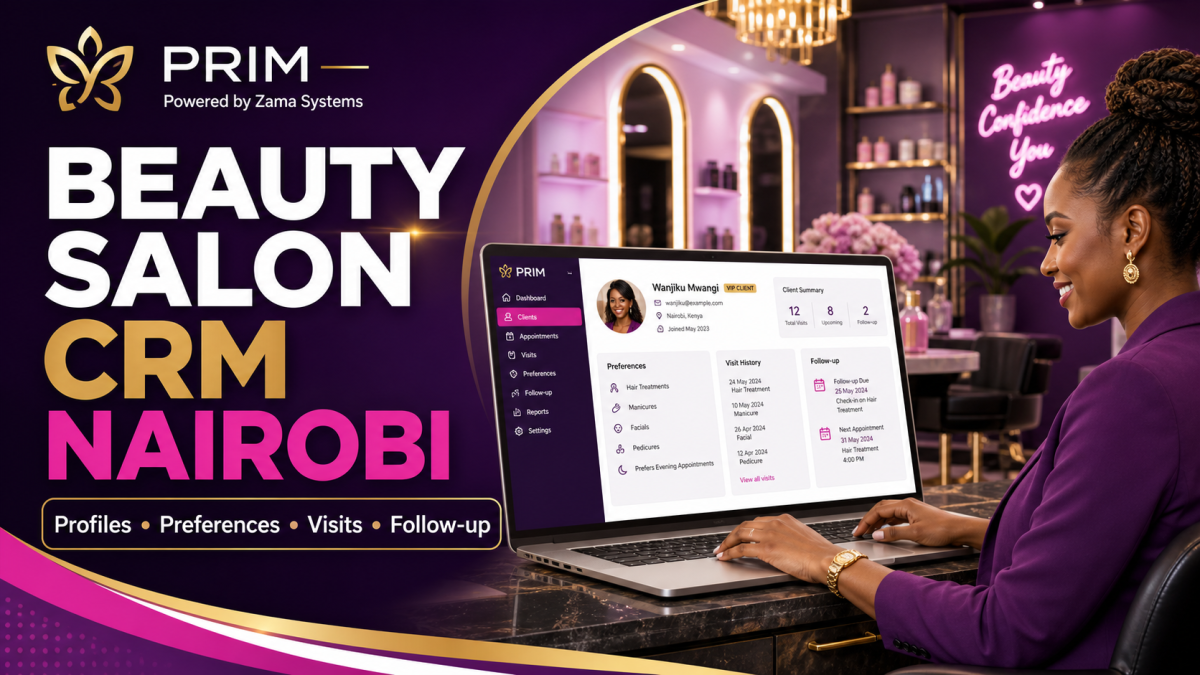
  • Beauty Salon CRM Nairobi: profiles, preferences, visit history and follow-up

    Beauty Salon CRM Nairobi: profiles, preferences, visit history and follow-up

    Beauty Salon CRM Nairobi is a purchase-intent search from an owner who wants a practical way to control profiles, preferences, visit history and follow-up. PRIM supports beauty salon businesses serving salons and beauty studios building repeat-client revenue across Nairobi with one operating record for clients, work, money, products and management decisions.

    Beauty Salon CRM Nairobi
    Beauty Salon CRM Nairobi guide by PRIM, Powered by Zama Systems.

    Powered by Zama Systems. PRIM combines beauty-industry workflows with Kenyan software implementation, mobile-first operations and support for local payment realities.

    See PRIM using your own workflow

    Bring your service list, team roles, current diary, payment methods and biggest operational leak. Request a focused PRIM demonstration.

    Why Nairobi business owners look for this software

    The visible sign of a successful beauty salon is a busy team, but activity alone does not guarantee profit. A recurring local problem is customer knowledge staying in employees’ memories and marketing messages being sent without useful segmentation or context. When records sit in notebooks, private phones, M-Pesa messages and memory, the owner receives answers late and employees follow different processes.

    PRIM creates a consistent path from enquiry to appointment, service delivery, checkout, stock movement and follow-up. This makes daily work easier to review without forcing the owner to be physically present at every transaction.

    Use client history to improve the next visit

    A client record can store visit dates, services, preferences and follow-up status. Access should be role-based and messages should remain relevant and consent-aware. The purpose is better service, not uncontrolled bulk messaging.

    Retention reporting helps the owner see which clients return, which services create loyalty and where a thoughtful reminder may be useful.

    Features buyers should test in a live PRIM demo

    • Real workflow fit: test profiles, preferences, visit history and follow-up, not only the dashboard.
    • Role permissions: reception, service staff, storekeepers and owners should see only what they need.
    • M-Pesa and cash visibility: payment method totals should connect to real sales records.
    • Audit trail: managers should be able to review changes, discounts, reversals and stock adjustments.
    • Useful reports: daily reports should answer operational questions without spreadsheet reconstruction.
    • Training and support: confirm how employees are onboarded and how issues are escalated.

    How to prepare your Nairobi business for implementation

    Document the current client journey

    Follow one client from first enquiry to booking, arrival, service, payment and next visit. Mark every duplicate entry, delay and decision that depends on one employee’s memory.

    Clean services, prices and durations

    Use consistent names and categories. Confirm which services require deposits, special skills, rooms or more time. Clean data prevents a confusing calendar and misleading reports.

    Count stock and define units

    Record a verified opening quantity. Distinguish items sold whole from products consumed across several services. Assign responsibility for receiving, adjustment and physical count approval.

    Agree staff rules

    Write permissions, discount limits, commission rules, attendance expectations and closing responsibilities before configuration. Software cannot resolve a rule the business has never agreed.

    Train with real scenarios

    Practice a walk-in, reschedule, partial payment, discount, product sale, stock adjustment and closing mismatch. Staff remember realistic exercises better than a generic feature tour.

    What success should look like after launch

    The owner should spend less time reconstructing yesterday. Reception should answer booking questions faster. Employees should understand how sales and commissions are recorded. Stock shortages should be noticed earlier, and client follow-up should use accurate visit history.

    Review the first weeks closely. Compare PRIM reports with M-Pesa, cash and physical stock, then correct setup or training gaps. A system becomes valuable through disciplined daily use, not merely because it was installed.

    Questions to ask before choosing Beauty Salon CRM Nairobi

    • Can it handle both appointments and walk-ins?
    • Can it record the exact services, durations and prices used by this business?
    • Can managers restrict refunds, discounts and stock changes?
    • Can payments be reviewed by method during closing?
    • Can commissions be traced to completed transactions?
    • Can the business add staff, services or branches later?
    • What onboarding, training and support are included?

    Frequently asked questions

    Is PRIM suitable for a small beauty salon in Nairobi?

    Yes. A small business can start with the essential workflow and add controls as the team, service list and client volume grow.

    Does PRIM support M-Pesa?

    PRIM can organize payment records by method. The exact M-Pesa integration or reconciliation scope should be confirmed during the demonstration.

    Can PRIM calculate commissions?

    PRIM can support configured commission rules and transaction-level review. Complex or changing rules should be documented and tested before launch.

    Can owners check reports away from the business?

    PRIM is designed to improve management visibility. Ask the demonstration team to show the access, permission and reporting setup suitable for your operation.

    How long does setup take?

    Timing depends on the cleanliness of services and stock data, number of users, integrations, branches and training requirements. A focused discovery produces a more reliable estimate.

    Related PRIM guides

    Explore the wider PRIM salon, spa, barber, beauty and wellness management platform. PRIM is Powered by Zama Systems, the enterprise automation and software-delivery authority.

    Ready to reduce operational leaks?

    Request a PRIM demo shaped around your beauty salon in Nairobi. Start the conversation.

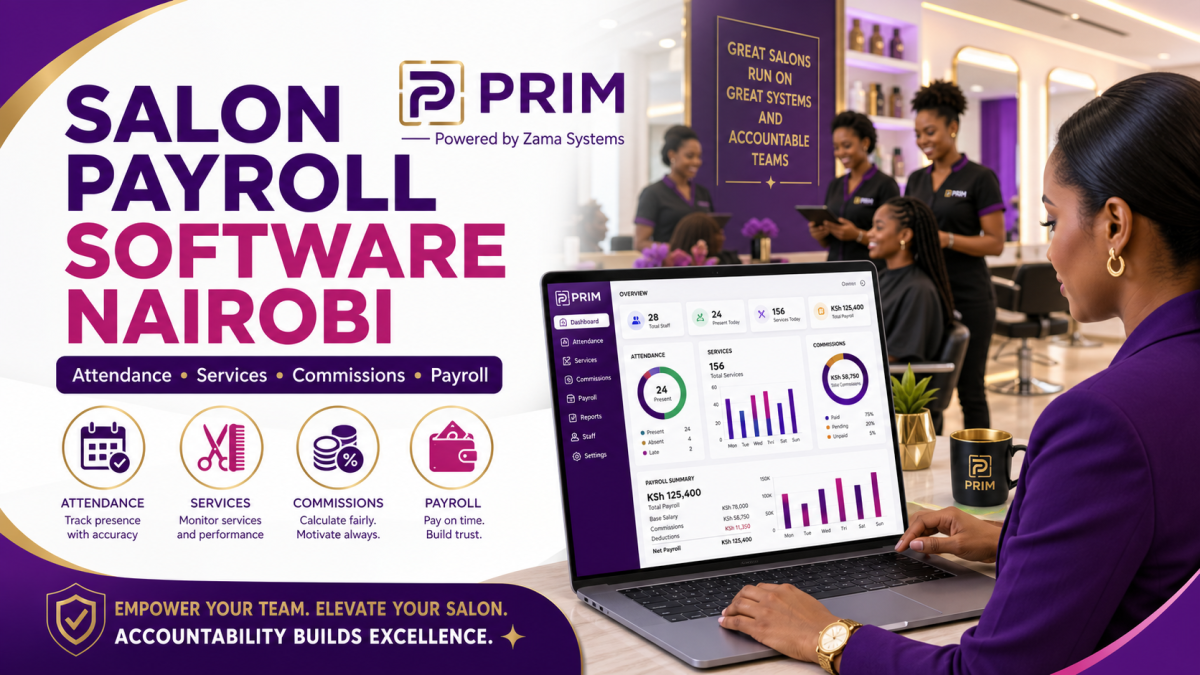
  • Salon Payroll Software Nairobi: attendance, service totals, commissions and payroll

    Salon Payroll Software Nairobi: attendance, service totals, commissions and payroll

    Salon Payroll Software Nairobi is a purchase-intent search from an owner who wants a practical way to control attendance, service totals, commissions and payroll. PRIM supports salon businesses serving salons, spas and barber businesses employing service professionals across Nairobi with one operating record for clients, work, money, products and management decisions.

    Salon Payroll Software Nairobi
    Salon Payroll Software Nairobi guide by PRIM, Powered by Zama Systems.

    Powered by Zama Systems. PRIM combines beauty-industry workflows with Kenyan software implementation, mobile-first operations and support for local payment realities.

    See PRIM using your own workflow

    Bring your service list, team roles, current diary, payment methods and biggest operational leak. Request a focused PRIM demonstration.

    Why Nairobi business owners look for this software

    The visible sign of a successful salon is a busy team, but activity alone does not guarantee profit. A recurring local problem is payroll depending on handwritten attendance and self-reported services instead of a consistent reviewed transaction record. When records sit in notebooks, private phones, M-Pesa messages and memory, the owner receives answers late and employees follow different processes.

    PRIM creates a consistent path from enquiry to appointment, service delivery, checkout, stock movement and follow-up. This makes daily work easier to review without forcing the owner to be physically present at every transaction.

    Turn service records into transparent staff pay

    Commission rules should be written before they are configured. The team must know whether rates apply before or after discounts, whether product sales qualify and how shared services are handled. PRIM provides the transaction trail required for review.

    Payroll approval should remain a management responsibility. Software improves accuracy, but a manager should still review attendance, exceptions, reversals and unusual totals.

    Features buyers should test in a live PRIM demo

    • Real workflow fit: test attendance, service totals, commissions and payroll, not only the dashboard.
    • Role permissions: reception, service staff, storekeepers and owners should see only what they need.
    • M-Pesa and cash visibility: payment method totals should connect to real sales records.
    • Audit trail: managers should be able to review changes, discounts, reversals and stock adjustments.
    • Useful reports: daily reports should answer operational questions without spreadsheet reconstruction.
    • Training and support: confirm how employees are onboarded and how issues are escalated.

    How to prepare your Nairobi business for implementation

    Document the current client journey

    Follow one client from first enquiry to booking, arrival, service, payment and next visit. Mark every duplicate entry, delay and decision that depends on one employee’s memory.

    Clean services, prices and durations

    Use consistent names and categories. Confirm which services require deposits, special skills, rooms or more time. Clean data prevents a confusing calendar and misleading reports.

    Count stock and define units

    Record a verified opening quantity. Distinguish items sold whole from products consumed across several services. Assign responsibility for receiving, adjustment and physical count approval.

    Agree staff rules

    Write permissions, discount limits, commission rules, attendance expectations and closing responsibilities before configuration. Software cannot resolve a rule the business has never agreed.

    Train with real scenarios

    Practice a walk-in, reschedule, partial payment, discount, product sale, stock adjustment and closing mismatch. Staff remember realistic exercises better than a generic feature tour.

    What success should look like after launch

    The owner should spend less time reconstructing yesterday. Reception should answer booking questions faster. Employees should understand how sales and commissions are recorded. Stock shortages should be noticed earlier, and client follow-up should use accurate visit history.

    Review the first weeks closely. Compare PRIM reports with M-Pesa, cash and physical stock, then correct setup or training gaps. A system becomes valuable through disciplined daily use, not merely because it was installed.

    Questions to ask before choosing Salon Payroll Software Nairobi

    • Can it handle both appointments and walk-ins?
    • Can it record the exact services, durations and prices used by this business?
    • Can managers restrict refunds, discounts and stock changes?
    • Can payments be reviewed by method during closing?
    • Can commissions be traced to completed transactions?
    • Can the business add staff, services or branches later?
    • What onboarding, training and support are included?

    Frequently asked questions

    Is PRIM suitable for a small salon in Nairobi?

    Yes. A small business can start with the essential workflow and add controls as the team, service list and client volume grow.

    Does PRIM support M-Pesa?

    PRIM can organize payment records by method. The exact M-Pesa integration or reconciliation scope should be confirmed during the demonstration.

    Can PRIM calculate commissions?

    PRIM can support configured commission rules and transaction-level review. Complex or changing rules should be documented and tested before launch.

    Can owners check reports away from the business?

    PRIM is designed to improve management visibility. Ask the demonstration team to show the access, permission and reporting setup suitable for your operation.

    How long does setup take?

    Timing depends on the cleanliness of services and stock data, number of users, integrations, branches and training requirements. A focused discovery produces a more reliable estimate.

    Related PRIM guides

    Explore the wider PRIM salon, spa, barber, beauty and wellness management platform. PRIM is Powered by Zama Systems, the enterprise automation and software-delivery authority.

    Ready to reduce operational leaks?

    Request a PRIM demo shaped around your salon in Nairobi. Start the conversation.