Barbershop Customer Retention and Rebooking Software Kenya is for owners who want to replace guesswork with a clear operating record. Many barbershops serve a client well, collect payment and then lose contact. Without visit history, preferred barber, normal haircut interval and consented follow-up, the shop waits for the customer to remember to return. This guide explains the controls to look for, how to introduce them without slowing the team, and which questions to ask during a software demonstration.
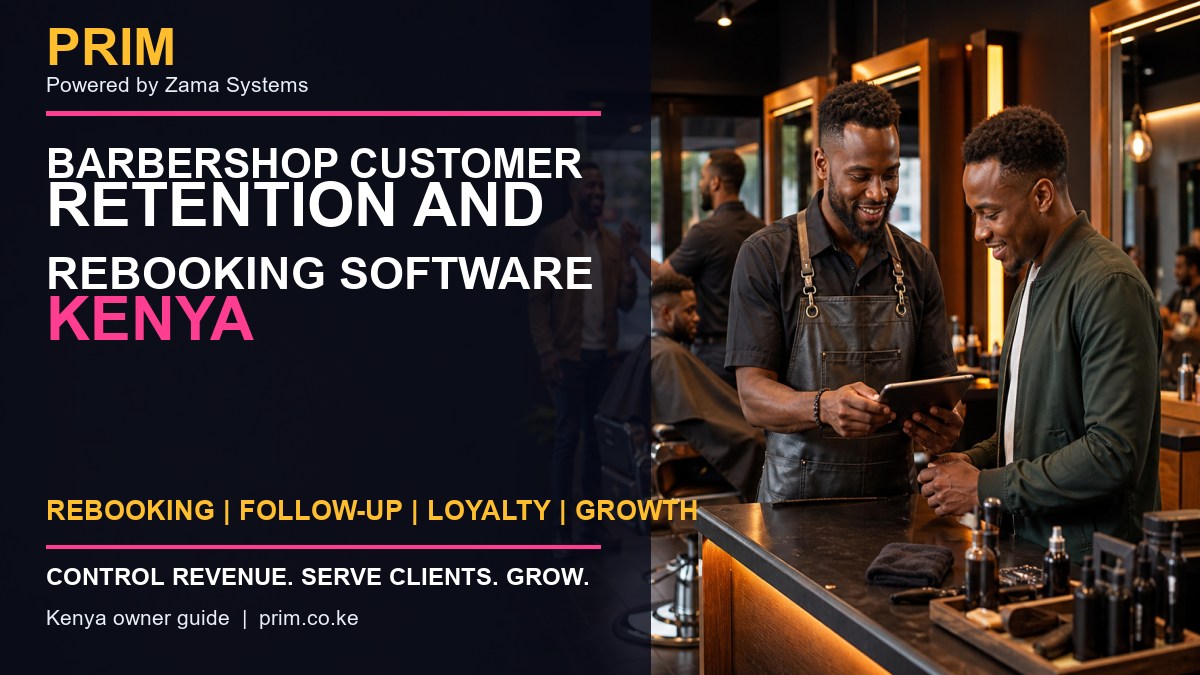
Powered by Zama Systems. PRIM is built for Kenyan salon, spa, barber, beauty, wellness and gym workflows, including local payment habits, role-based access and practical owner reporting.
See this workflow using your business
Bring your current booking, payment, staff and reporting process to a PRIM demonstration. The team can show how the platform fits the way your business actually operates.
Why owners search for Barbershop Customer Retention and Rebooking Software Kenya
Many barbershops serve a client well, collect payment and then lose contact. Without visit history, preferred barber, normal haircut interval and consented follow-up, the shop waits for the customer to remember to return.
The underlying problem is disconnected records. A booking may exist in one phone, a payment on another device, a staff total in a notebook and the management report in a spreadsheet. When those records disagree, the owner spends time investigating instead of growing the business.
What PRIM changes
PRIM connects each visit to the client, barber, service and next recommended date. Teams can rebook at checkout, identify overdue regulars and send relevant follow-up without relying on a barber personal phone.
Good software should make the correct process easier for reception and service staff while giving owners enough evidence to investigate exceptions. It should not require the owner to be physically present for every decision.
A practical workflow to implement
Ask permission to keep the client record, capture the preferred barber and usual service, offer the next appointment before checkout, and create reactivation lists based on realistic visit cycles. Measure repeat visits instead of sending the same promotion to everyone.
Start with clean setup
Confirm services, prices, duration, staff roles, payment methods and approval permissions. Incorrect setup simply digitizes an existing problem.
Train with real scenarios
Practice a walk-in, advance booking, cancellation, reschedule, split payment, discount, refund and end-of-day mismatch. The team should understand both the normal flow and the exception process.
Review the first four weeks
Compare system totals with M-Pesa, cash, physical stock and attendance. Investigate differences immediately and correct training or configuration before bad habits become permanent.
Essential features buyers should compare
- Fast booking and checkout: staff should serve clients without unnecessary screens or duplicate entry.
- M-Pesa and payment separation: the daily report should distinguish M-Pesa, cash, card and other methods.
- Staff accountability: services, sales, attendance and approved changes should have a user trail.
- Customer history: authorized staff should see visits, preferences, packages and follow-up status.
- Stock control: retail sales, professional use, purchases and adjustments need different records.
- Owner reporting: management should identify sales, busy periods, performance and exceptions without rebuilding spreadsheets.
- Multi-branch readiness: growing businesses should compare branches while protecting local permissions.
How this system protects revenue
Revenue leakage is often a process problem: a service is not recorded, a discount has no approval, a payment cannot be matched, stock leaves without a transaction, or a renewal is never followed up. PRIM creates a connected trail from customer activity to payment and reporting.
Owners should still maintain cash controls and reconcile external payment statements. For Kenyan tax requirements, confirm the appropriate invoicing process through the official KRA eTIMS information. For privacy responsibilities, review guidance from the Office of the Data Protection Commissioner.
Questions to ask before buying
- Can the system handle appointments and walk-ins together?
- How are M-Pesa payments matched and reconciled?
- Can managers trace discounts, refunds and edited transactions?
- Can staff permissions be limited by role or branch?
- How are commissions, packages or memberships calculated?
- Can existing customer, product and service data be imported?
- What onboarding, training, backup and support are included?
Frequently asked questions
Is PRIM suitable for a small business?
Yes. A small operation can begin with booking, customers, POS and core reporting, then activate additional controls as the team grows.
Does PRIM work for more than one branch?
PRIM supports branch-oriented workflows. The demonstration should confirm permissions, stock movement, shared clients and consolidated reporting for your structure.
Can staff use PRIM on a phone or tablet?
PRIM is designed for practical digital workflows. Confirm the devices, connectivity and offline expectations at your locations during onboarding.
Does software automatically stop theft?
No system replaces supervision. Software improves traceability, approvals and reconciliation so suspicious differences are easier to identify and investigate.
How quickly can we start?
Timing depends on service setup, staff, products, opening balances, branches, integrations and training. Clean data and an accountable project owner make implementation faster.
Related PRIM resources
- barbershop queue and commission guide
- PRIM software for Nairobi County
- PRIM salon, spa, barber and gym management platform
- Powered by Zama Systems
Turn the business problem into a controlled workflow
Request a PRIM demo and test the exact process described in this guide using your team, services and payment methods.